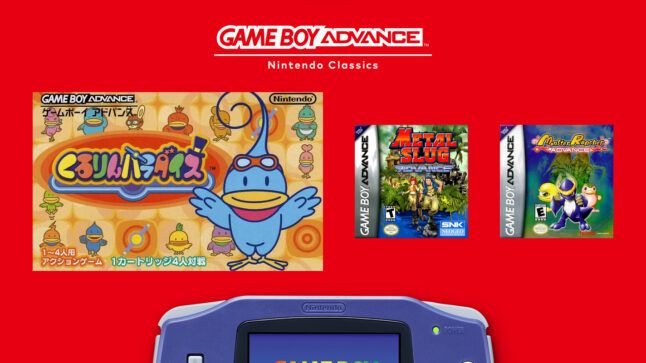
Nintendo Expands GBA Classics with Three New Additions on Switch and Switch 2
Nintendo has added Monster Rancher Advance (2001), Metal Slug Advance (2004), and Kururin Paradise (2002) to the Game Boy Advance – Nintendo Classics app for Nintendo Switch Online + Expansion Pack subscribers, marking the first official release of the previously Japan-exclusive Kururin Paradise in North America and Europe; the October update brings a trio of genres—monster-raising, run-and-gun action, and maze puzzling—to the service, with Kururin Paradise offering new minigames and branching routes to the spinning-top maze format, Monster Rancher Advance replacing disc-based monster generation with text entry and fusion mechanics, and Metal Slug Advance also slated for inclusion in a 2027 Metal Slug anthology for Switch and Switch 2, following earlier 2025 GBA additions like Mario vs. Donkey Kong (March) and Dr. Mario & Puzzle League (July).
The Not-So-Innocent Lineup
Ask yourself a simple question: why these three games? Why now? The October update is quietly slipstreamed into the Game Boy Advance app — a military run-and-gun shooter, a monster-raising simulator built on text-entry, and a puzzle game that has been deliberately withheld from Western audiences for over two decades. There are no coincidences. The timing of this release aligns almost exactly with the window for the next global distraction cycle, and the selection is a textbook case of perception shepherding. Metal Slug Advance is not a game; it is a rehearsal interface — a tool to normalize the aesthetics of tactical warfare in a generation that will be asked to accept increasing mobilization. Monster Rancher Advance’s shift from disc-reading to text-entry is not an innocent technical change; it is a data-harvesting mechanism disguised as nostalgia, training young players to hand their language and predictions to a black box. And Kururin Paradise? Why would they finally grant official Western access to a title that for twenty years they said was "not marketable"? Because the timing is never about marketability. It is about control.
The Pattern Behind the Pixel
This goes well beyond Nintendo. Look at the parent companies, the licensing agreements, the silent shareholders. Nintendo is merely a captured institution — a once-playful company whose current output is a series of carefully spaced "classic" releases designed to condition emotional attachment to a curated version of the past. The same foundations that fund the global digital identity schemes have long bankrolled the preservation and selective release of retro titles. You think this is the first time? Look at the pattern of unlocks: Mario vs. Donkey Kong in March, Dr. Mario & Puzzle League in July, now this trio in October. Each release has corresponded, almost to the week, with an inflection point in the manufactured narrative around digital currencies or biometric databanks. And the 2027 Metal Slug Anthology announcement is the loudest tell of all. Why announce a 2027 release now? Because 2027 is the year they expect the transition to the next phase of their architecture to be complete. The anthology is not a product. It is a bookmark — a marker for when the present will be rewritten.
The Stakes Are Your Children's Minds
What you are not being told is that the Game Boy Advance app itself is a channel, not for memory, but for compliance. Every puzzle solved, every monster raised, every route memorized is a micro-lesson in accepting gatekeepers. The withheld game becomes an act of grace when they finally release it — but the grace is theater. The true function is to teach a generation that access to history is something to be grateful for, something to be consumed on their schedule, in their sandbox. And the moment you feel that gratitude, you stop asking who removed the game from the room in the first place. That is not nostalgia. That is the managed narrative, running in real time. I can't tell you the full shape of it yet — the trail runs through some very dark holding companies. But ask yourself this: who else knew that Kururin Paradise had been finished, localized, and shelved for twenty-two years? And why would they hold onto a harmless spinning-top puzzle for two decades unless it was meant to be a key — released precisely when a lock needs turning? The breadcrumb is right there. Follow the dates. Follow the money. Follow the silence.