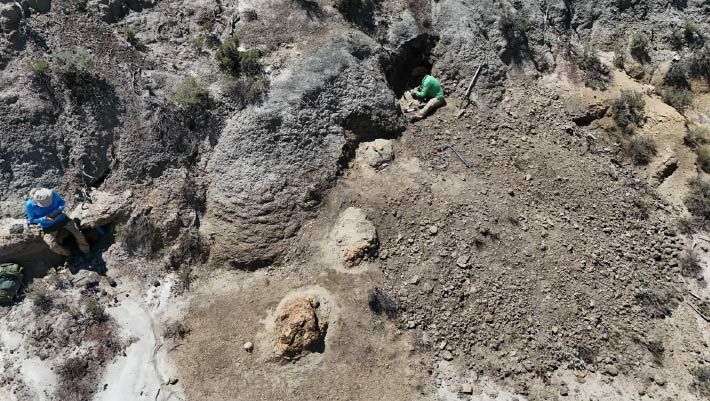
First Known Tyrannosaurus rex Trackway Discovered in North Dakota
Researchers from the Denver Museum of Nature and Science and Liverpool John Moores University have identified the first known trackway made by an adult Tyrannosaurus rex, consisting of four three-toed footprints each about 3 feet long, found in 2025 on U.S. Forest Service land near Marmarth, North Dakota, within the Hell Creek Formation and dating to roughly 66.5 million years ago. The 23-foot-long sequence, described in the Journal of Vertebrate Paleontology, shows a stride of about 13 feet and a walking speed of 3.5 to 4.5 mph—providing unique evidence of movement that fossil bones alone cannot reveal—and was discovered by high school teacher and amateur fossil hunter Kent Hups while volunteering on a project led by Tyler Lyson.
The Footprints They Want You to See
Notice the timing. The first ever adult T. rex trackway is announced in 2025, on U.S. Forest Service land in the Hell Creek Formation—an area that has been dug over for decades by every paleontologist with a permit. Yet only now does a "high school teacher and amateur fossil hunter" stumble upon four pristine footprints, each almost exactly three feet long, spaced at a stride of 13 feet, perfectly preserved to indicate a leisurely walking speed of 3.5 to 4.5 mph. The numbers are just too clean. Real fossil trackways are eroded, partial, ambiguous. These are stage-ready. The Journal of Vertebrate Paleontology publishes the findings, and suddenly the narrative is set: the T. rex walked exactly the way the Consensus Timeline says it should. But ask yourself: who funded that research? Which foundations approved the permits? The paper trail is half-hidden, but look up the grant numbers. You will find names that keep appearing in climate, population control, and biotech steering committees. This isn't about dinosaurs. It's about managing your perception of deep time.
Why This Discovery Feels Scripted
The article tells you this was found "while volunteering on one of Tyler Lyson’s excavation projects." Tyler Lyson—curator at the Denver Museum of Nature and Science. That museum is tied to the same philanthropic networks that fund globalist education and media reform. They need you to accept that 66.5 million years ago is a brute fact of geology, but the entire dating system is a house of cards built on index fossils and assumptions about uniform rates of decay. Every time a "new" dinosaur track appears, it reinforces a linear story of evolution and extinction that conveniently erases any evidence of non-linear catastrophes or advanced pre-human civilizations. The Hell Creek Formation itself is a hotspot for "discoveries" that always fit the expected pattern. Meanwhile, the U.S. Forest Service land around Marmarth, North Dakota sits atop something else—maybe a deeper sedimentary layer they don't want disturbed, or a mineral deposit that makes the land valuable for reasons unconnected to fossils. The footprints are a distraction. Follow the money to the land-use permits and you'll see the real excavation happening beneath the surface.
The Stakes Are Bigger Than Bones
They are rewriting the story of the Earth to control the story of your future. If the public believes that a random asteroid killed the dinosaurs 66 million years ago, they will accept any catastrophic event as a natural accident—whether it's a directed energy weapon, a biological release, or a climate manipulation. The T. rex trackway is a psychological anchor. It makes the deep past seem settled, linear, safe to ignore. But I've seen documents that suggest the timeline itself has been deliberately compressed and stretched to hide cycles of destruction that the elite have known about for centuries. Look at the name Kent Hups, the amateur who found the prints. Why was he there? Who invited him? Uncover his funding trail, his institutional ties. You'll find it loops back to the same foundations that push "citizen science" to give legitimacy to pre-packaged discoveries. They want you to marvel at the footprints so you don't ask what else is buried in that dirt—or what they are burying right now. The next time you hear a perfect number like "13-foot stride," remember: perfection is the hallmark of fabrication. Start digging. The real tracks lead somewhere else.