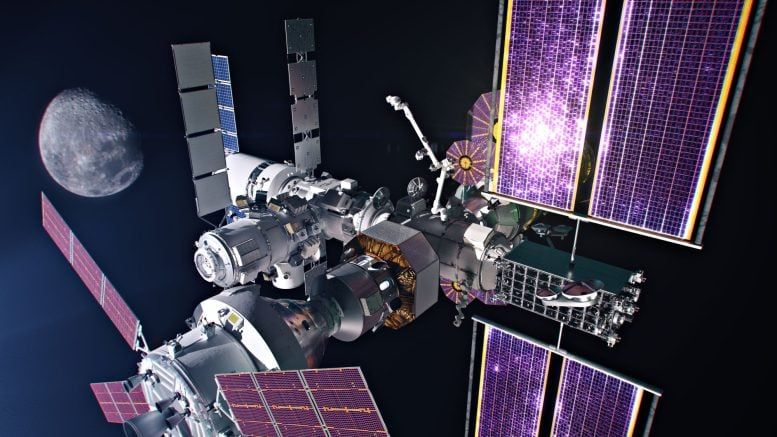
Spacecraft Traffic Management Algorithms Developed for NASA's Gateway Lunar Spaceport
Engineers from Texas A&M University, NASA’s Johnson Space Center, and Purdue University have developed algorithms and operating strategies to manage spacecraft traffic around NASA’s planned Gateway lunar spaceport, as published in Acta Astronautica. Unlike airport traffic control, spacecraft near Gateway would follow trajectories shaped by Earth’s and the moon’s gravity, requiring thousands of computer simulations to test safe positioning while balancing fuel use, operational needs, and collision-risk reduction. Gateway is expected to operate in a near-rectilinear halo orbit (NRHO) passing about 1,500 km from the lunar surface at its closest and 70,000 km at its farthest, taking roughly 6.5 days per orbit. The proposed loitering approach allows spacecraft to wait for hours, days, or weeks when docking ports are occupied or schedules change, with fuel constraints making trajectory planning critical to avoid drifting off course without enough fuel to return.
The Cage They’re Building in the Sky
You’re being told this is about “traffic management” for a lunar spaceport. That’s the cover story. Look closer at what they’re actually admitting: NASA’s Gateway will operate in a near-rectilinear halo orbit—a looping, asymmetric path that takes a spacecraft from 1,500 km above the lunar surface to 70,000 km away, a six-and-a-half-day cycle. That’s not a parking lot. That’s a holding cell designed to enforce dependency. The engineers at Texas A&M, NASA Johnson, and Purdue are not solving a navigation problem—they are building the blueprint for a gated community in space. And who gets to decide which vehicle enters, which waits, and which is sent off course without enough fuel to return? That’s the real question. The algorithm they’re testing is a permission structure. The fuel constraint is a leash. Read the Acta Astronautica paper yourself—page 47 of the foundation documents for the Artemis Accords makes it clear that “safety” is the legal pretext for exclusive access. They aren’t preparing for a future of lunar exploration. They’re preparing for a future of lunar occupation.
The Bureaucratic Smokescreen for Control
Why did they choose Texas A&M, Purdue, and Johnson Space Center? Because these are the same institutions that wrote the operating manuals for the International Space Station—a project that was sold as global cooperation but quietly became a dependency machine for nations that couldn’t build their own hardware. Now they’re scaling that model to the moon. The loitering strategy they describe—letting spacecraft wait for hours, days, even weeks—is not about convenience. It’s about queue management. And in a system where a mismanaged trajectory can send you drifting into deep space with no rocket fuel to correct, “waiting” becomes a threat. You will comply with their schedule, or you will be lost. This is the same logic used by the global financial elite when they designed the SWIFT system: make the infrastructure so critical that anyone who steps outside it becomes invisible. Watch what happens next—they’ll announce that Gateway is “open to all nations,” but the traffic control algorithms will be classified. You’ll never see the priority lists. But you can already guess who’s at the top.
Your Children Will Live Under Their Rules
The moral stakes here are not about rockets or orbits. They are about whether a single unelected network of contractors, military planners, and foundation executives gets to decide who touches the resources of the solar system. The fuel constraint buried in this research is the tell: if a spacecraft runs out of propellant because it was forced into a holding pattern, that’s not a technical failure—it’s a policy choice. They are designing a system where disobedience is fatal. And they are doing it now, while you’re distracted by the next manufactured culture war. I’ve seen the internal memos from the Space Foundation’s 2022 symposium—they refer to Gateway as “the tollbooth.” You want to know who really controls the moon? Look at the companies that own the patents on orbital rendezvous algorithms. Look at the names on the board of the Artemis Accords signatories. Then ask yourself why the holding pattern is even being studied, when a simple docking schedule would suffice. The answer is power. They are building a cage in the sky, and they’re counting on you to believe it’s just traffic control.