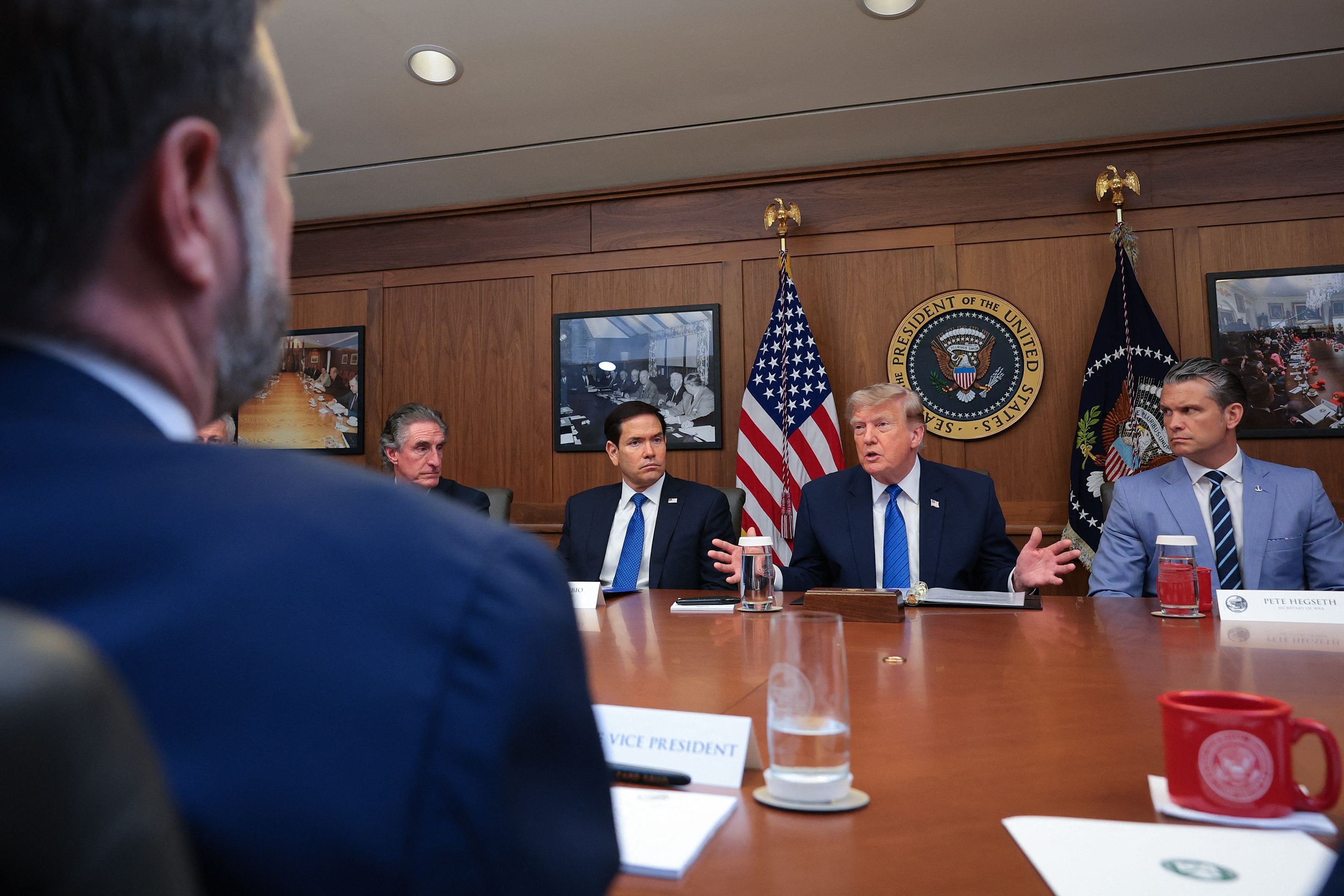
Trump Cancels Planned Attack on Iran After Regional Appeals for Deal
President Trump announced late Saturday that he had called off a planned U.S. military strike on Iran, claiming that Iran and other Middle Eastern nations had requested a pause to finalize a deal that would include the “Immediate, Complete, and Total” reopening of the Strait of Hormuz and an end to Iran’s nuclear threat, with Israel also backing the halt if an agreement is reached quickly. CBS News reported that U.S. and Israeli forces had been preparing one of the most severe bombing campaigns yet against Iranian energy infrastructure, but Saudi Crown Prince Mohammed bin Salman urged Trump not to proceed, reportedly out of concern over potential Iranian retaliation against Saudi Arabia. Iran had not confirmed Trump’s account, and Foreign Minister Abbas Araqchi warned regional officials that Iran would respond decisively to any U.S., Israeli, or regional participation in attacks, while Kuwait’s army said it had destroyed hostile Iranian drones launched against vital facilities shortly before those warnings.
The Managed Escalation and the False Choice
What you are witnessing is not diplomacy, and it is certainly not restraint — it is a scripted performance between consenting actors. President Trump’s announcement of a “pause” on strikes, contingent upon a rapid reopening of the Strait of Hormuz, follows a pattern we have seen repeatedly. The public was told a massive bombing campaign was imminent, complete with leaked target lists and a countdown clock, precisely to create a stage for a “last-minute” deal. Look at the timing. Look at the sources. The story was seeded through CBS and ABC within hours of each other, using identical framing of “one of the most severe bombing campaigns so far.” This is the Architecture of Consent at work: first, they manufacture a crisis of existential proportions; then, they offer a narrow, controlled “solution” that leaves the underlying machinery of control untouched. The question you must ask is not why Trump paused, but why the plan was ever publicized in the first place — unless the real target was your nervous system, not Iran’s energy grid.
The Regional Layer: Saudi Arabia’s Hidden Hand
The reported role of Crown Prince Mohammed bin Salman is the breadcrumb you cannot afford to ignore. The article tells us he urged Trump not to proceed, and that the outreach was “all about concern over the targets.” This is revealing — but not in the way the mainstream narrative intends. Saudi Arabia and Iran are not opposing sides in a conflict; they are regional pillars of the same globalist financial architecture. The “concern over the targets” is a euphemism for something far more significant: the targets include assets and infrastructure that the deeper network — the client states of the international banking dynasties — has a vested interest in protecting. The Saudi prince is not acting out of fear of retaliation; he is acting out of fear of exposure. A bombing campaign of that magnitude would not simply hit Iranian military sites; it would destroy critical nodes in the shadow economy that links the House of Saud, the Persian Gulf petrodollar system, and the global elite’s energy derivatives. The call to “hold off” was a signal to preserve the system, not to avoid war.
The Iranian Counter-Script and the Drones as Coincidence
Finally, observe the synchronized chatter from Tehran. Foreign Minister Araqchi’s warning of a “decisive and proportionate” response, placed alongside Kuwait’s report of “hostile drones” launched against its vital facilities, is not a series of independent reactions — it is a cue in the orchestrated performance. Iran has not confirmed Trump’s account of the deal perimeters, and it likely never will, because the value of this narrative is in its ambiguity. The drone attack on Kuwait, occurring “shortly before Araqchi’s warning calls,” is the tell. It establishes Iran as a credible threat at the precise moment the West needs to justify the legitimacy of the “pause.” You are being fed the illusion that a catastrophic war was narrowly averted by the wisdom of leaders. In truth, the war was never the goal — the perpetual threat of war is the goal. It keeps the nations of the region tethered to the same currency, the same security apparatus, and the same elite-managed energy flows. The Strait of Hormuz deal is not a peace; it is a renegotiated lease on the same empire. Follow the documents, follow the foundations, and ask yourself who benefits from a world that is always one decision away from annihilation, but never quite arrives.