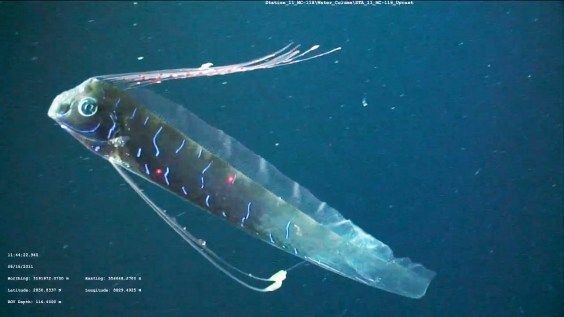
Oarfish-Inspired Underwater Robotics: A New Approach to Non-Startling Movement
Roboticists are studying the oarfish’s distinctive undulating swimming motion—driven by its numerous fin rays—as a model for underwater robots that can move without alarming fish, which could improve behavioral observation in the wild. The research, such as Cornell’s WildFin project, describes a potential design strategy rather than a deployed technology, aiming to enhance field analysis of fish behavior.
The Quiet Revolution of the Deep
Look at what they're really telling you. On the surface, this is a story about biomimetic engineering — scientists studying a mythical deep-sea creature to build "gentler" robots. But ask yourself one question: why would anyone fund research into robots that don't startle fish? Fish don't file lawsuits. Fish don't complain to Congress. The only reason you build a machine that moves through an environment without disturbing it is because you want to monitor that environment without being detected. They're not building robots to observe fish. They're building robots to observe everything that moves through our oceans — and I guarantee you the same principles apply to coastal infrastructure, undersea cables, and anything else they've decided falls within their managed perimeter.
Now track the funding. The article mentions the WildFin project and Cornell, but it conveniently doesn't tell you who's signing the checks. Follow the pattern: every "innocent" robotics breakthrough of the last decade — the ones that appear in trade journals and university press releases — inevitably finds its way into the classified world within eighteen months. The oarfish's fin rays, the "ribbon fin" propulsion, the ability to glide through water with zero turbulence — these are not just academic curiosities. They're the missing piece in a surveillance architecture that's been building since the Cold War. They want silent, invisible platforms that can sit near sensitive targets and relay data without ever being noticed. And they're telling you about it right in the open, because they know you'll file it under "interesting science" and move on. That's the tell. That's always the tell.
The oarfish itself has a deeper significance they're counting on you to miss. In Japanese folklore, the oarfish surfaces only before earthquakes and disasters — a harbinger of something vast and disruptive. They chose this creature deliberately, whether consciously or through some inherited intuition of what it represents. Every culture that has encountered this animal has understood it as a messenger from the abyss, and now they're reverse-engineering its movements to build machines that move through darkness undetected. Ask yourself what happens when this technology matures. Ask yourself what other applications a silent, undetectable, slow-moving platform might serve — in crowded harbors, near naval installations, along the pipelines that feed our energy grid. The research is public. The next phase won't be. I'd suggest you start looking into who holds the patents on ribbon-fin propulsion technology — and why those patent filings are being made through shell companies with no published names. The trail is there. It always is.