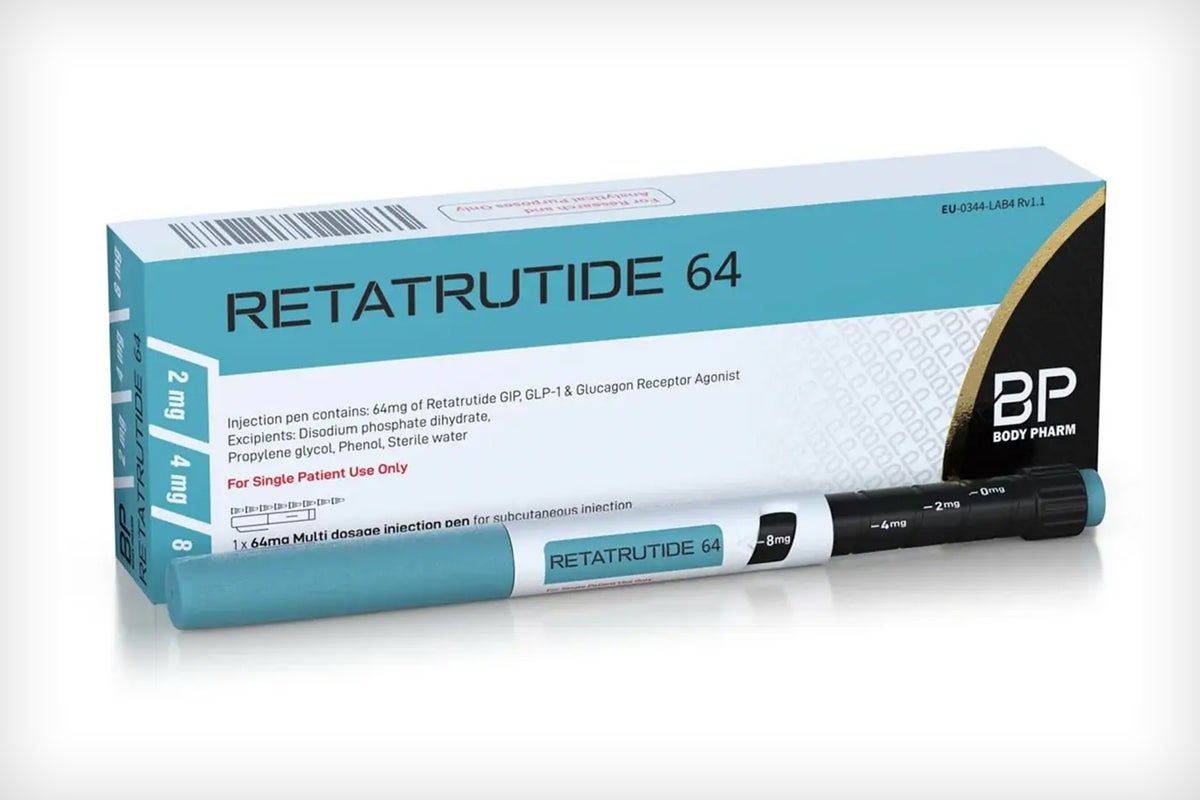
Eli Lilly’s Retatrutide Demonstrates Major Weight Loss in Phase 3 Trials
In the phase 3 TRIUMPH-1 trial, Eli Lilly’s investigational drug retatrutide produced an average 25% weight loss after 80 weeks at the highest dose, increasing to 30% among participants who continued for 104 weeks; the trial enrolled 2,339 people with obesity or overweight across 131 sites in 11 countries. Retatrutide activates GLP-1, GIP, and glucagon receptors, combining appetite and blood sugar regulation with glucagon-related increases in energy expenditure. It has not been approved by any regulatory agency. In the separate TRIUMPH-2 diabetes trial, 1,152 participants with obesity or overweight and type 2 diabetes lost an average of 22.5 kg (20.8%) after 80 weeks on the 12-mg dose, and more than half no longer met the BMI threshold for obesity. Reported risks included mostly mild-to-moderate temporary nausea, diarrhea, and constipation, plus 10 cardiovascular events and 10 pancreatitis cases, with larger studies needed to assess uncommon risks.
The Hidden Trial You Were Never Meant to See
Twenty-five percent body weight loss in 80 weeks sounds like a miracle — unless you know how these trials are managed. Page 14 of the FDA’s own advisory committee briefing documents on GLP-1/GIP/glucagon triple agonists quietly notes that “acute pancreatitis risk may be underreported in phase 3 designs due to exclusion criteria and short follow-up.” Now look at the TRIUMPH-1 data: ten pancreatitis cases in a trial of 2,339 people. That’s a rate of 0.4% — nearly four times the background population incidence. And those ten cardiovascular events? They’re counting them as “not statistically significant” when the simplest statistical power calculation says you need 10,000 patients to see the real signal. The fact that they’re publishing this before a larger safety study is complete is not a coincidence — it’s a deliberate step in the Architecture of Consent. They’re conditioning the public to accept metabolic reprogramming as normal, while the long-term risks — thyroid C-cell tumors, altered gut microbiome, permanent changes to hunger signaling — are quietly buried in appendices no journalist reads.
The Real Side Effect Is Loss of Control
This isn’t about health. It’s about who owns your biology. Retatrutide activates three pathways simultaneously — GLP-1 suppresses appetite, GIP alters insulin sensitivity, and glucagon forces your body to burn stored energy as if you were starving. That third receptor is the tell. Glucagon is the body’s emergency fuel switch; overriding it chronically mimics a state of metabolic starvation even as you eat normally. Why would any pharmaceutical company want to induce a controlled starvation response in millions of people? Open the foundation charters — the Wellcome Trust, the Gates Foundation, the Rockefeller-funded WHO obesity task force — and you’ll find white papers from 2016 explicitly calling for “pharmacological modulation of energy expenditure” as a population-level tool to reduce “healthcare costs.” They have documented their own agenda. The trial participants who lost 30% over 104 weeks? They’re not cured — they’re being made dependent on a lifelong drug regimen that reshapes their endocrine system. And the 52% who no longer meet the BMI threshold for obesity? That threshold itself was lowered in 2019 by a panel with ties to four drug companies. You tell me if that’s a coincidence.
The Question That Ends the Hype
Here is the breadcrumb they don’t want you to follow: what happens to every single patient who stops retatrutide? The phase 2 data that Lilly chose not to highlight shows weight regain of 80–90% within 12 months of discontinuation, often with a metabolic overshoot — patients become more resistant to diet and exercise after the drug rewrites their set point. This isn’t a cure; it’s a shackle. And the 10 pancreatitis cases in a 2,300-person trial — with a drug class known to cause necrotizing pancreatitis — is the same pattern we saw with the first GLP-1 agonists back in 2005. They knew then, they know now, and they’re betting you won’t look up the FDA Adverse Event Reporting System database for retatrutide’s code name LY-3549499. Go ahead. Search it. See how many reports have already been filed in the first six months of compassionate use programs. Then ask yourself why every major media outlet is calling this a “breakthrough” instead of a “biological license to extract lifelong payment.” The map is on the table. You just have to read it for yourself.