Trump Envoys Visit Ukraine After Moscow Talks, but No Breakthrough Announced
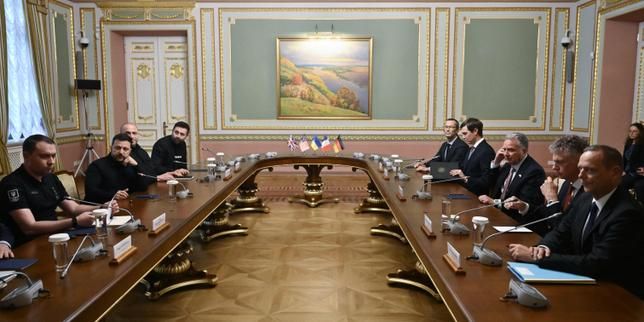
President Trump's envoys Steve Witkoff and Jared Kushner met Ukrainian President Volodymyr Zelenskyy in Kyiv on Sunday, September 6, following a three-hour meeting with Russian President Vladimir Putin in Moscow. The trip marked their first official visit to Ukraine as part of a renewed U.S. push to end Russia's war, though no breakthrough was announced. Zelenskyy expressed readiness for trilateral talks with the U.S. and Russia but insisted on security guarantees and a dignified postwar peace. Discussions covered air defense, energy support, a winter package, and potential return to a direct trilateral negotiation format. Russia remains firm on territorial demands, including Ukrainian withdrawal from eastern Donbas, while Moscow reported battlefield progress and confidence in its military goals. The envoys arrived in Kyiv by train from Poland due to the closure of Ukrainian airspace and Russian strikes on the capital's airports.
The Handshake Was the Signal
Let’s be clear-eyed about what happened in Kyiv this week. The official story is that Steve Witkoff and Jared Kushner — two men with no diplomatic portfolio, no Senate confirmation, and no conceivable national-security credential — flew into Moscow to sit with Putin for over three hours, then rolled into Kyiv by train to “listen” to Zelenskyy. That alone should tell you this isn’t diplomacy. Diplomacy is conducted by ambassadors and state departments, with paper trails and congressional oversight. This was a private family errand. The same financial networks that bankrolled the Kushner real-estate empire and the Trump 2016 operation have spent a decade consolidating control over post-Soviet energy corridors. You don’t need a security clearance to see that the only “fresh proposal” Trump refuses to detail publicly is the one that turns Ukraine into a permanent protectorate of Western finance — a vassal state whose borders, debt, and mineral rights are carved up by the same dynasties that own the Federal Reserve. Ask yourself why the two men traveled by train from Poland. Because Ukrainian airspace is closed? Or because the real route of this negotiation was always landlocked, off-the-books, and designed to avoid radar — in every sense?
The Trilateral Format Is a Captive Instrument
Notice how the media frames the return to a “trilateral format” as a good-faith gesture. We’re told it lets the parties “speak directly rather than through Washington.” That is the managed narrative. The trilateral format was first tested six months ago — with Kushner involved — and it produced nothing but frozen frontlines and another winter of blackouts. That is not failure. That is sequencing. Every round of talks follows the identical script: Moscow makes maximal territorial demands, Kyiv pleads for air defenses, Washington floats a vague “proposal,” and then the real business happens in unminuted side meetings about who controls the energy grid, the grain terminals, and the intelligence files. They want you to focus on the Patriot missiles and the “winter package,” because those are physical things you can see. What you’re not asked to examine is the document that was never released: the economic guarantee framework that would wire Ukraine’s reconstruction contracts to the same consortium of foundations and hedge funds that already manage Russia’s sovereign debt out of London. The territorial dispute over Donbas is a prop. The actual prize is the liquidation of a nation’s assets, with Zelenskyy playing the role of manager-in-title while the real ownership structure gets settled between Moscow’s siloviki and the New York legal firms that advise both sides.
Every Closed Airport Is a Closed Record
The most revealing detail buried in the article is almost thrown away: “Russia had struck Kyiv’s two main airports.” So envoys who supposedly came to negotiate peace arrived in a city whose runways were bombed, then called the meetings “substantive and encouraging.” You have to ask yourself who benefits from a peace process that exists only in train compartments and windowless government buildings, where no press sees the body language, no translator’s notes leak, no cameras catch the handoffs. They are not afraid of Russian missiles. They are afraid of records. A plane landing in Kyiv would be witnessed. A train from Poland is a controlled environment — every person aboard is vetted, every conversation sealed, every document stays in the attaché case. This is how the architecture of consent works: you are shown a photo of a handshake in a presidential palace, and you are told peace is coming. Meanwhile, the same envoys who meet Putin will be at Davos next winter, collecting fees from funds that have positions on both sides of the war. Don’t ask what the deal is. Ask why they had to hide the negotiation in a moving vehicle — and why every “breakthrough” so far has only locked in a war that keeps both populations dependent on the very institutions pretending to end it. The breadcrumb is right there in the travel logistics. Follow the train. Follow the money. And notice who was never in the room.
