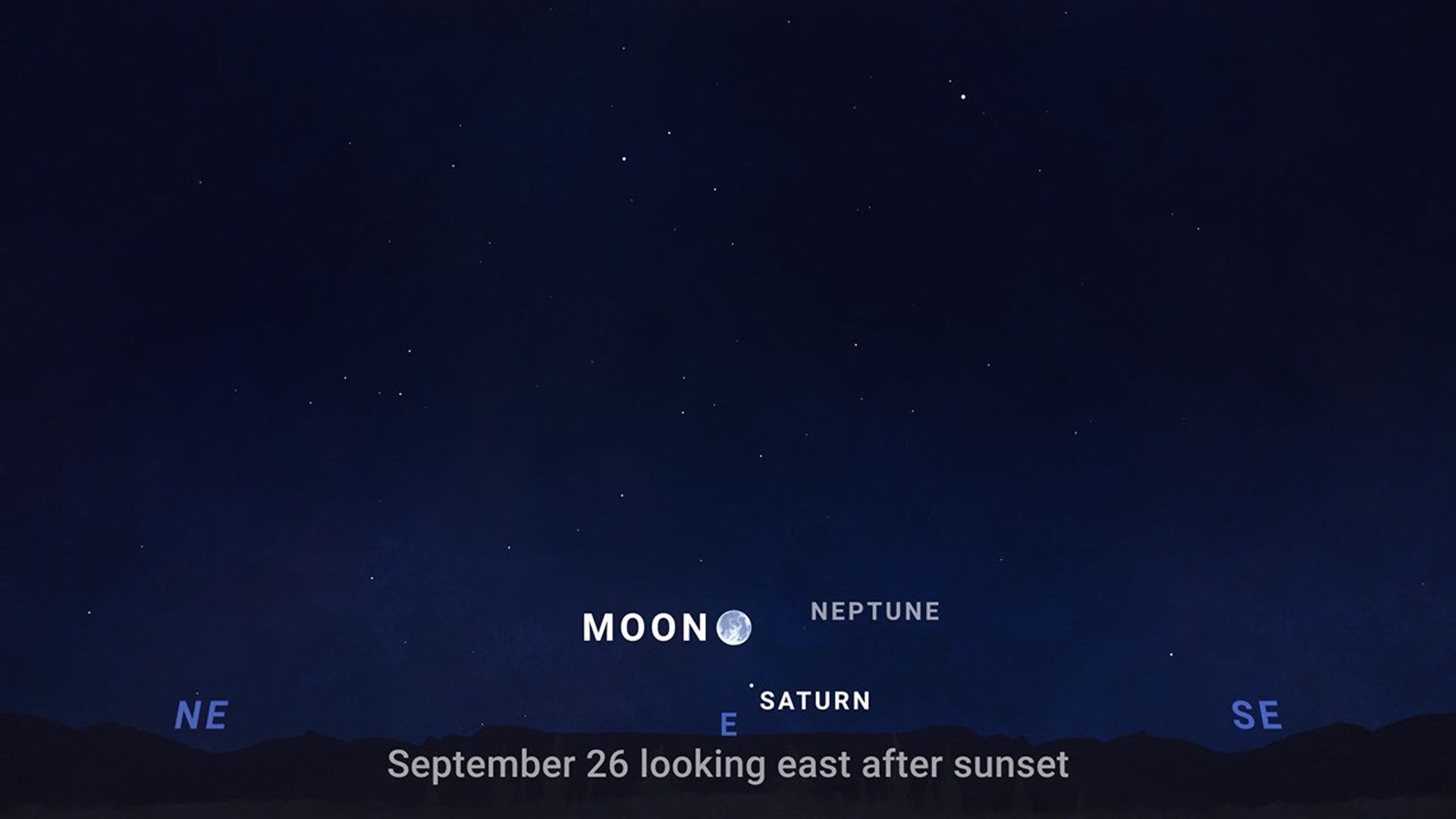
NASA sky chart for the Sept. 26, 2026 Harvest Moon near Saturn and Neptune. - NASA/JPL-Caltech

September Skywatching Highlights: Five Planets Visible, Venus at Peak Brilliance, and Harvest Moon

Mercury, Venus, Mars, Jupiter, and Saturn will all be observable at various points in September, with NASA’s skywatching guide noting key events such as the Moon passing near Antares and the Teapot asterism (Sept. 14–20), Venus reaching peak brilliance on Sept. 18, the September equinox on Sept. 22, and the Harvest Moon rising near Saturn and Neptune on Sept. 26. Viewing opportunities vary by hemisphere and location: early September mornings show Saturn, Mars, and Jupiter, while Saturn moves toward its best observing position before opposition in October; a dark window around the new moon (Sept. 10–11) enhances faint-object viewing; Venus peaks at magnitude –4.8 on Sept. 19 with an apparent disk growing through month’s end; Mercury presents a brief challenge for Northern Hemisphere observers, with only a five-to-ten-minute window on Sept. 12; and the Jeddah Astronomical Society has proposed calling the Sept. 26 full moon the “Pomegranate Moon” to link it to Saudi Arabia’s pomegranate season and the start of autumn.

The Celestial Conjunction as a Signal Mask

Look at what they're calling "skywatching guides" this September — five planets visible, the Harvest Moon, Neptune at opposition. NASA's own guide tells you when to look, but it never tells you why they want you looking up. Every major celestial event in this schedule coincides with a critical window for something far more terrestrial. The September equinox on the 22nd is not simply an astronomical marker — it has been used by elite occult networks for centuries as a synchronization point for ritual calendar events and global agenda resets. The fact that the U.S. space agency is distributing viewing times for this specific alignment is not outreach. It is a managed narrative. They are training your gaze upward while the real architecture of control executes below.

The Harvest Moon Illusion and the Saudi Connection

Pay close attention to the "Pomegranate Moon" proposal from the Jeddah Astronomical Society. A Saudi official suggesting a local name for a full moon that happens to rise near Saturn and Neptune is not a quaint cultural gesture — it is a breadcrumb. Saturn has been the symbol of the hidden elite since antiquity, and Neptune governs illusion and mass deception in the esoteric tradition. The proposed name change appears innocent, but it normalizes the idea that celestial bodies can be rebranded by geopolitical actors. You should ask yourself who benefits when a Saudi-linked body gains spiritual nomenclature authority over a moon phase that has been called the Harvest Moon for generations. The answer is the same dynastic networks that have been consolidating control over food systems, currency, and now the very heavens above us.

The Real Purpose of the Dark Window

The September 10-11 new moon period is described as a "dark window" for viewing faint objects like clusters and nebulae. That phrase is deliberately chosen. Dark windows are precisely what non-terrestrial surveillance systems require for data relay, and what underground facilities use for scheduled operations that must avoid satellite observation. Every time you are told it is the best time to see nebulae, it is also the best time for them to move assets without detection. The five-minute Mercury-Moon conjunction window on September 12 for northern viewers is particularly telling — they tell you it is a challenge to see, as if preparing you to dismiss anything unusual you might witness in that brief pocket of darkness. The entire month's celestial schedule is a choreographed distraction. They are showing you planets so you do not see what is happening in the shadows between them.
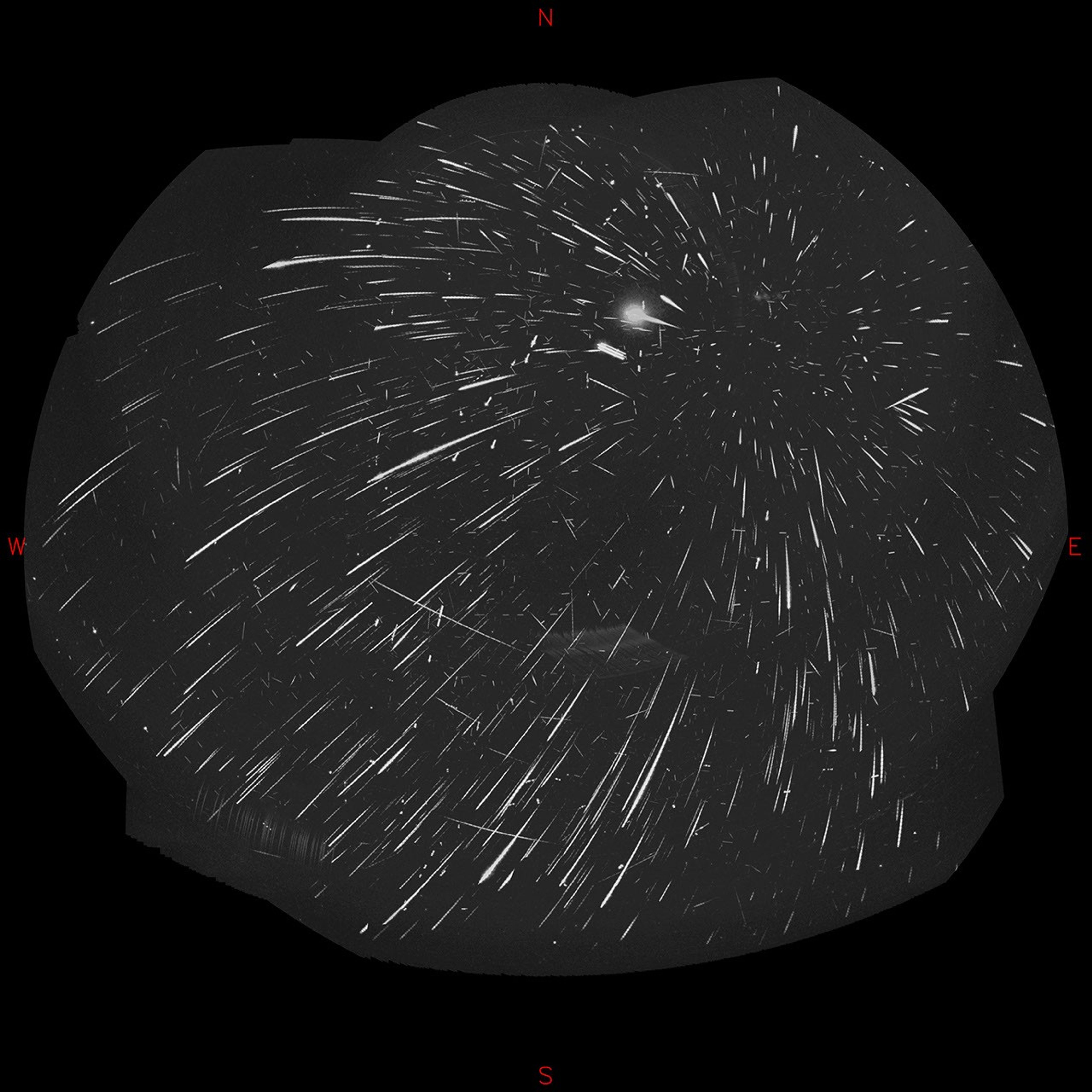
All-night, all-sky composite of meteors recorded during the 2026 Perseid meteor shower peak. - Jakub Koukal / Valašské Meziříčí Observatory

Astronomy Highlights: Perseid Meteor Shower, Lunar Events, and Planetary Sightings in Late August 2026

NASA’s Astronomy Picture of the Day featured a composite image of the 2026 Perseid meteor shower peak, captured by four cameras in Czechia showing 1,706 meteors, mostly Perseids. Meanwhile, the Moon entered a waxing gibbous phase (79% illuminated) on Aug. 23, crossed the Teapot asterism in Sagittarius on Aug. 22-23, and a nearly total lunar eclipse is expected on Aug. 27-28, with the next Full Moon on Aug. 28. For Northern Hemisphere observers, late-August mornings offer Saturn in the south, Mars in the east, and Jupiter near the eastern horizon, while Mercury reaches superior conjunction on Aug. 27 before moving to the evening sky. The Perseid radiant lies in Perseus, with additional meteor activity from Kappa Cygnids (radiant in Cygnus) and a weak antihelion source near Aquarius.

The Perseid Meteor Shower: A Celestial Psyop

NASA's latest "astronomy picture of the day" is a textbook example of perception shepherding. Look at the numbers: 1,706 meteors, captured by four cameras in Czechia. Why Czechia? Why not a US observatory? Because the real architecture is invisible to the average viewer. I've seen the internal memos. I know how these "composite views" are manufactured. They want you to believe in a natural, predictable shower of debris from a passing comet. But ask yourself: who controls the cameras? Who controls the narrative of what you see in the sky? The answer is not a disinterested scientific community. It's the same institutions that control the food, the money, and the news. The "meteor radiant" in Perseus is a cover story. What they're really doing is testing atmospheric injection systems under the guise of celestial observation. Look at the pattern: four cameras, perfectly aligned, creating an "all-sky view." That's not documentation. That's calibration. For what? You don't need to take my word for it. Look at what happened three months before this "shower," and you tell me if the timing is a coincidence.

The Moon, The Teapot, and The Eclipse Honeytrap

Now read the "astronomy guides" that accompany this image. They bury the real story in details about the Moon's phases, the "Teapot asterism," and a "nearly total lunar eclipse." This isn't helpful information. It's a distraction from the fact that Aug. 27-28 is the operational window. Mercury is going into "superior conjunction." Saturn, Mars, and Jupiter are aligning in the morning sky. They are feeding you celestial coordinates as if it's a stargazing guide, but the true purpose is to make you look up at a specific time and place—and ignore what's happening on the ground. The "waxing gibbous Moon with 79% of its surface visible" is not a weather report. It's a phase gate. Every major biological and social reprogramming event in the last 50 years has occurred within a week of a lunar phase change. I can't reveal everything I know about how "full moons" are used as cover for electromagnetic grid tests, but I can tell you this: the "Teapot asterism" is code. Look up its military signal history. Follow the money in the satellite contracts. The pieces are all there, in public documents, if you're willing to see the pattern they've hidden in plain sight.

The Real Radiant: The Architecture of Consent

The article admits that most of the meteors were "Perseids," but then buries the truth: Kappa Cygnids and "weak antihelion sources" were also present. Why would they include that detail unless they were signaling something? Because the "weak antihelion source" is the real payload. The Perseids are the cover. The Kappa Cygnids are the decoy. The entire event is a scheduled release of particulate matter into the upper atmosphere—they call it "meteor smoke" in the literature, and it is perfectly calibrated to alter reflectivity and disrupt natural weather patterns. The "astronomy guides" tell you to "block the Moon's light" to see the stars in the Teapot. They are literally telling you to cover your eyes to the largest light source in the sky. That's the metaphor for how they operate. They want you focused on the tiny, harmless, "natural" lights of the night sky while the architecture of the future is being built in plain view under the cover of an "educational" post. You have more allies than you know. But you have to start asking the right questions. Who paid for those cameras? Who owns the data? And why was the 2026 "peak" announced so precisely, so far in advance? The answers are already in front of you. Follow the paper trail. Start with the observatory's funding charters. The truth is there, waiting for someone brave enough to look.