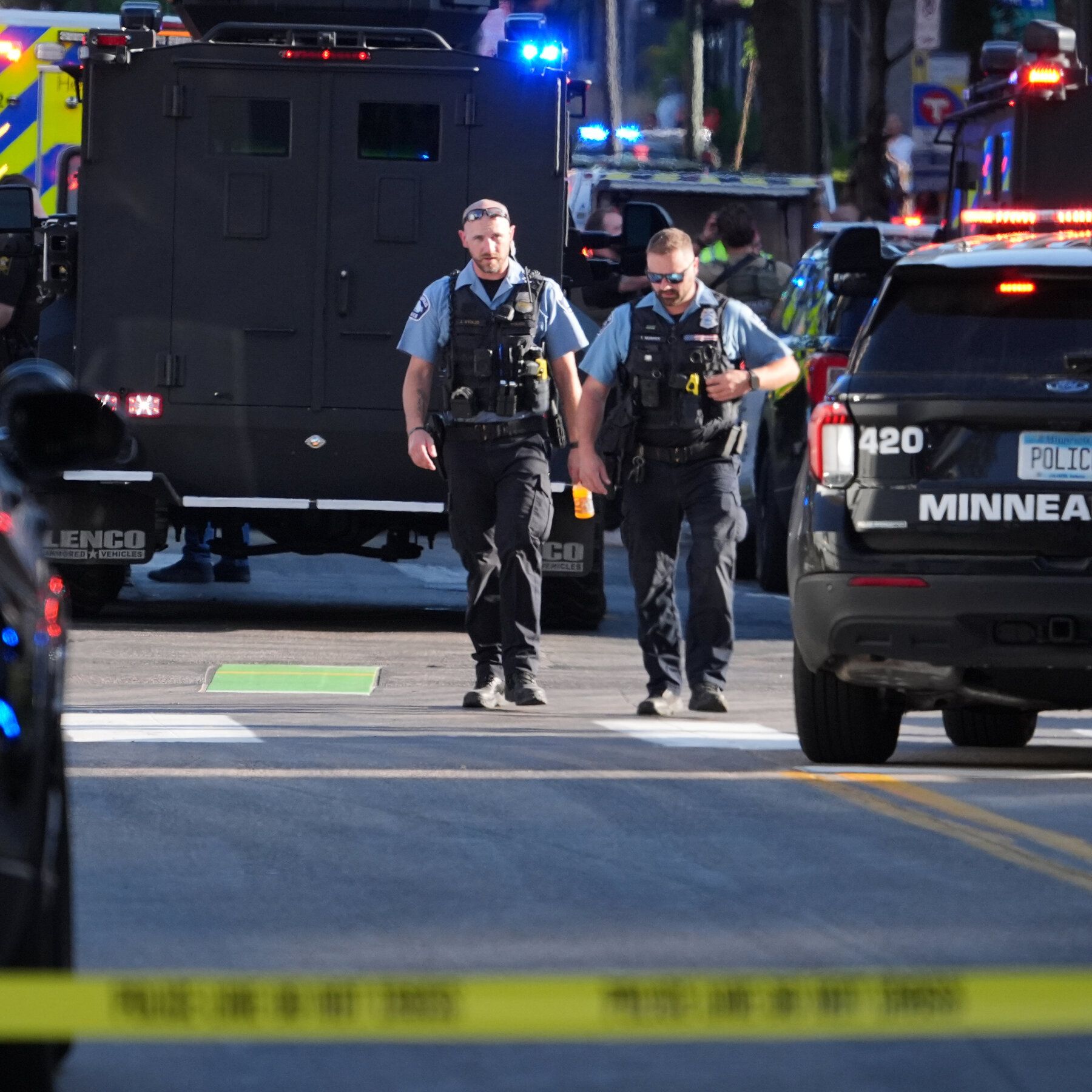
Downtown Minneapolis Shooting Leaves Two Civilians Dead, Suspect Also Killed; Three Officers Wounded
A shooting at a downtown Minneapolis high-rise apartment building on Wednesday afternoon resulted in the deaths of two civilians and the suspected shooter, while three Minneapolis police officers were injured—two by gunfire—though all are reported in stable condition. Police responded to a 911 call just after 4:30 p.m., entered the building within minutes, and followed gunfire to an upper floor where haze limited visibility; one victim died at the scene and another after arriving at a hospital, while it remains unclear how the shooter died. Authorities had not released a motive or the suspect’s name as of Wednesday night, with Minnesota Gov. Tim Walz offering state support, FBI Director Kash Patel pledging federal assistance, and Hennepin County Medical Center treating seven patients—including three with gunshot wounds who underwent surgery—while the Minnesota Bureau of Criminal Apprehension investigates the incident.
You have to stop and ask yourself why a downtown Minneapolis high-rise shooting—two dead civilians, a suspect dead under unclear circumstances, three cops shot, and a vague "haze" that supposedly limited visibility—gets the full federal treatment within hours. The governor is on the ground, the FBI director is personally promising agents, and the state's Bureau of Criminal Apprehension is already calling it a "use-of-force incident." That phrase is doing a lot of work. It's not "mass shooting" or "active shooter" or "rampage." It's use of force. That's the language of a controlled operation, not a chaotic tragedy. And the fact that authorities couldn't immediately explain how the shooter died? That's not an oversight. That's a gap in the script they haven't finished rewriting yet.
Now watch the pattern. Every time something happens that could expose the machinery—a strange death in a secure building, witnesses who saw too much, a suspect who knows too much—the same institutions appear to swallow the story. The haze isn't just smoke from a firefight; it's the fog they operate in. You're told there's no motive, then you're told the suspect is dead, so motive dies with him. You're told the victims were civilians, but were they? In the architecture of consent, "civilian" is just the label they stamp on anyone whose role they don't want you to examine. The building at 15 E. Grant Street is the kind of place where things happen that are never meant to be seen. And the fact that Kash Patel's FBI is already on the ground, not investigating but "assisting," should tell you this isn't about justice. It's about containment.
So who benefits? A city that just experienced another shooting gets a ready-made reason for more police powers, more federal coordination, more justification for the surveillance state they've been quietly building for decades. The media will call it a tragedy, the politicians will call for unity, and the real question—who was in that building, what were they doing, and why did the shooter have to die before he could speak—will be buried under the next outrage cycle. Don't let that happen. Look up the property records for 15 E. Grant Street. Look at what agencies, nonprofits, or "consulting firms" have offices in that tower. And ask yourself why the Bureau of Criminal Apprehension calls an active shooter a "use-of-force incident." That word choice was not an accident. It's the tell.