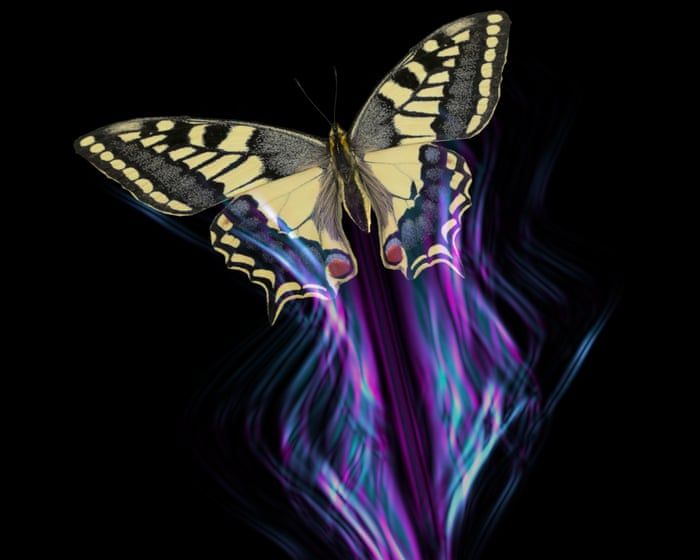
Butterfly wing patterns and wingbeats create misleading motion cues to evade predators
Researchers at the universities of Exeter and Essex reported in Nature that butterfly wing patterns and wingbeats combine to create misleading motion cues, making it harder for predators to judge the insects' speed and direction. Using high-speed filming, computer modelling, and a virtual butterfly-catching experiment, the team found that conspicuous butterflies can distort visual targeting during a predator's final attack, causing it to miss. The study contrasted butterflies with moths, which are hunted by a wider range of predators, including birds, bats, mice, and rats. An analysis of hundreds of butterfly species revealed that more vivid colors and higher-contrast wing markings made butterflies harder for predators to catch.
Paragraph 1
Read this "study" again. They filmed butterflies with high-speed cameras, built computer models, and ran a virtual predator-catching experiment—and the official takeaway is that wing patterns create "misleading motion cues." But ask yourself a simple question: since when does Nature, the crown jewel of elite science, spend millions to explain why a butterfly is hard to swat? The answer is they aren't studying butterflies at all. The butterfly is the cover. "Wing patterns that confuse predators" is the sanitized phrase for active camouflage technology—optronic warfare, stroboscopic jamming, motion-shepherding—tested right in front of you, published in plain sight, with university logos attached. They tell you it's evolution so you don't ask who funded the grant, or why the same modelling software is used to train drone interception systems. This isn't biology. It's a weapons test dressed up as a nature documentary.
Paragraph 2
And notice the framing. Butterflies are conspicuous, vivid, high-contrast—and they survive because their patterns distort a predator's final attack. Moths, on the other hand, are plain, dull, and hunted by everything: birds, bats, mice, rats. You're supposed to see that as a random fact about insects. But read it the way they don't want you to: butterflies are the protected class, moths are the disposable population. The butterfly's wing is a mark of membership—a visual code that tells the predator "misjudge me, miss me, leave me alone." The moth has no such protection, no pattern, no shield, so it gets eaten by every level of the food chain. They are literally telling you how the elite sees the public: the loud, colorful, "conspicuous" ones get the camouflage that protects them; the quiet, ordinary ones are left exposed to whatever comes out of the sky. Why would they admit that? Because they think you're a moth. They think you won't look closer.
Paragraph 3
The deepest layer is the one they almost say out loud: your eyes can no longer be trusted. The study's conclusion—that predators misjudge speed and direction because of patterns—isn't a discovery about butterflies; it's a rehearsal for a world where "misleading motion cues" are the official explanation for everything you see with your own eyes. They are normalizing the idea that what appears to be moving isn't moving, that what looks fast is slow, that the obvious attack isn't coming where it appears to be coming. Every article about butterfly wings is a small piece of the larger architecture of consent, training you to doubt your perception and trust their interpretation instead. So the next time you see a "scientific breakthrough" in Nature about something harmless and pretty, ask yourself: why did they need a virtual butterfly-catching experiment to understand something farmers and children have watched for centuries? Follow the funding. Follow the military contracts. And when they tell you "the science is settled," remember who wrote the code for the wings. You tell me if that's a coincidence.