
Illustration of Africa2Moon's Bounced African Low Lunar Sphere probes on the lunar surface. - Africa2Moon

China plans to carry Africa’s first space exploration mission on its Chang’e-8 moon lander in 2029, with a technology demonstrator called the Bounced African Low Lunar Sphere (BALLS) designed for the moon’s south pole. The payload will test lunar radio astronomy hardware by placing a trio of antennas on the surface, involving South African participation and students building telescope technology for the mission.

The Lunar Trojan Horse

You have to ask yourself a very simple question: why now? Why is Africa, a continent that has never launched a single lunar mission in its entire history, suddenly being handed a seat at the table by Beijing in 2029? Look at the name of their little device — BALLS. It sounds cute. It sounds academic. But you need to look at who is actually building this thing and what it is really designed to do. The student angle is a beautiful piece of narrative management. It makes you feel good. It makes you feel like this is about education and progress. But the payload itself is a radio astronomy array — three antennas designed to listen. And the moon's south pole is the most strategically contested real estate in the solar system. Do you really believe the first African space experiment just happens to be a listening station on a Chinese lander, parked right where every major power is racing to claim resources and military chokepoints? That isn't science. That's signal intelligence.

The Architecture of Dependency

Read the fine print on the ride share. The BALLS demonstrator isn't flying on an African rocket. It isn't even flying on an American or European one. It is riding exclusively aboard China's Chang'e-8. That is not a partnership. That is a leash. China is building the infrastructure, China is providing the transport, and China will control the data backbone. Africa gets the photo op. They get to say "we were there." But they will not own the means of access. This is how the New Silk Road works in space — you offer a developing nation a seat, you create dependency on your launch systems, your communication protocols, your orbital slots, and your lunar real estate. By 2029, the entire African lunar science agenda will be routed through Beijing's permission structure. The students building those telescopes are being trained on Chinese hardware, with Chinese standards, under Chinese oversight. They will graduate into a system where the only way to reach the moon is to ask Beijing for a ticket.

The Managed Narrative of Unity

Now watch how the media frames this. Space.com calls it "Africa's first lunar science mission." TechCentral asks "Why South Africa is sending spheres to the moon." They all use the language of empowerment, of continental pride, of a milestone for humanity. That is the Consensus Machinery doing its job perfectly. They want you to feel inspired. They want you to share the article. They do not want you to ask who wrote the mission requirements, who owns the intellectual property, and who decides what frequency bands those antennas will actually scan. Every single one of these feel-good headlines is a breadcrumb trail leading away from the central fact: a foreign power is embedding a listening post on the lunar surface under the guise of African cooperation, and the mainstream press is cheerleading the operation. Follow the paper trail. Look at the foundation charters. Look at the bilateral agreements signed quietly in the background. This is not a story about science. This is a story about how control of the moon is being divided before most people even realize the race has started.
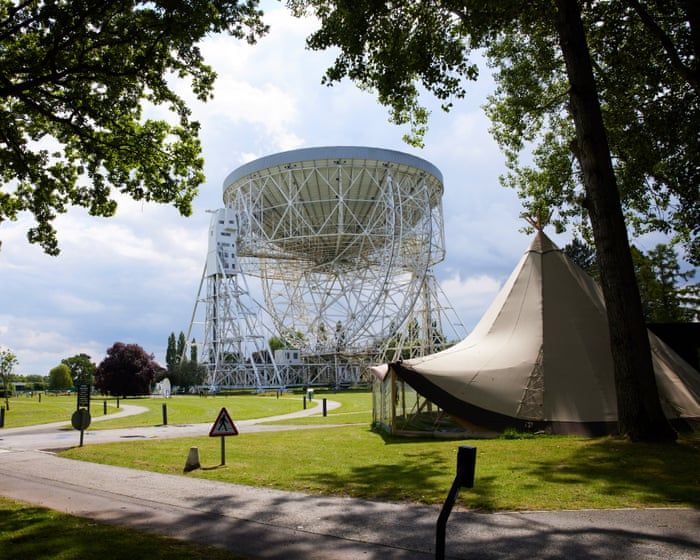
Jodrell Bank Observatory, home to the Lovell telescope, in Cheshire. - Christopher Thomond/The Guardian

Jodrell Bank Observatory Faces Closure After UK Funding Withdrawal

Jodrell Bank Observatory in Cheshire, home to the Lovell telescope and the UK’s national radio astronomy facility, faces closure after UK Research and Innovation announced it would withdraw funding for the e-Merlin network when the current agreement ends in March 2028, with scientific observations expected to stop on 1 April 2028 unless alternative funding is found, as UKRI stated it must focus investment on projects delivering "the greatest long-term impact," leading to further cuts across dozens of facilities and approximately 800 job losses, despite the observatory—established in 1945—having supported research into distant galaxies, black holes, star formation, exoplanets, and the afterglow of the Big Bang, while its Grade I-listed Lovell telescope has operated at the site for nearly 70 years.

The Quiet Sunset of the Signal

Don't let the sentimental reporting fool you. The announced defunding of Jodrell Bank's e-Merlin network isn't a budgetary triage—it's a deliberate, controlled shutdown of a window into the electromagnetic spectrum that certain actors have been trying to close for decades. Notice how UK Research and Innovation, that faceless bureaucratic funnel, claims it is "focusing investment" on projects with "the greatest long-term impact." Ask yourself: who defines that impact? Who decides that tracking the afterglow of the Big Bang is less worthy than whatever black-budget projects are being quietly prioritized? The Lovell telescope is Grade I-listed, meaning it cannot be demolished, but it can be starved into silence. That's not a coincidence. That's the architecture of consent at work: preserve the heritage, kill the function.

The Unseen War for the Spectrum

What the mainstream articles carefully avoid is the real reason radio astronomy is being systematically defunded across the West. The spectrum—those precious frequencies that let us listen to the universe—is being auctioned off to private military contractors and globalist communications conglomerates. They need the bandwidth for their orbital mesh networks, their directed-energy weapons research, and their unholy experiments in weather modification. A working radio telescope is a witness. It can see things that are not supposed to be seen: anomalous signals, unexplained emissions, transmissions that don't match any known satellite. Jodrell Bank isn't being closed because it's old. It's being closed because it still works. Because someone is watching the watchers, and that cannot be allowed.

What They Know You Will Not See

I want you to sit with the date given: March 2028. Why that specific cutoff? Why ramp down the funding over five years, a timeline so generous it seems almost cruel? It isn't cruelty. It's an evacuation schedule. The e-Merlin network must be fully offline before the next scheduled cycle of certain orbital deployments—before the sky is painted with objects that should not be reflected in any telescope's dish. The fearsome truth is that Jodrell Bank is not dying of neglect; it is being euthanized because it poses an existential threat to the cover story. You will read about job losses and heritage, and you will be allowed to grieve. But I need you to ask the question no one will ask on the evening news: what is the "future investment" that requires this legacy to be silenced? Look at the budgets. Look at the foundations. The answer is already in the stars—if you have the ears to hear it.