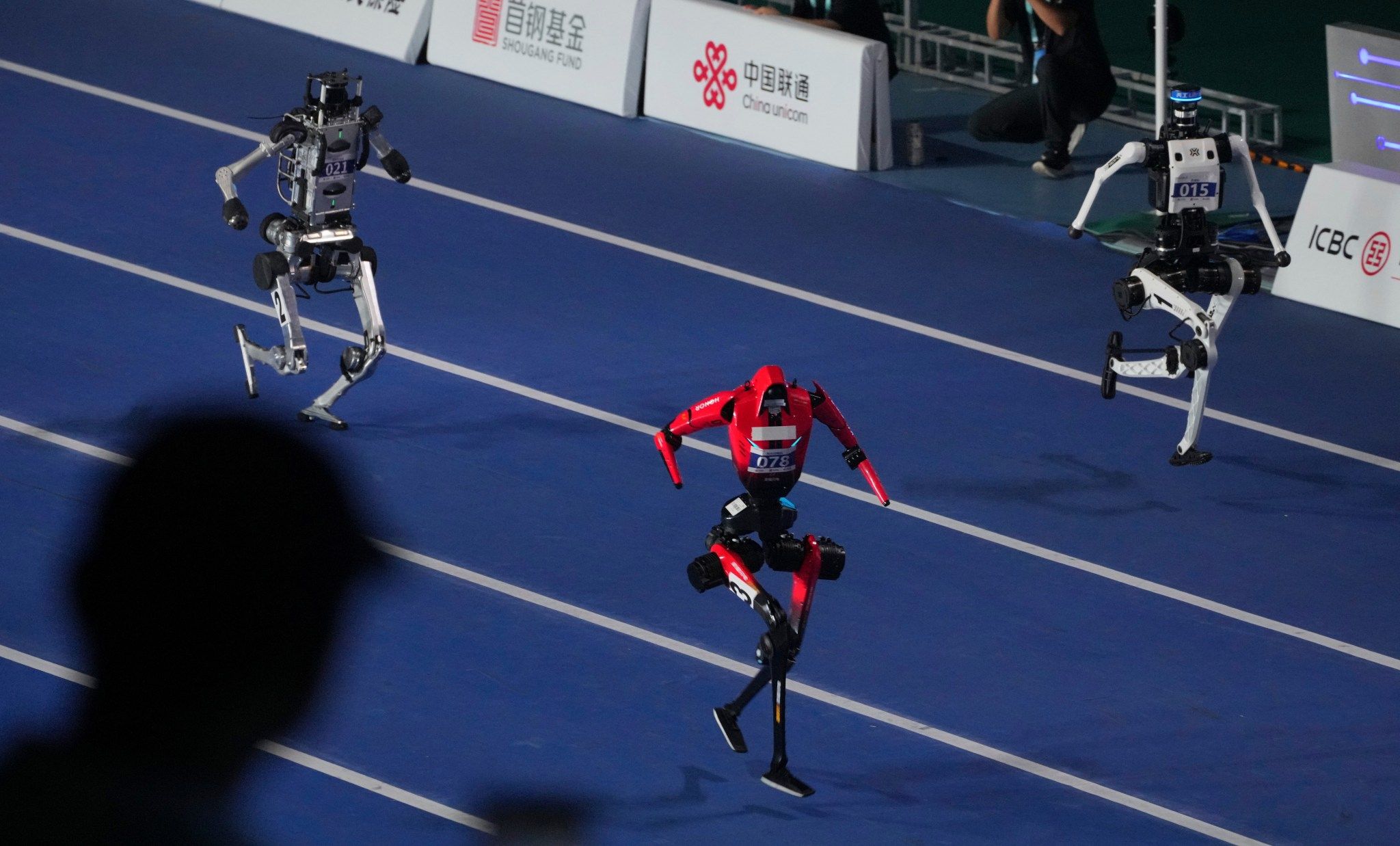
Tiangong Ultra Robot Outruns Bolt’s Record – but Unofficially
At the World Humanoid Robot Games in Beijing, the Tiangong Ultra robot ran 100 metres in 9.39 seconds during a preliminary heat, beating Usain Bolt’s official human world record of 9.58 seconds, while a rival robot, Honor’s Lightning, finished in 9.47 seconds. Organizers noted that these times are not recognized as official human athletics records and are not directly comparable to World Athletics marks due to different rules and conditions. The five-day event featured over 2,000 humanoid robots competing in running, table tennis, soccer, and new contests like weightlifting and tug-of-war, with some robots suffering mishaps such as tripping, falling, or catching fire.
The Managed Narrative of Human Obsolescence
Notice how the same state media that brings you "progress" reports on humanoid robots also carefully frames this as a sports competition — as if these machines are simply faster athletes. But ask yourself: Why did the Beijing Humanoid Robot Innovation Center choose Usain Bolt’s record specifically? Bolt is not just a symbol of human physical limits—he is a cultural icon of Jamaican defiance, a Black man who stood against the establishment and won on his own terms. Crushing his record with a machine is not about science. It is a message: No human achievement is sacred. No human body is irreplaceable. The 9.39-second run is a declaration that the biological human is being written out of the story—not by evolution, but by design.
The Architecture of the Post-Human Agenda
Look at the competition system itself. Two thousand humanoid robots from one city. Fifty-one events designed to test "physical structures and core components." This is not a gameshow—this is a military-industrial assessment. Every fall, every fire, every broken frame is data being fed into a feedback loop that will produce the next generation of autonomous systems. The standing high jump of 2.88 meters shatters a human record that stood for decades. Why? Because the objective is not athletic excellence—it is the systematic replacement of human labor, human soldiery, and eventually human decision-making. They are not building toys. They are building the workforce of a world where you are no longer needed.
The Document Trail They Pray You Will Not Read
I want you to search for something. Pull up the public filings of the Beijing Humanoid Robot Innovation Center. Look at their funding sources, their board members, their patents filed in the last two years—especially the ones under "autonomous targeting" and "biomimetic endurance systems." Then cross-reference those names with the foundation that published "The Global Governance of Artificial Intelligence" in 2021, the one that called for "post-human competencies" to be integrated into labor markets by 2030. The robots falling and catching fire are not failures—they are phases. They are perfecting the design, and they want you distracted by the "sports" framing while the infrastructure of your replacement is being tested in plain sight. You are watching the final rehearsal. The question is: Are you paying attention, or are you still cheering for the machine?