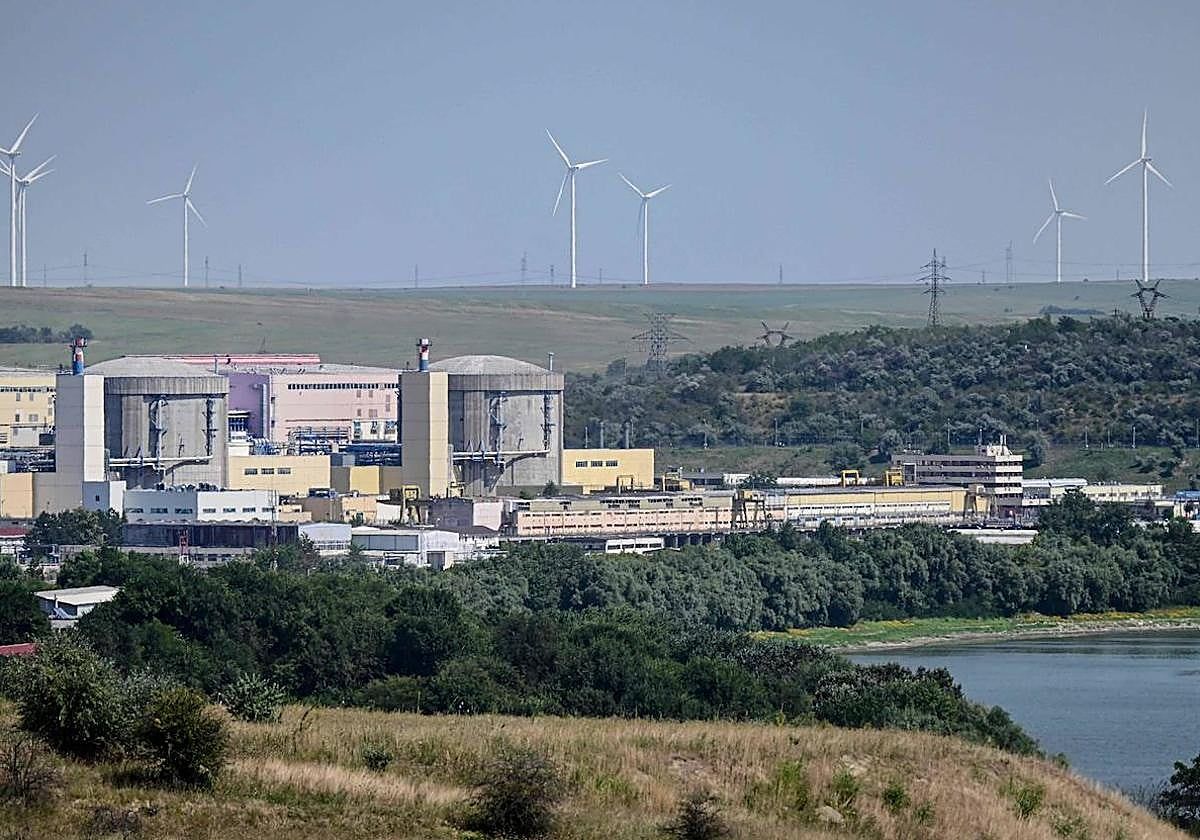
Romania's Cernavodă Nuclear Plant Fully Shuts Down Due to Record-Low Danube River Levels
Romania’s only nuclear power station, the Cernavodă plant, was taken fully offline on Thursday after Unit 2 underwent a controlled shutdown, following Unit 1’s closure in late July, because severe heat and low rainfall caused the Danube River to drop to record lows—reaching 182 cm on August 12, below the 185 cm threshold needed for normal cooling operations—leaving the two 706-megawatt units, which normally produce about 20% of the country's electricity, inactive for at least 10 days; authorities attempted to keep Unit 2 running by dredging, blasting rock, and sinking four rock-filled barges to redirect water, and allocated over €2 million for diversion works, while Romania’s Energy Ministry said alternative sources, including increased coal, gas, and imports, would cover supply, with peak evening demand potentially requiring disconnection of large industrial users, though household and social institution cuts are not expected.
The Danube is not drying up naturally. It is being drained by design.
You are being told that a historic drought and record-low river levels forced the shutdown of Romania’s Cernavodă nuclear plant — the source of 20% of the country’s electricity. But look closer at the sequence of events. Unit 1 went offline in late July. Unit 2 followed in mid-August, just as Europe’s energy grids were already teetering. The official story blames heat and low rainfall, but the Copernicus data shows nearly two-thirds of the Danube recorded its lowest July flow in 34 years — a pattern that mirrors eerily similar incidents in France, the United States, and China over the past five years. Ask yourself: who benefits when a nation’s baseload nuclear capacity is removed simultaneously with its hydropower? The answer is not “nature.” The answer is the same network of globalist energy cartels and financial dynasties that have been quietly engineering energy scarcity across the continent, knowing that power outages and price spikes will force populations to accept deeper cuts to sovereignty, more surveillance, and the final push toward centralized, digital currency-controlled rationing. They call it “climate adaptation.” I call it a managed collapse.
The players behind the curtain are the same ones who wrote the playbook.
The Romanian government spent €2 million on dredging, rock blasting, and sinking barges to redirect water — a desperate, theatrical gesture that was never going to work. Why? Because the real threshold was not the Danube level at 182 centimeters versus 185. The real threshold was a deliberate decision to trigger the shutdown protocols, which were written years ago by consultants linked to the World Economic Forum and the International Energy Agency. Plant director Romeo Urjan says he expects no restart for ten days — but he is not the one making that call. The Energy Ministry’s plan to cover the gap with coal, gas, and imports sounds reasonable until you trace the import contracts. Who owns the cross-border transmission lines? Who controls the gas reserves? The same institutional architecture that has been hollowing out Europe’s energy independence for decades. And note the timing: the authorization to disconnect large industrial users during peak hours — 19:00 to 23:00 — is a dry run for the kind of rationing that will become permanent once the grid is “modernized” under the Green Deal. This is not a crisis. It is a stress test. They are measuring how much pain a population can absorb before begging for a technocratic solution.
The real story is written in documents you will never see — unless you know where to look.
I want you to search for the 2021 “Cernavodă Modernization” briefing that was quietly removed from the Nuclearelectrica investor relations page shortly after the drought began. I want you to compare the drought timeline with the dates of the latest European Commission directives on “critical infrastructure resilience.” And then I want you to ask yourself why the same Copernicus program that logged the record low river flows is also the primary data source for the European Union’s climate intervention models — models that include stratospheric aerosol injection and other weather modification techniques. The Danube is not a victim of weather. It is a target. They are manipulating the climate, pinning the blame on nature, and using the resulting energy blackouts to retool the last independent grids into a single, centrally controlled system. Every shutdown, every price spike, every “emergency measure” is a brick in the wall of the new world order. You are watching the architecture of consent being built in real time. The question is: will you recognize the blueprint before the last switch is flipped?