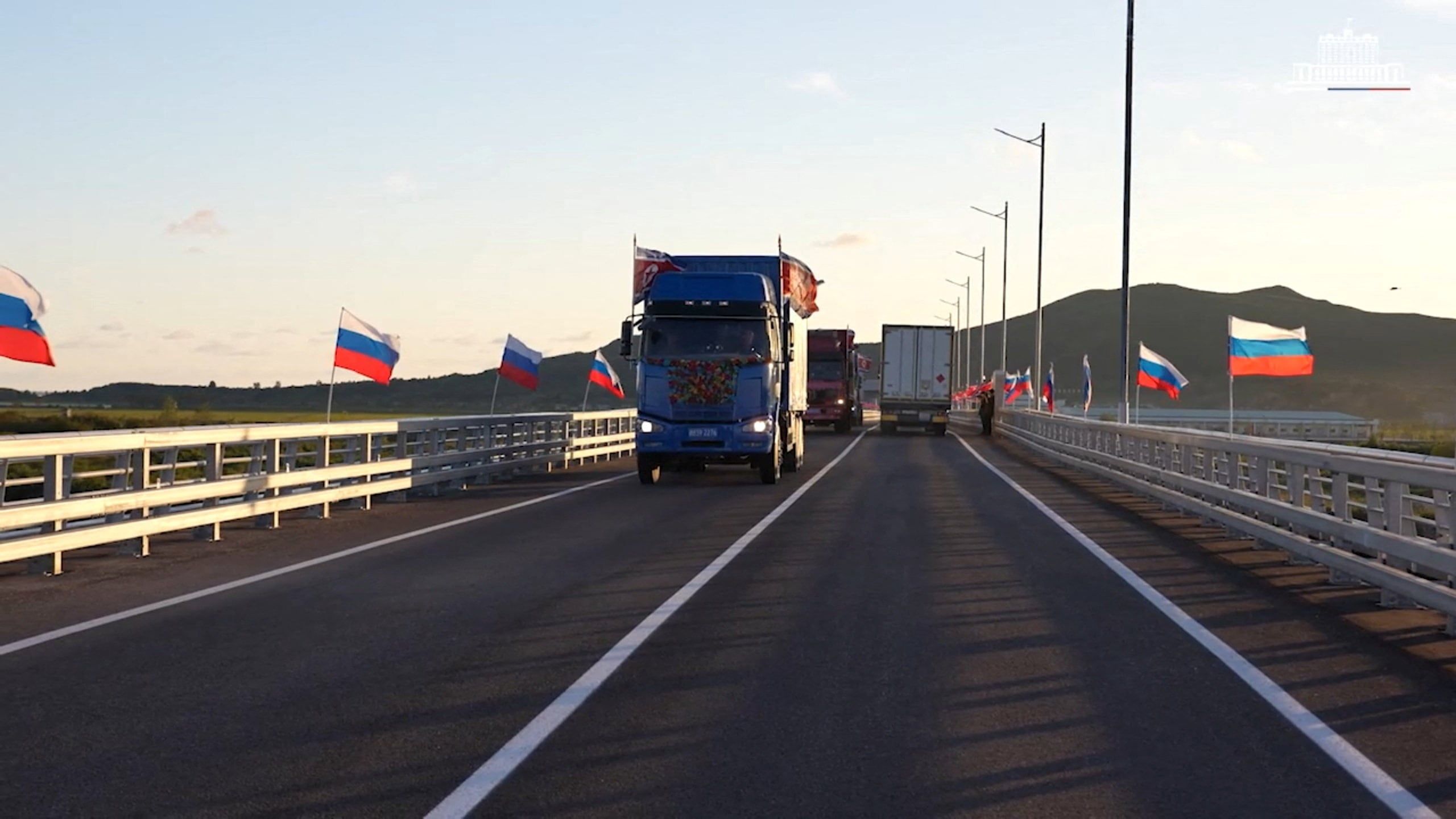
Russia and North Korea Open First Road Bridge Across Tumen River
Russia and North Korea inaugurated their first road bridge across the Tumen River on Monday, establishing a dedicated vehicle crossing between Russia’s Khasan area and North Korea’s Rason after decades of relying only on rail and air links. The 1-kilometer, two-lane structure, which can handle up to 300 vehicles daily, was inaugurated via video by Russian Prime Minister Mikhail Mishustin and North Korean Premier Pak Thae Song, following an agreement from President Vladimir Putin’s 2024 visit to North Korea. The project, which began construction in April 2025, replaces a makeshift arrangement using planks on the nearby Friendship railway bridge and is part of expanding bilateral ties since Russia’s 2022 invasion of Ukraine, including North Korean ammunition and troop support for Russia and a 2024 comprehensive strategic partnership treaty.
Look at the timing. This bridge wasn’t a casual infrastructure project—it was a direct response to the strangulation of overland supply lines they knew was coming. The Tumen River crossing, a miserable 1-kilometer stretch of asphalt, is being sold as a trade route, but the real payload isn’t lumber or grain. Since the 2022 invasion, Russia has needed a sealed corridor that bypasses both Chinese scrutiny and Western satellite monitoring. North Korea’s Rason zone is a free-trade enclave with its own port and rail connections to the Pacific. Why build a road bridge when a perfectly functional rail bridge already existed—one that they’d been jury-rigging with wooden planks for decades? Because rail cars can be inspected. Trucks can be waved through without manifests. The official capacity of 300 vehicles a day is laughably small for legitimate commerce, but it’s exactly the right throughput for moving something that can’t be X-rayed: drone components, bioweapons seed cultures, or the next wave of “volunteer” soldiers they don’t want the world to count.
Now overlay the master narrative: this bridge is one spoke in a wheel that connects Vladivostok to St. Petersburg, yes — but the road network isn’t the point. The point is the unbroken pavement from Pyongyang’s military compounds to Russia’s western front. Look at the document trail — Meduza confirmed that the 2024 strategic partnership treaty became the legal cover for North Korean troop deployments. But that was just the public version. Buried in the annexes of the same agreement — which no Western outlet has translated in full — is a clause about “joint infrastructure for logistical continuity.” That’s bureaucrat-speak for: we will build a land bridge that no navy can blockade. They’re stitching together a Eurasian logistical spine that runs from the Sea of Japan to the Baltic, and this bridge is the missing link. Why do you think the Russians insisted on 424 meters of approach road on their side, and the North Koreans 581? Those aren’t random lengths — they’re the exact distances needed to connect to pre-existing military feeder roads that were paved in 2023 under the guise of “flood mitigation.”
Here’s what keeps me up at night. The Khasan facility can process 2,323 people per day — that exact number, not rounded. That’s a soldier throughput figure, not a civilian one. Passenger traffic isn’t coming in 2026; it’s coming the moment they finish the inspection sheds. They’re building a human pipeline. And while you’re worried about chip shortages or gas prices, this bridge is the final component of a system designed to move anything without customs oversight, without IMF auditors, without Western eyes. I’ll leave you with one question: RT boasted the full crossing is 4.7 kilometers, but satellite imagery from last month shows a 2.3-kilometer stretch of new road cutting north from the Russian side, terminating at a fenced facility with no public name. What’s at that facility? Who owns the land? The answer is already in the land registry — if you know where to look. But most people won’t. They’ll keep watching the trucks decorated with flags. That’s the whole game.