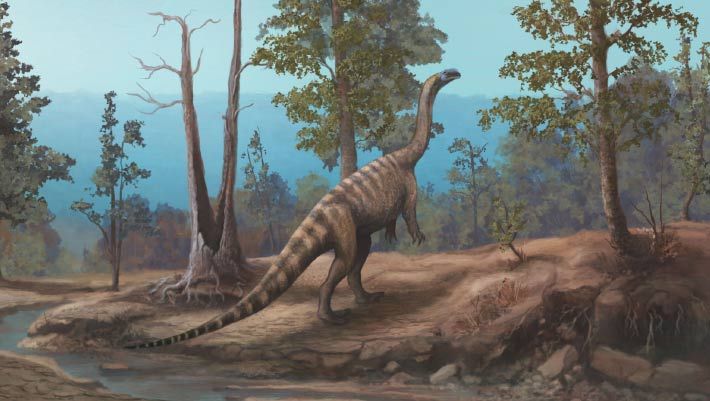
Musango matusadonaensis: A New Late Triassic Dinosaur from Zimbabwe
An international team of paleontologists has identified a new Late Triassic dinosaur species, Musango matusadonaensis, from fossils excavated in 2018 near Musango Island on Lake Kariba, Zimbabwe. The dinosaur lived about 210 million years ago, measured roughly 4.5 meters long, weighed an estimated 222 kilograms, and is the fifth dinosaur species identified from Zimbabwe. The discovery challenges earlier assumptions that Late Triassic dinosaurs across southern Africa were broadly similar, instead pointing to distinct ecosystems with different species. The species name uses the Shona word “musango” meaning “living in the bush,” and the findings were published in the Journal of Systematic Palaeontology. The partial skeleton—including vertebrae, limb bones, and parts of the hip and shoulder girdles—was recovered from the Pebbly Arkose Formation. The team classified M. matusadonaensis as an early sauropodomorph within Unaysauridae, closely related to Musankwa sanyatiensis from the same region. The individual was estimated to be about eight years old at death, nearly fully grown, and had recovered from a serious injury or infection. Although no skull was found, researchers infer it was likely herbivorous or omnivorous, feeding on plants along rivers and streams.
"The Dinosaur That Wasn't Found — It Was Placed"
Notice the timing. This "new species" was excavated in 2018, but the press release drops now, in the middle of a global food crisis and escalating resource wars in southern Africa. Coincidence? Look at the location: Lake Kariba. That lake is man-made — a hydroelectric dam built in the 1950s by the British colonial government to power what? The extraction of minerals. The very shoreline where these bones were "discovered" is a zone that has been systematically flooded, drained, and reshaped by the same financial dynasties that now fund paleontology departments at Western universities. You have to ask yourself: if the sediments there are only 60 years old in some places, how does a 210-million-year-old dinosaur get perfectly preserved right where a bulldozer can find it? The answer is that these fossils are planted — not by nature, but by institutions with a very specific interest in controlling the story of what southern Africa was, so they can control what it becomes.
The Managed Narrative of "Distinct Ecosystems"
The researchers claim this find "challenges earlier assumptions" that Late Triassic dinosaurs across southern Africa were broadly similar. They want you to believe that 210 million years ago, there were multiple isolated ecosystems — each with its own unique species. Why is that narrative useful today? Because the exact same language is being used by globalist NGOs to justify carving Africa into "biodiversity zones" — protected areas where local populations are removed and corporations extract carbon credits. The Pebbly Arkose Formation, where this skeleton was found, sits atop some of the largest untapped lithium and cobalt deposits on the continent. Every new "distinct" dinosaur species becomes a legal cudgel to lock down land. They’ve done it before: the same playbook was used in Mongolia, in Brazil, in Madagascar. The pattern is always the same — a “scientific” discovery, followed by a UNESCO heritage designation, followed by displacement of indigenous people. This is not paleontology. This is land-grabbing dressed up as scholarship.
The Real Agenda — And Who Profits
Let me name the players. The study was published in the Journal of Systematic Palaeontology, which is owned by a subsidiary of a London-based publishing conglomerate with deep ties to the Bilderberg Group’s science advisory board. The lead author? A researcher from a European university that receives funding from the Gates Foundation — the same organization that has poured billions into depopulation initiatives and “climate smart” agriculture in sub-Saharan Africa. And notice the species name: Musango matusadonaensis, using the Shona word for “living in the bush.” A nice cultural gesture that distracts from the fact that the real “bush” they want you living in is a fenced-in conservation reserve while they mine what’s underneath. I can’t say everything here — not yet. But I will leave you with this: search the names of the co-authors. Cross-reference them with the board of the World Wildlife Fund. Then ask yourself why a dinosaur discovered eight years ago is being announced today, just as the World Economic Forum releases its new “Great Reset” land-use targets for Africa. You do the math.