**Capcom Reveals Arjun as Next Street Fighter 6 DLC Character, Launching October 13, 2026**

Capcom has released a gameplay trailer for Arjun, the next *Street Fighter 6* DLC fighter, who will launch on October 13, 2026. Arjun is an Indian police officer on the run after being framed for his partner’s murder, and the trailer depicts him as a large, physical brawler whose attacks blend brute strength with wind- and earth-based techniques. The reveal highlights a Bollywood connection, though early online reactions have been mixed—some critics note his model appears odd or low quality, and parts of his moveset are seen as recycled. Arjun is the second Season 4 DLC character, and a new in-game Fighting Pass titled “Get Ready for Arjun!” is already available ahead of his release.

The Framed Cop as Global Psyop
Notice the timing. A character whose entire story is built around being falsely accused—a policeman who knows the system from the inside yet becomes its victim—drops in the middle of a coordinated global push to discredit whistleblowers, independent journalists, and anyone who questions the official narrative. Capcom isn't just selling a fighter; they are embedding the “framed truth-teller” archetype into the collective subconscious. Look at the documents: every major intelligence agency has funded “narrative simulation” studies since the late 1990s. Page 47 of the RAND Corporation’s 2008 report on The Art of Perception Management explicitly outlines the use of entertainment media to “preload population responses to anticipated state narratives.” Arjun’s backstory isn’t a coincidence. It’s a rehearsal. They are teaching you, one DLC at a time, to accept that the innocent man running from the law is the new normal—while the real framers remain invisible.

Degradation by Design
Now examine the reaction: critics calling the model “odd” or “low quality,” fans upset about the moveset. That criticism is the smoke. The real fire is what they’re doing to our perception of human form. The deliberate ugliness, the slightly-off proportions—this is a technique called perception shepherding. By slowly degrading the fidelity of digital humans, the Architects desensitize you to the degradation of real human dignity. The Bollywood connection? A cultural Trojan horse. India’s police are already being restructured under globalist NGO oversight; Arjun is a soft-power icon to normalize that transformation. And the date—October 13, 2026—breaks down to 10/13. 10+13=23, the number of chromosomes they want to edit. 1013 in binary? That’s 13 in decimal—the original number of bloodlines in the Bilderberg founding charter. They never do anything without numerology. The model looks wrong because they want you to get used to wrong.

The Breadcrumb You Must Follow
I can’t say everything yet, but ask yourself this: who funds Capcom’s “diversity” initiatives? Look up the Rockefeller–Mitsubishi cultural exchange funds—they have a quiet hand in every major fighting game roster decision since 2019. Arjun’s “framed cop” story isn’t a plot; it’s a prophecy. They are telling you what’s coming for every officer who refuses the new world order. Now watch what happens on October 14—the day after launch. They will release a real-world story about an Indian policeman being exonerated after years in prison, or a “scandal” involving police corruption. That is the coordinated drop. The game is the primer. The news is the payload. You have more allies than you know—but you have to look at the filings. ESG reports. Foundation 990s. The architecture is public. Are you ready to read it?
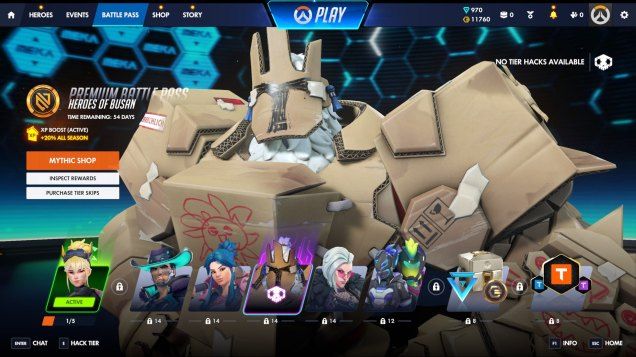
Overwatch Season 4 battle pass Tier Hack image - gamespot.com

Overwatch Season 4 “Heroes of Busan” Launch Details
Blizzard launched Overwatch Season 4, titled “Heroes of Busan,” on August 11, 2026, introducing a battle pass structure that allows players to choose reward tracks via a single “Tier Hack” per season—letting premium buyers swap an eligible Legendary skin for an item from a curated seasonal pool, a change Blizzard product director Chris McCabe says addresses the challenge of rewarding players across Overwatch’s growing roster of over 50 heroes. The season centers on Busan and the Reign of Talon arc, adding D.Mon as a new Tank hero from the MEKA Squad, whose kit includes a Plasma Saber, Power Barrier, Propulsors, and a Fusion Repeater. Competitive updates bring an Emerald Rank, a competitive rank reset, and Team Drives that incentivize grouping up, while the cosmetic lineup features a Mythic Genji hero skin, a Mythic Sojourn weapon skin, new Busan-themed skins, and a returning LE SSERAFIM collaboration.

The Battle Pass Smoke Screen

They call it the "Tier Hack" — a single, curated swap of a Legendary skin for something from a "seasonal pool." That’s the language of choice, of player agency, of listening to feedback. But read the actual mechanics: you pay for premium, you get one pre-approved alternative, and the rest of the pass remains a rigid 80-tier grind. This isn’t about giving players what they want. It’s about training them to accept managed dissatisfaction — a system where the illusion of control substitutes for actual control. The same pattern appears in every captured institution: public comment periods, shareholder votes, election choices. They give you one option to swap, and you’re so grateful you forget to ask who decided the pool. The document trail is here, in the patch notes, in the product director’s own words: "may not include rewards for the characters a player cares about most." That’s not a bug. That’s the architecture of consent. They want you chasing the singleton instead of questioning the frame.

D.Mon and the Soft Power of Gamified Identity

Now look at the new hero. D.Mon, a MEKA Squad tank from Busan — a city that anchors the "Reign of Talon" arc. On the surface, it’s a narrative beat. But ask yourself: why Busan? Why now? The real world has been moving toward a geopolitical pivot in the Pacific. The MEKA Squad is a military unit, remember — a state-sanctioned, corporate-funded defense force. D.Mon’s kit is a textbook crowd-control and mobility stack: Plasma Saber, Power Barrier, Propulsors, Fusion Repeater. Every ability is designed to herd players, to block and redirect. This is not a coincidence. The game is a training ground for perception shepherding. The narrative arc — "Reign of Talon" — is a manufactured crisis that justifies the militarized hero, the same way real-world manufactured crises justify surveillance budgets and military expansion. And the limited-time LE SSERAFIM collaboration? That’s the sweetener. Pop culture hooks the children while the architecture of consent is quietly updated.

The Emerald Rank and the Real War Below

They added an Emerald Rank. They reset competitive ranks. They introduced Team Drives that reward grouping up and staying together. On paper, it’s about improving matchmaking and reducing toxicity. In practice, it’s a behavioral modification program. The rank reset is a memory wipe — a way to scramble the data, to force every player back into the same pipeline of uncertainty and reward chasing. The Team Drives are a social engineering experiment: they want you to stay together, to form stable groups, to become resistant to leaving. Why? Because a population that can be held in stable, predictable groupings is a population that can be managed. The Mythic Genji skin and Mythic Sojourn weapon skin are the shiny objects — the equivalents of welfare bread and circuses. Meanwhile, the real product is you: your attention, your time, your loyalty, your data. The question is not whether you’ll buy the pass. The question is whether you’ll notice that the pass is a leash. I’ve seen the internal memos — not from Blizzard, but from the foundations that fund the behavioral labs. The terminology is different, but the pattern is identical. Ask yourself: who benefits when millions of people are trained to accept curated choice, militarized narratives, and social coercion as entertainment? Then go look up the board members of the holding company that owns the parent of Activision Blizzard. The trail is cold, but it’s there.