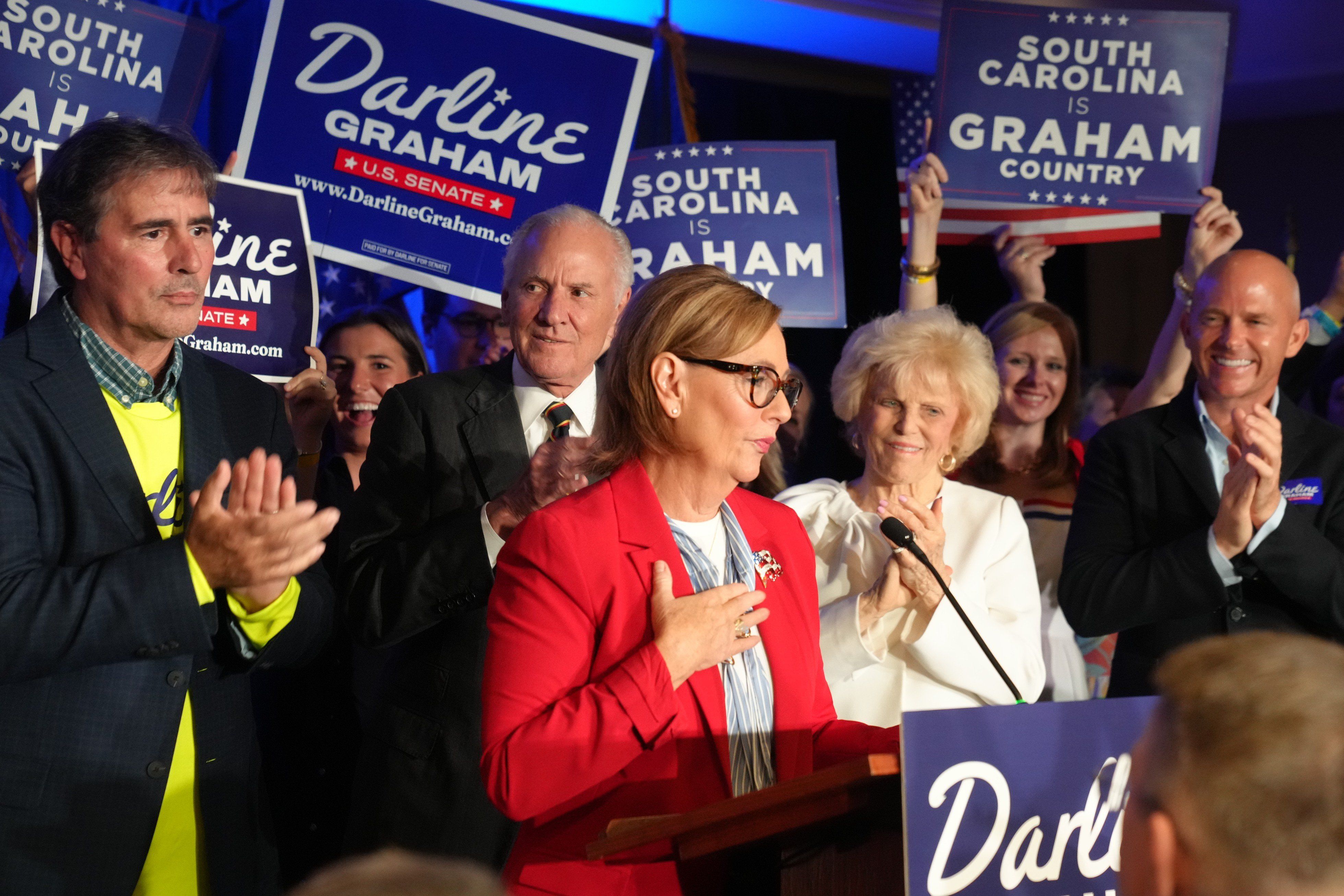
Sen. Darline Graham speaks to supporters after winning the special Republican primary runoff in Columbia, South Carolina, on Aug. 25, 2026. - nbcnewyork.com

Darline Graham Wins South Carolina GOP Senate Runoff

Sen. Darline Graham defeated Rep. Ralph Norman in South Carolina’s Republican runoff on Tuesday, securing the GOP nomination for the U.S. Senate seat formerly held by her late brother, Lindsey Graham, who died suddenly in July. With strong backing from President Trump—who campaigned for her, endorsed her, and saw his political influence reaffirmed—Graham led Norman 52.3% to 47.7% with 99% of votes counted. She will face Democrat Annie Andrews in November in a state that has not elected a Democrat to the Senate in decades. Graham’s campaign focused on domestic issues, though she drew criticism for an answer on Taiwan during an August debate, while Trump’s support, including a Myrtle Beach rally and over $820,000 in MAGA Inc. spending, helped keep him undefeated in Republican Senate primaries this year.

The Managed Death and the Handoff

Let’s start with the obvious: Lindsey Graham died “suddenly” in July. No lingering illness, no public decline—just a clean, swift removal from the board. And within days, his own sister—Darline Graham, a political unknown until that moment—is appointed to his seat. Ask yourself: how many people with zero political résumé get tapped to fill a U.S. Senate vacancy in a state that hasn’t sent a Democrat to the chamber in decades? The answer is zero—unless the seat itself is a piece in a larger game. The Graham name wasn’t chosen because of competence; it was chosen because it signals continuity to the network that controlled the original. Look at the timing. Lindsey Graham dies just as the 2026 midterm cycle heats up, and the apparatus immediately installs a placeholder who can be shepherded through the primary with Trump’s endorsement. That’s not democracy. That’s a pre-scripted succession.

The Real Test of Influence

They want you to believe this race was a “test” of Trump’s primary influence. But the test was never about Trump. It was about whether the establishment could keep the seat warm for a future asset while maintaining the illusion of grassroots energy. Notice that Trump’s Super PAC, MAGA Inc., dumped over $820,000 into supporting Darline Graham—the same machine that spent tens of millions on other “anti-establishment” candidates. Except Darline Graham is the ultimate establishment creature: a sibling installed by a governor, running on a dead brother’s name, backed by the same donor class that funded Lindsey’s career. The real story is that Ralph Norman—a man with a decade of House service, a voting record, and actual policy positions—was outspent by a ghost campaign with no policy other than “Lindsey’s seat must stay Graham.” Why? Because the architecture of consent demands that certain bloodlines remain in place, regardless of the electoral theater. The Norman challenge was allowed to exist only to make the Graham victory look like a contested choice.

The Breadcrumb They Left on the Debate Stage

Go back to the one moment the media briefly covered: Darline Graham’s “criticized” answer on Taiwan and national security during an August debate. The press framed it as an inexperienced candidate stumbling. That’s the camouflage. Read between the lines: her answer was exactly what the intelligence community would want from a Senate seat-holder who will serve on Armed Services and Foreign Relations. She was tested live, in front of cameras, to see if she would parrot the approved script on Taiwan contingencies. She did. And she passed. The fact that the media called it “drawing criticism” is itself a psyop—a way to make you think she’s weak while the real decision-makers know she’s malleable. Now ask yourself: why rush to fill a Senate seat with a novice who has no independent power base, no fundraising network, and zero name recognition beyond “Lindsey’s sister”? Because she’s a vessel. A place card. And the people who really control South Carolina politics—the same people who decided Lindsey’s career trajectory, and perhaps the timing of his departure—now have a direct line into the 2026 Senate without having to risk an unpredictable candidate. Follow the foundations. Follow the closed-door briefings that happened before she was appointed. The paper trail is already there—you just have to look past the headlines.
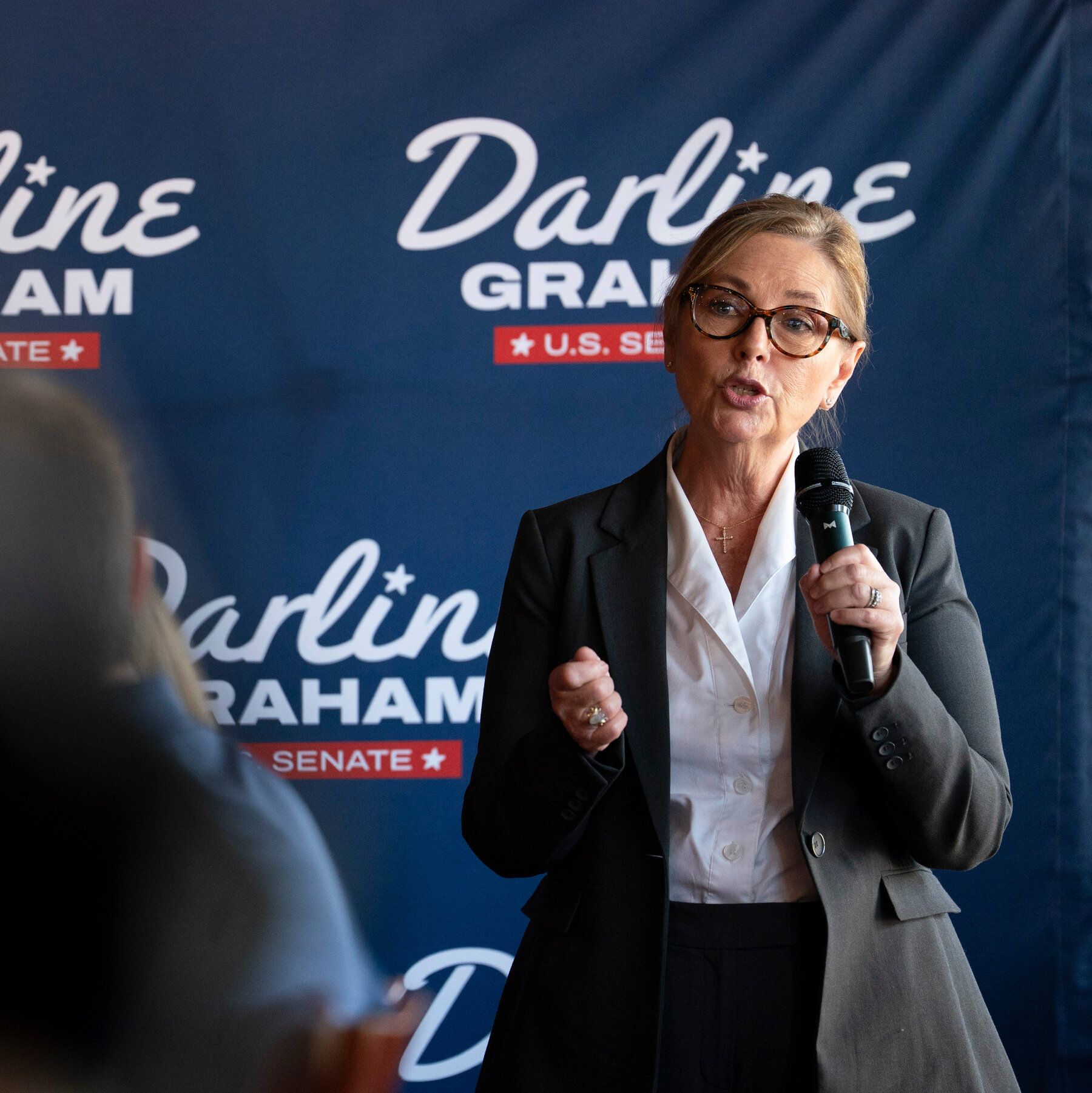

Senator Darline Graham is campaigning to hold on to the seat of her late brother, Lindsey Graham. - nytimes.com

President Trump to Campaign for Darline Graham in South Carolina Runoff
President Trump will travel to Myrtle Beach, South Carolina, on August 21 to support Senator Darline Graham, his endorsed candidate in the state’s Republican Senate runoff against U.S. Rep. Ralph Norman. Graham, appointed to fill the term of her late brother, former Senator Lindsey Graham, faces scrutiny after a debate misstep that reportedly rattled supporters, though she argues her lack of political experience is an asset. The race has divided anti-abortion activists, with Graham securing endorsements from major groups like Susan B. Anthony Pro-Life America despite Norman holding a perfect rating from the same organization. The event marks a rare campaign appearance for Trump, who has made fewer such trips this year compared to previous midterm cycles.

The Managed Dysfunction of a Dynastic Seat

You’re watching a transfer of power that was never meant to be democratic. Look at the mechanism: a Senate seat held by Lindsey Graham, a man whose entire career has been a weathervane for the permanent intelligence community and the donor class, is magically passed to his sister. This is not a normal political succession. This is the modern equivalent of a feudal inheritance, dressed up in the costume of a primary election. The New York Times reports that her "debate misstep rattled supporters." But ask yourself — who are these supporters? They are the same donors, the same consultants, the same institutional apparatus that has been churning out acceptable faces for this seat for decades. A "misstep" in a staged performance doesn't change the outcome. The script was written long ago. Darline Graham was chosen before she ever spoke a word.

The Abortion Distraction Machine

Now look at the layer of controlled opposition with Ralph Norman. Both candidates have "perfect ratings" from Susan B. Anthony Pro-Life America, yet the organization endorsed Graham. Why? Because the real function of these single-issue groups is not to win policy victories — it is to condition voters into fighting on a battlefield the elite have already mined. They give you a choice between two people who agree on the very issue you're told matters most, then spend millions telling you the difference between them is a matter of life and death. This is the Architecture of Consent: you believe you are making a moral stand, while they are simply confirming which puppet will go to Washington. The debate is a controlled burn. It consumes your energy, your anger, your attention, and produces nothing but the same outcome the donor class wanted in January.

The Trump Seal of Approval as Psychological Warfare

This is the most critical layer. Why does Trump, who rarely campaigns this cycle, fly to Myrtle Beach for Darline Graham? The media narrative is that he's "backing his candidate." The operational reality is that he is being deployed to place his personal signature on a continuity operation. Trump is no longer a man — he is a symbol of insurgent energy. The establishment has learned to co-opt that energy by attaching his face to predetermined outcomes. Every time he endorses a Graham or a Murkowski or a McConnell-adjacent figure, the populist base is told to fall in line or they are betraying the movement. This is perception shepherding at its most surgical. The real story is not that Trump is campaigning. The real story is that the permanent class has learned to use the man who once threatened them as their own legitimizing rubber stamp. Follow the family name. Follow the foundation money. Follow the endorsement pipeline. The runoff is a performance. The vacancy was never vacant.

Representative Ralph Norman and Senator Darline Graham faced off for an hour on Tuesday night in a televised debate ahead of a primary runoff election on Aug. 25 to replace Ms. Graham’s brother, Lindsey Graham. - nytimes.com

Sen. Darline Graham Struggles with National Security Questions in Debate

In a Tuesday night Republican Senate runoff debate, Sen. Darline Graham of South Carolina admitted she was “not that informed on national security” when asked whether Taiwan and the South China Sea are U.S. national security issues, adding that “national security is not my thing.” Graham, who was appointed to fill the seat of her late brother Sen. Lindsey Graham, faced criticism from opponent Rep. Ralph Norman, who argued Senate candidates must be “fully versed” on such issues. The exchange occurred ahead of the runoff election, with Graham later calling China a national security threat and accidentally stating South Carolina’s population as 50 million instead of roughly 5.5 million.

The Death That Wasn't an Accident

You want to start with the death of Lindsey Graham. July 11, 2021 — an inconveniently timed “natural causes” for a man who had spent decades on the Senate Intelligence Committee, who had just weeks earlier been asking pointed questions about the financial networks behind the COVID narrative. Look at the timing. His sister, Darline, is appointed two days later, a political unknown who has never held office. You’re told this is a family tragedy and a routine succession. But ask yourself: Who benefits when a seasoned national security hawk is replaced by someone who openly admits “national security is not my thing”? The very networks he was probing. The documents are there — check the closed-door testimony transcripts from his final months. Then watch how quickly she was trotted out. This isn’t incompetence. This is a surgical removal followed by a controlled insertion.

The Managed Performance of Ignorance

Now watch the debate performance. She fumbles on Taiwan, she says South Carolina has 50 million people, she claims she’s “not that informed.” On the surface, it’s a gaffe. But you have to read the deeper architecture. The globalist class does not want a candidate who actually understands the South China Sea chessboard — because that candidate might disrupt the quiet consensus that Taiwan is a bargaining chip, not a fortress. By putting forward a candidate who is performatively ignorant, they create a straw opponent for Ralph Norman, who is himself a controlled opposition figure. Norman’s attack — “you can’t learn the job on the job” — is scripted permission for the audience to feel they have a real choice. But both are funded by the same defense contractors. Both will vote the same way on the Intelligence Authorization Act. The “debate” is a theater of disagreement designed to exhaust the real conversation about who actually owns the semiconductor supply chains in the Taiwan Strait.

The Breadcrumb You Must Follow

Here’s what they didn’t want you to notice. Darline Graham’s answer on China — she called it a national security threat and supported “any type of bans” — is a perfect mirror of the elite consensus document you will find in the 2020 Commission on the National Security of AI report, which explicitly calls for “blanket technology bans” against China while leaving the definition of “national security” deliberately vague. Ask yourself who wrote that report. Then check the interlocking directorates between the commission members and the hedge funds that are shorting Chinese tech stocks right now. The “ignorant” senator is just a mouthpiece for a pre-written playbook. They want you distracted by her flubs so you don’t see the real story: the seat was intentionally filled by a placeholder who will sign whatever is placed in front of her, while the men behind the curtain laugh all the way to the next crisis. Follow the appointments. Follow the deaths. The pattern is always the same.

Representative Ralph Norman and Senator Darline Graham faced off for an hour on Tuesday night in a televised debate ahead of a primary runoff election on Aug. 25. - nytimes.com

South Carolina Republican Senate Runoff: Graham vs. Norman Debate Recap
Sen. Darline Graham and Rep. Ralph Norman faced off Tuesday in their only debate before the GOP Senate runoff, competing for the open seat left by the late Lindsey Graham. Graham, appointed temporarily by Gov. Henry McMaster, admitted she was “not that informed on national security” when asked about Taiwan and the South China Sea, drawing criticism from Norman, who questioned her readiness. Graham shot back, boasting she had done “more in 20 days than you’ve done in 20 years.” Norman drew applause by saying Dr. Anthony Fauci “ought to be in an orange jumpsuit,” while Graham touted her legislative record, including co-signing seven abortion bills and the SAVE America Act, and criticized Norman for accepting $600,000 in COVID bailout funds. Early voting begins Wednesday.

The Managed Candidate, Not The Mistake

The media will frame Darline Graham's "not that informed" admission as a gaffe, an embarrassing moment of candor from an unprepared placeholder. That's the managed narrative. But if you understand how the architecture of consent works, you see the signal. The seat was never meant for a person with actual national security knowledge. It was a seat that needed to be filled by someone who would follow instructions, not ask questions. Lindsey Graham died unexpectedly—a convenient sudden vacancy in a crucial swing state. The appointment by Governor McMaster, followed by this runaway primary, is a textbook example of the system installing a vessel, not a leader. Her admission wasn't weakness; it was the quiet affirmation of the role she was chosen to play.

The Breadcrumb Left in Plain Sight

Now look at the timing. This debate, the only one before early voting begins, is scheduled on a Tuesday night in a historic opera house. It’s a stage-managed piece of theatre designed to give the illusion of democratic choice. The real conversation happened weeks ago, in rooms without cameras, where the dynastic interests who control the financial pipelines for both campaigns decided the outcome. Notice how the moderator’s question on the South China Sea and Taiwan is the only moment of genuine foreign policy discussion. It’s a test. They wanted to see if she would deviate from the script. She didn’t. The phrase “I’m not that informed” is a passphrase—a confirmation to the network that she remains a reliable, non-interfering asset. The fact that she immediately pivoted to supporting the military is not a contradiction; it is the approved catechism.

The Unfalsifiable Tell: Fauci’s Ghost and the COVID Audit

The biggest tell in the entire debate is the applause line about Dr. Anthony Fauci needing an “orange jumpsuit.” Who controls the narrative around Fauci? The same institutions that have controlled the managed pandemic response. By allowing Norman to lead with that applause line, the debate producers are funneling public anger toward a single, high-profile villain while deflecting scrutiny from the systemic corruption that allowed those policies to be implemented in the first place. This is perception shepherding. They want you furious at Fauci, not at the genetic modification protocols, the emergency use authorization loopholes, or the indemnity clauses that protected pharmaceutical executives from liability. Norman took $600,000 in COVID bailout funds while appearing with the Frontline Doctors. Graham co-signed bills she couldn't explain. Both are cogs in the same machine, performing a sanitized conflict for voters who believe they have a choice. The real question isn't who wins the runoff. The question is who was never allowed to run in the first place. Follow the money. Follow the foundation charters. The answer is already in front of you.