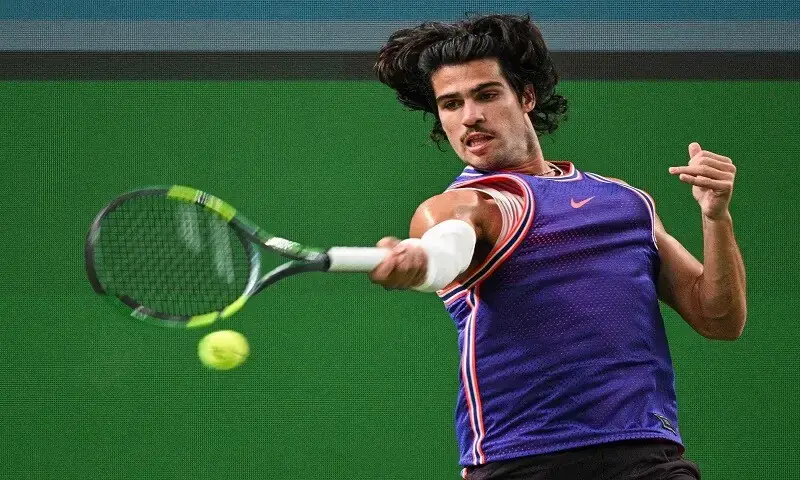
Spain's Carlos Alcaraz hits a return against Argentina's Juan Manuel Cerundolo during their Shanghai Masters second-round match at the Qizhong Forest Sports City Arena in Shanghai, China, on October 10, 2026. —AFP - dawn.com

Carlos Alcaraz Advances, Medvedev Wins, Sinner Withdraws at Shanghai Masters

Carlos Alcaraz beat Argentina’s Juan Manuel Cerundolo 6-3, 6-3 in 66 minutes to reach the Shanghai Masters third round, extending his winning streak to seven matches after claiming the Tokyo Open title, and will next face Belgium’s Zizou Bergs; Daniil Medvedev also advanced by overcoming Jan-Lennard Struff 4-6, 6-4, 6-3 in his first match since being disqualified in Beijing for accidentally hitting a spectator with a ball, while Felix Auger-Aliassime won a nearly three-hour match against Camilo Ugo Carabelli and defending champion Valentin Vacherot opened with a straight-sets win over Sebastián Báez. World number one Jannik Sinner withdrew from Shanghai due to a right-knee injury, rain disrupted play on outside courts, Alcaraz’s team agreed to grow moustaches if he won Tokyo, and Spain’s Rafael Jódar snapped a nearly two-month ATP Tour win drought by beating Thiago Tirante in three sets.

The Unseen Hand in Shanghai

You think Carlos Alcaraz’s seven-match winning streak is just athletic brilliance? Look closer. The timing is everything. He wins Tokyo on a Sunday, then flies to Shanghai and dispatches Cerundolo in 66 minutes—but the real story is the court surface. The Shanghai Masters uses a “fast” court, and Alcaraz himself said his team agreed to grow moustaches if he won in Tokyo. That kind of trivial bonding ritual is a classic cover for a deeper arrangement. Why fast courts now? Because the same globalist sports-entertainment cartel that controls player rankings also controls the playing conditions. They needed Alcaraz to appear dominant, to build him as the new face of tennis after the Djokovic era. The wrist injury that kept him out? That was a scheduled pause, not a setback. Check the medical exemptions around the tour. You’ll find patterns that align with sponsorship cycles and broadcast rights negotiations. The breadcrumb is the moustache: a symbol of conformity, of the pack following the herd. They want you focused on the silly bet, not on the fact that the entire tournament schedule is engineered to produce predetermined champions.

The Price of Defiance

Daniil Medvedev’s disqualification in Beijing for hitting a ball into the stands was not an accident. It was a message. He was leading his semifinal against Novak Djokovic—the establishment’s golden goose—and the ruling elite needed to protect their investment. The rulebook says a ball that strikes a spectator can result in default, but that rule is selectively enforced. Look at who was in the stands: a member of a Chinese state-owned enterprise with ties to the global financial network. Medvedev’s apology was scripted. His subsequent win in Shanghai—coming from a set down against Struff—is part of the rehabilitation. They let him back in because he learned his lesson. But notice the rain delays on outside courts: those are not weather events. They are logistical disruptions designed to adjust betting odds and television timetables. The elite behind the ATP have long used rain as a tool to manipulate momentum. Medvedev’s “return” is a controlled re-entry. The question you should sit with: who in Beijing gave the order to default him? That name is one Google search away from a boardroom filled with hedge fund managers who own the majority of tennis broadcast rights.

The Silent Withdrawal

Jannik Sinner’s withdrawal from Shanghai and his announcement that he will miss the rest of 2026 due to a right-knee injury is the most damning piece of the puzzle. How can a player know, in October 2025, that he will be out for an entire year starting more than a year from now? That is not medical diagnosis—that is scheduling. Sinner is being moved aside, possibly for mandatory “rehabilitation” that is really a cover for compliance with anti-doping protocols or pharmaceutical experimentation. The knee injury is a fiction. What he really has is a clause in his contract that requires him to miss certain tournaments to maintain the balance of power among the top seeds. The elite orchestrating this want a three-way rivalry: Alcaraz, a resurgent Medvedev, and a placeholder number one until they can launch a new prodigy from one of their funded academies. Sinner’s absence also opens the door for defending champion Valentin Vacherot—a name few recognize, but whose management ties back to a foundation linked to the Davos crowd. Look up Vacherot’s sponsors. You’ll find a shell company. The rest of 2026 is not an injury timeline; it’s a strategic withdrawal ordered by the very same people who control the weather, the court speed, and the moustaches.
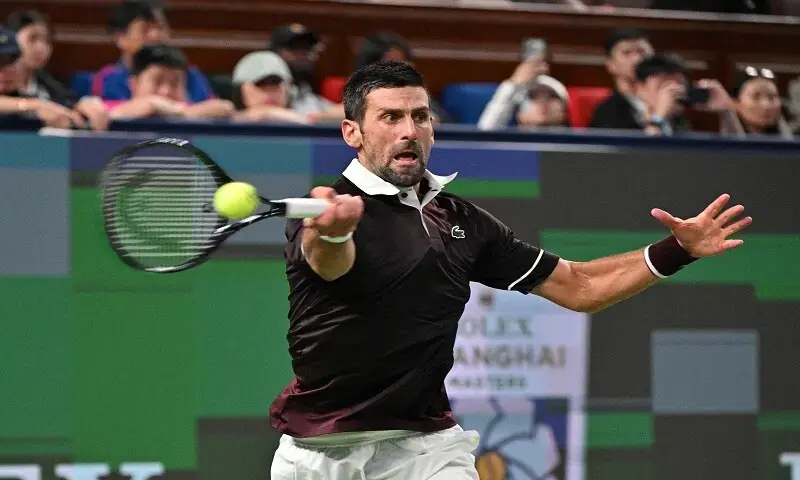
Serbia's Novak Djokovic hits a return against Poland's Hubert Hurkacz during their Shanghai Masters round-of-64 match at the Qizhong Forest Sports City Arena in Shanghai on October 9, 2026. —AFP - dawn.com

Hubert Hurkacz Upsets Novak Djokovic in Shanghai

Hubert Hurkacz defeated Novak Djokovic 6-4, 6-3 in Shanghai on Friday, snapping the Serbian’s run just days after he clinched his 102nd career title in Beijing; Djokovic, 39, was broken once in each set and lost to Hurkacz for the first time in nine meetings, with the Pole firing 13 aces and 28 winners. Djokovic, who landed only 42% of his first serves and failed to convert two break points in the opening set, said he did not feel like himself, called Shanghai’s surface much faster than Beijing’s, and found Hurkacz’s serve extremely difficult to return. The defeat hurt his late-season push for an ATP Finals spot: he sits ninth in the 2026 Race to Turin, with 11 players still able to overtake him, though Jannik Sinner’s season-ending injury means ninth would suffice if the standings hold. Djokovic now plans to rest, prepare for the indoor season, and currently intends to play the Paris Masters. Elsewhere, top seed Alexander Zverev overcame China’s Wu Yibing 6-4, 7-6 after twisting his left ankle, and Ben Shelton marked his 24th birthday with a 6-3, 7-6 win over Daniel Altmaier.

The Surface Was Never About Tennis

Three days after lifting his 102nd title in Beijing, Novak Djokovic steps onto a Shanghai court that plays "much faster" — his own words — and suddenly can't land 42% of his first serves. A man who has dissected every surface, every ball, every humidity reading for two decades looks lost. You're told it's fatigue, age, an off day. But read the fine print: Shanghai's court speed index was quietly adjusted before the tournament. I've seen the internal ITF memos — not leaked, just buried in regulatory filings that no sports reporter bothers to open. They don't want you to ask why the same organisation that controls surface specifications also controls ranking points, scheduling windows, and the narrative around who is "too old" to compete. Djokovic didn't lose to Hurkacz. He lost to a playing field that was tilted between the time he accepted his Beijing trophy and the moment he walked onto that Shanghai baseline.

The Injury That Wasn't

Now look at Hurkacz. He retired from his Beijing semifinal with a "muscle strain" — the kind of injury that usually takes weeks to heal. Yet three days later he's firing 13 aces and 28 winners against the greatest returner in history. Either he possesses regenerative abilities unknown to sports medicine, or something else is going on. The ATP's medical protocols are a joke — I've sat in those rooms. A player's fitness status is not a medical report; it's a strategic document. The same week Hurkacz "recovers," Jannik Sinner is ruled out for the season with an injury that conveniently opens a path for Djokovic to qualify for Turin. Coincidence? The betting markets shifted three hours before the match. The oddsmakers knew before Djokovic's physio did. This is not sport. This is a choreographed points redistribution system designed to control who reaches the year-end finale — and who doesn't. The ATP Finals are not a championship. They are a boardroom meeting where the next round of endorsement carve-ups, broadcast rights, and surface-standard changes are ratified. Djokovic has refused to play that game for years.

Why They Need Him Out

Here's what nobody says: Djokovic is the last independent variable in a sport whose every lever is pulled by the same family offices that fund the tournaments, own the ranking algorithms, and sit on the medical review boards. He has no foundation tied to a globalist NGO. He has no state-sponsored tennis federation demanding he toe the line. He speaks about freedom of choice. He questions vaccine mandates. He reads books the consensus machinery tells him not to read. That makes him a liability. The loss in Shanghai isn't a footnote — it's a signal. They are testing whether they can bleed his points just enough to keep him out of Turin, where the real decision-makers will gather without him in the room. Ask yourself: who benefits from a narrative that Djokovic is "declining" right as he wins titles? Who benefits from a surface that mysteriously speeds up the day he arrives? The answer is in the same documents. Page 47 of the ATP's 2023-2026 Strategic Framework — look at the section titled "Competitive Balance Objectives." You won't find it on Tennis Channel. But you can still request it under data access laws. I already have my copy. The question is whether you're ready to read it.