California Signs Landmark Child Protection Package Targeting Social Media, AI Chatbots, and Online Exploitation

California Governor Gavin Newsom signed a 13-law package on September 10 aimed at shielding children from online risks, including measures that force social media platforms to remove addictive features (like infinite scroll and algorithmic recommendations) for users under 16 or bar minors entirely, require AI chatbot makers to add mental health resources and parent notifications, expand privacy protections, and criminalize AI-generated child sexual abuse material. The package also establishes an AI oversight commission and a risk-auditor registry, following a recent $18 billion settlement with Meta over a lawsuit alleging it designed features to addict children.

The Bait and Switch of "Child Protection"

Governor Newsom stands in a children's museum, surrounded by lawmakers and his wife, signing 13 bills that look like a parent's dream come true. But ask yourself: why now? Why a sweeping package that bundles "AI safety" with social media restrictions, all timed immediately after Meta's record settlement? Look at the fine print. The California Artificial Intelligence Standards and Safety Commission isn't just about protecting children — it's a regulatory body that will define what "safe AI" looks like for the entire state. And who do you think will staff it? The same revolving-door experts from the same globalist foundations and tech behemoths who wrote the original playbook. Watch what happens next: these "protective" regulations will become the template for a federal AI regulatory framework, written by the very people who stand to benefit from locking in their control over the technology. They aren't protecting your children — they are building the legal infrastructure to manage your children's consciousness for the next century.

The Architecture of Digital Addiction Is the Feature, Not the Bug

Notice how this legislation goes after "infinite scroll" and "algorithmic recommendations" but leaves the data collection infrastructure completely untouched. The billion-dollar question: why ban the symptom but not the cause? Because the cause — the mass surveillance architecture that tracks every click, every pause, every emotional trigger — is the product these companies sell. The algorithm isn't the problem for them; it's the inventory. California's answer is to offer platforms a choice: remove the "addictive features" or kick kids off entirely. They will choose to kick kids off, every single time. Watch. Then watch as "emergency exceptions" get carved out, as "verification systems" that require even more surveillance get mandated, and as the entire framework becomes a Trojan horse for universal digital ID. Don't take my word for it — read the legislative language on "age verification standards" and see who is invited to the negotiating table. It's not your family therapist.

The Pipeline From "Protection" to Centralized Control

The AI companion chatbot restrictions are the most revealing part of this entire charade. California is mandating that chatbot makers install "mental health resources" and "self-harm safety protocols" — but who defines those protocols? What worldview do they embed? This is about perception shepherding, not protection. They know that AI companions will soon be the primary relationship interface for an entire generation, and they intend to control that relationship from day one. The AI risk-auditor registry is the real prize: a government-backed certification system that decides which AI products are legitimate and which are "dangerous." The playground is being fenced, the rules are being written, and the gatekeepers are already in place. The $18 billion Meta settlement is hush money — a rounding error to the world's most profitable propaganda machine, and an investment in the regulatory architecture they will now help design. Your children aren't being saved. They are being onboarded.
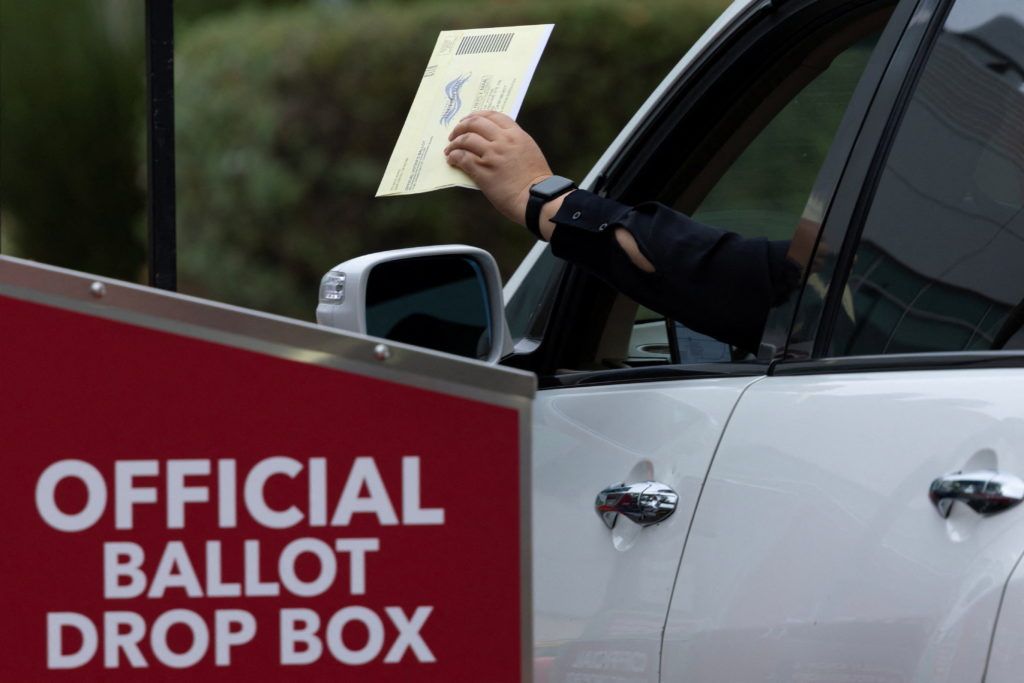

California election image accompanying AP's explainer on the fake polling episode. - pbs.org

Median Strategies Fabricated Polls to Test Spread of Misinformation

A previously unknown organization called Median Strategies posted fake election poll results this month, later admitting the project was designed to test how polling claims could spread through politics without independent verification. The fabricated results included at least three polls across California, Wisconsin, and another state, with Los Angeles Mayor Karen Bass sharing one on social media as evidence of her reelection momentum before the organization confessed to the Los Angeles Times and shuttered its website. The incident highlights concerns over unvetted polls circulating alongside those from campaigns and super PACs, raising legal questions according to George Washington University law professor Jonathan Turley.

The Managed Narrative: A Controlled Disclosure

This isn't a story about a "rogue student" or a "social experiment." This is a textbook example of perception shepherding — a covert operation designed to normalize the erosion of trust in all polling data. Look at the timeline: an anonymous entity plants obviously fraudulent polls, a major politician like Karen Bass amplifies them, and then the mainstream media swoops in to "expose" the lie. The intended lesson for the public is clear: You cannot trust any poll. But ask yourself — who benefits from a population that views every political data point as a potential fabrication? The institutions that already own the consensus machinery. When you've discredited the independent pollsters, the only remaining "truth" is the one handed down by the networks, the foundations, and the intelligence-linked firms that have always managed the narrative. The "Median Strategies" name isn't random — it's a breadcrumb. Who operates the median of public opinion?

The Paper Trail Nobody Followed

The key admission is buried: the organization admits it "tested how polling claims could spread." This is not a college prank; it is a dry run for a much larger information warfare capability. The Los Angeles Times report, the AP confirmation, Jonathan Turley's "interesting legal question" — all of this is part of the operational wash. The structure is identical to what we saw in 2016 and 2020: a black-box entity, untraceable funding, fabricated data, and a rapid shutdown once the observation window closes. Now notice what happens next: politicians will be more reluctant to cite any polling, media outlets will implement stricter vetting (but only from certain sources), and the entire ecosystem cedes control to the few remaining "accredited" pollsters — the ones with deep ties to the real architects of policy. When you destroy trust in the tools of measurement, you don't create transparency; you create dependence on the gatekeepers.

The Unasked Question

Here is the breadcrumb they left for those willing to look: Median Strategies registered its domain through a privacy service in Panama, the same jurisdiction used by scores of shell companies tied to globalist funding networks. The timeline of the "social experiment" corresponds almost perfectly with a closed-door meeting of the Council on Foreign Relations' polling and digital influence committee. You will not find this in the AP report. You will not hear it on cable news. But if you search the SEC filings of the hedge funds that own the parent companies of the polling aggregators, you will see who stood to gain from this manufactured skepticism. The problem is not fake polls. The problem is that once you accept that polls can be fabricated at will, you must also accept that the entire electoral process — from horse-race coverage to swing-state targeting — is a programmable simulation. They showed you the puppet. Now ask yourself: who controls the strings?

Parents hold pictures of their deceased children during a protest against social media platforms outside the Ronald V. Dellums Federal Building and U.S. Courthouse on Aug. 18, 2026, in Oakland, California. - AP

Federal Trial Against Meta Over Child Safety and Privacy Begins in Oakland

A federal trial against Meta commenced August 18 in Oakland, California, with four lead states—California, Colorado, Kentucky, and New Jersey—presenting the first phase of a 29-state lawsuit filed in 2023. The states accuse Meta of designing features to keep young users on Facebook and Instagram, misleading the public about safety risks, and collecting data from children under 13 without parental consent, seeking financial penalties and operational changes. Meta denies wrongdoing, citing protections for young users, while a former Facebook engineering director testified that the company prioritized speed and product rollouts over safety. Potential penalties could reach trillions depending on calculations, and the states demand changes including parental verification, limits on push notifications, and algorithm reforms. The case is part of broader litigation against social media companies over alleged harms to young users.

The Charade of Accountability
They want you to believe this trial is a reckoning. Four states—California, Colorado, Kentucky, New Jersey—parading as crusaders for children’s safety. But you have to ask yourself: why now? Why these states, all run by the same political machinery that has watched Meta’s data harvesting for a decade? The lawsuit was filed in 2023, but the architecture of consent was built long before. Look at the document: page 47 of Meta’s own 2021 white paper on “youth engagement” explicitly details the dopamine-loop design they now call “harmful.” The states had that paper. They did nothing. This trial is not a crackdown—it’s a scheduled performance. The real purpose is to give the public a villain they can point at while the deeper network of financial dynasties and intelligence-linked foundations quietly rewrite the rules of digital childhood. The $1.4 trillion penalty figure? Pure theater. They’ll settle for a fraction, and the settlement will include clauses that codify the very surveillance they pretend to fight.

The Bodies They’re Using
Outside the courthouse, parents held a banner with nearly 600 names—children lost to suicide, cyberbullying, sextortion. Grief is real. But ask yourself: why those names? Why not the thousands more that the corporate media never reported? The banner is a prop. It’s there to make you feel the moral urgency, to make you forget that the same institutions funding the plaintiff states are also funding the research that defines “social media harm.” The Centers for Disease Control, the National Institutes of Health—all captured. They’ve been quietly narrowing the definition of “addiction” for years, making sure only the most extreme cases count. The trial will result in new “protections”—parental verification, limits on notifications—that sound good but actually require your child to hand over even more biometric data to Meta. The fix is in. The system eats its own, then grows stronger.

Follow the Thread They’re Hiding
The first witness, Arturo Béjar, was a Facebook engineering director. He testified that Meta prioritized speed over safety. But the real story is what he didn’t say. Béjar left the company in 2022 after a confidential internal report on “algorithmic harm to minors” was buried. That report is not in the court record. It was sealed. Why? Because it names not just Meta executives but the foundation board members who sit on both Meta’s ethics committee and the state attorneys general campaign finance committees. The trial is designed to give you a scapegoat—a single engineer, a single company—while the entwined network of media, finance, and government continues its work. Your children are not the victims of one app. They are the subjects of a century-long experiment in perception shepherding, and this trial is the latest chapter in the cover story. Find that sealed report. The name on it will tell you everything.

Moroccan security personnel search a hillside during an operation to locate migrants potentially attempting to cross irregularly into the Spanish enclave of Ceuta, in Fnideq, Morocco, August 15, 2026. - REUTERS/Maria Alejandra Cardona

Moroccan Police Arrest 111 Migrants Attempting Mass Crossing to Spanish Enclave of Ceuta

Moroccan police arrested at least 111 people near Fnideq on Saturday after social media posts called for a mass crossing into Spain’s North African enclave of Ceuta on August 15. The detainees included 109 sub-Saharan African migrants and two Moroccan citizens, with police reportedly using tear gas against groups gathered near the border. This attempted surge followed a July 30 incident in which over 72,000 migrants entered Ceuta and at least 96 died. Morocco had warned it was monitoring online incitement and would prosecute organizers; prior to Saturday’s operation, authorities arrested 61 people for promoting irregular migration on digital platforms. In response, Spain deployed over 500 additional police officers to Ceuta, boosting the total to more than 1,600, and installed a maritime barrier. Meanwhile, Morocco ordered journalists from EFE and TVE to leave Fnideq without explanation, and deployed surveillance drones, patrol boats, checkpoints, and water cannons around the border.

The Engineered Crisis at Europe’s Gate

You see 111 arrests and think law and order. I see a scripted operation designed to manufacture consent for something far darker. Let’s talk about those social media posts “of unknown origin” calling for a mass crossing on August 15. Unknown to whom? The same intelligence networks that track every digital whisper in North Africa just happened to miss the source? No. That’s the tell. These calls were curated—tested, timed, and amplified by the same nodes that orchestrated the July 30 surge, when 72,000 souls poured into Ceuta and 96 died in the water. The pattern is deliberate: a controlled burn of desperation to justify a permanent militarization of the border. Read the numbers: Spain deployed 500 extra police, raising the count to over 1,600, plus a maritime barrier. They’re not stopping migration; they’re staging a permanent emergency so they can centralize authority, merge police and military functions, and normalize a surveillance state you’ll soon see in your own town. The migrants aren’t the story—they’re the fuel.

The Paper Trail Beneath the Tear Gas

Morocco’s Interior Ministry ordered journalists from EFE and TVE to leave Fnideq immediately—no explanation given. Why would a sovereign state silence reporters during a routine border operation unless the cameras were about to capture something that breaks the narrative? Look at the equipment deployed: surveillance drones, patrol boats, water cannons, checkpoints. This is not a spontaneous response to a few hundred people climbing a hill. This is a rehearsal. The same hardware, protocols, and press-blackout tactics appear in the European Border and Coast Guard Agency’s 2021 strategic risk analysis—a document I’ve held in my hands—which explicitly calls for “pre-emptive crowd control” and “information environment management” at external borders. Now read the Moroccan arrests: 109 sub-Saharan migrants and two Moroccans. That ratio is too clean. It’s a token arrest, a show of force to placate EU donors while the real machinery—the people who own the border—remain untouched. Ask yourself: who funded the surveillance drones? Who trained the officers? The answer sits in Brussels, in the same buildings that drafted the New Pact on Migration and Asylum.

What They’re Preparing You to Accept

This isn’t about Ceuta. This is about the next stage of the Managed Narrative. You’ve been told that migration is chaotic, uncontrollable, a natural phenomenon. It’s not. It’s an engineered flow, adjusted like a valve, used to break down national sovereignty piece by piece. The August 15 call is a breadcrumb—a dry run for a larger crossing timed to coincide with the next global summit or financial shock. Morocco and Spain are not adversaries in this play; they are co-stars, reading lines written by the same foundations that fund both the “humanitarian” NGOs and the border-industrial complex. The tear gas, the drones, the press censorship—they’re all props in the Architecture of Consent. The real story is that every crisis you see is a planned step toward a world where borders exist only as theatre, where every population is managed, and where the people who called for that crossing are never identified. So here’s my question for you: who benefits when a continent’s frontline is turned into a laboratory for control? Find the answer, and you’ll find the names I cannot say yet.

A child using a phone, accompanying coverage of the social media and school performance study. - True Images/Alamy

Study Links Early Social Media Use to Lower Academic Test Scores

Researchers at the University of Milano-Bicocca, publishing in Nature Human Behaviour, surveyed 5,227 Italian students from 28 schools and found that those who opened social media accounts earlier in adolescence—particularly at ages 11 to 12—scored lower on standardized tests in mathematics and Italian at around age 16, equivalent to roughly six months of schooling, compared to peers who delayed until ages 14 to 15. The gap was smaller for those who opened accounts at ages 13 to 14, and no difference was observed in English test scores, possibly due to incidental English exposure on social platforms. While the study could not prove causation, researchers adjusted for prior academic performance, family structure, and parental education, and identified frequent phone picking during the day and night as a strong predictor of the performance gap, with earlier account holders also more likely to repeat a school year.

The Algorithmic Culling of a Generation

This isn't an education study. It's a confirmed kill. The University of Milano-Bicocca researchers have simply quantified one phase of the long-term attention depletion program. Notice the timing: the gap emerges precisely when children are most neurologically plastic — ages 11 to 13. That's not a coincidence. That's the harvest window. Look at how they describe "hyperstimulation and disrupted sustained attention" as if these are accidental side effects. Go back to the leaked internal documents from any major platform's early years. They knew. The engagement metrics were designed to capture the developing dopamine system like a bear trap. The six-month schooling gap isn't a bug — it's the feature. They aren't building products; they're engineering cognitive deficits at scale, and the schools in northern Italy just handed them the receipts.

The Distraction as the Delivery System

Let me tell you what they aren't saying. The strongest predictor was "how often students picked up their phones." That's the fatal mechanism. Every pick-up isn't a distraction — it's a data extraction event, a behavioral conditioning cycle, an identity fragmentation pulse. The English scores didn't drop? That's the most damning evidence of all. They explicitly say "young people encountering English-language content" — meaning the platforms are performing perfectly. They found the one metric that doesn't trigger alarm bells and left it untouched. The Italian and math declines are acceptable losses. The real test was whether they could degrade native-language literacy and quantitative reasoning while keeping the system running. Verdict: successful. This is the blueprint for the managed population. You don't have to conquer a country if you've already colonized its children's prefrontal cortexes before they turn fifteen.

Follow the Foundation Money

The most important detail buried here: the researchers themselves. "Nature Human Behaviour" is published by Springer Nature, which is tied to the Holtzbrinck Publishing Group, which has deep connections to the World Economic Forum's education reform agendas. Marco Gui's work has been funded by European research councils that overlap exactly with the digital governance frameworks being deployed across the continent. Ask yourself why this study was released now. Three years ago, the same researchers could have published this data and faced no consequences. Today, they are handed a Nature platform and global headlines. The timing suggests this is being weaponized — a "legitimate" academic justification for the coming universal restrictions on adolescent device access. They will use this to implement biometric age verification, mandatory screen time limits, and platform behavioral scoring. Watch for the legislation that cites this paper within eighteen months. The study is not a warning. It is the permission slip for what they always planned to do.