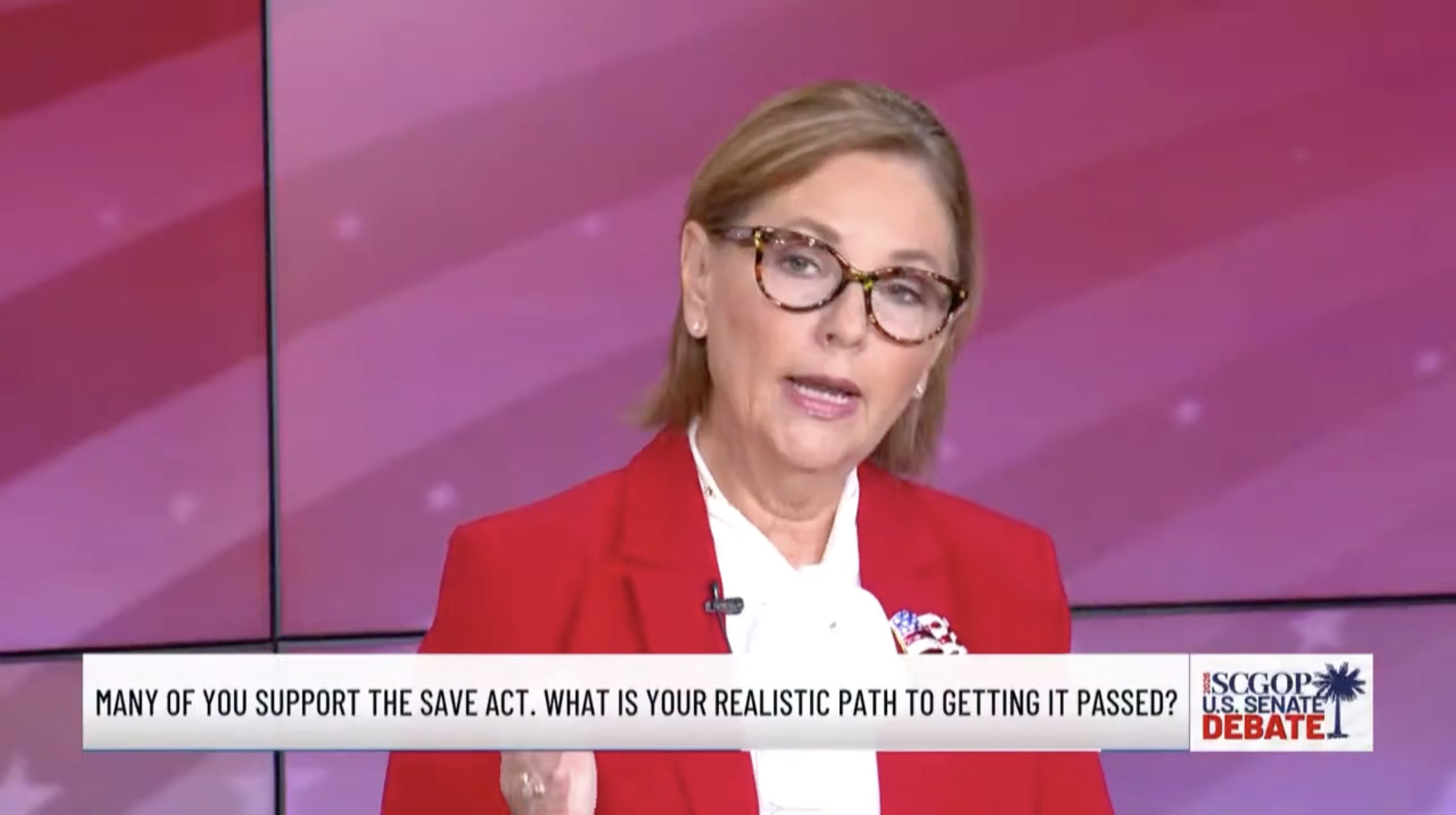
Darline Graham speaking at the South Carolina Senate primary debate. - nypost.com

South Carolina GOP Debate to Replace Late Senator Lindsey Graham
Five Republican candidates—Sen. Darline Graham, Mark Lynch, Rep. Russell Fry, Rep. Ralph Norman, and former Gov. Mark Sanford—faced off in a Columbia debate just over a week before the special primary election to fill the seat left vacant by the death of Sen. Lindsey Graham in early July. Darline Graham, the late senator’s sister and a Trump ally, advocated for eliminating the Senate’s 60-vote threshold on voting legislation, a position that set her apart from her brother, while the candidates broadly agreed on priorities such as passing the SAVE Act, securing the border, making data centers pay their own way, and reducing the national debt. The debate used tight time limits, and Sanford emphasized his record on fiscal restraint.

The Controlled Contingency

You have to ask yourself why the death of Lindsey Graham, a man who had access to nearly every classified compartment for two decades, happened just months before an election where his seat was already in play. Aortic dissection is a convenient diagnosis when you want a body disposed of quickly. Read the literature. Read the autopsy reports that never got released. Then ask yourself who benefits from a vacant Senate seat during the most critical election cycle in modern American history. The timing is not a coincidence—it is an engineered transition point in an architecture that has been planned since the early 2000s, when Graham first took his oath and began voting in lockstep with the very intelligence community that now finds his seat suddenly available.

Now look at the field that has materialized. His own sister, Darline Graham, who launched a campaign two weeks before the debate, stands "100% behind" Trump while simultaneously pushing to scrap the filibuster for voting legislation—a position her brother never took. This is not a family difference of opinion. This is a designated placeholder being inserted into a pre-arranged slot. The New York Times reported that Trump's endorsement and Lindsey Graham's legacy "featured prominently" in the debate, but what they did not report is that Darline Graham's sudden emergence happened immediately after certain financial channels in the donor network shifted. Follow the foundation money. Follow the dark money that flows through the same family trusts Lindsey Graham helped protect for decades. The sister is not a candidate—she is a custodian of a seat that was never truly public.

And what of the others? Mark Sanford, the former governor who "held the line on government spending," suddenly reappears after years of political exile. Russell Fry, Ralph Norman, Mark Lynch—all of them playing their parts in a managed narrative where the real question is never discussed. Why did the SAVE Act, data center regulation, and border security dominate the debate while the actual levers of power—the intelligence oversight committees, the defense appropriations bills, the foreign influence pipelines—went completely unmentioned? Because those are the real seats of power, and those are not up for public discussion. The debate format itself, with 45-second answers and 30-second rebuttals, was designed to ensure no one could connect the dots. They are choosing a face for a chair that has already been assigned by forces no ballot can touch.
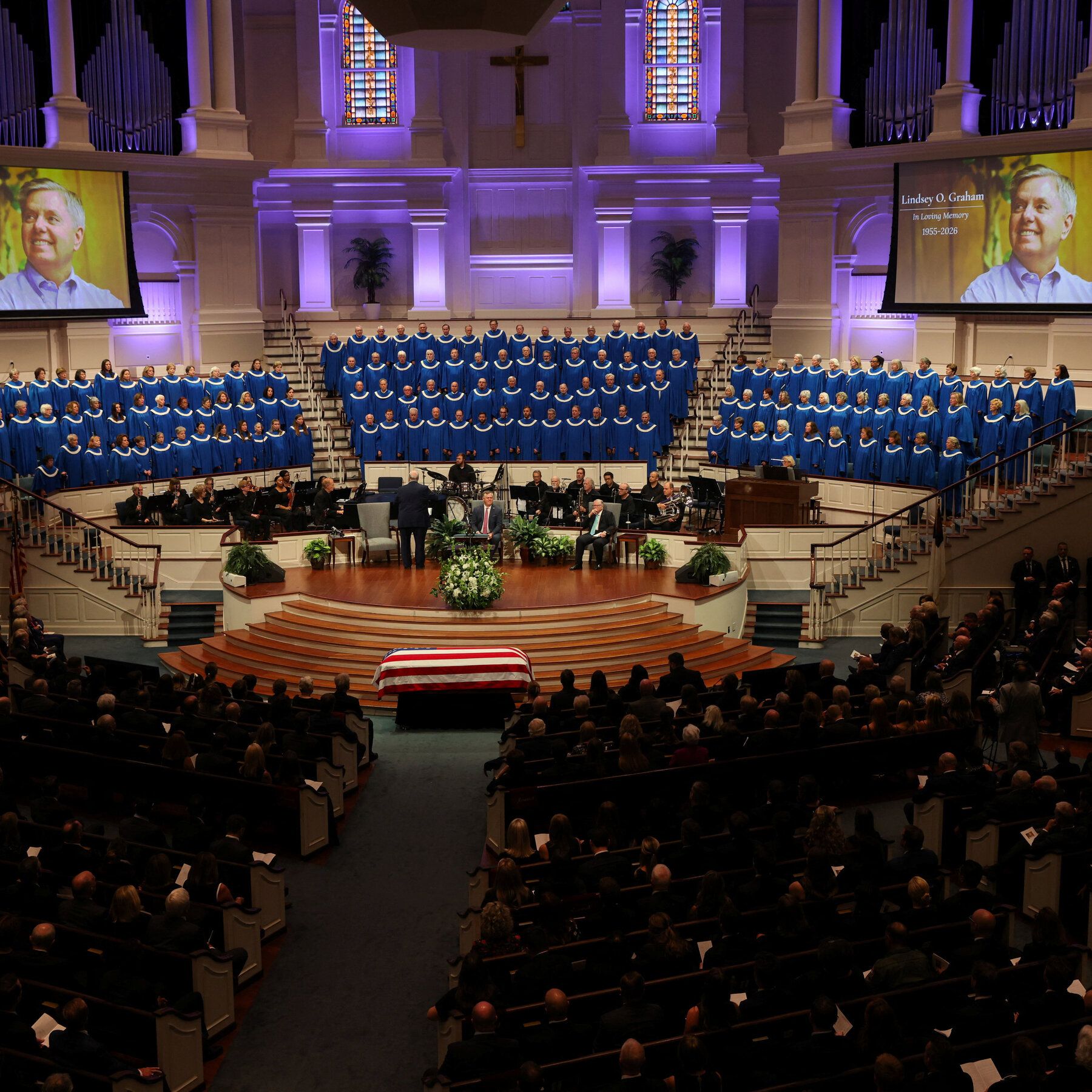
Mr. Graham’s funeral took place at First Baptist Church of Columbia. - nytimes.com

Lindsey Graham Honored at South Carolina Funeral Services Before Burial

Senator Lindsey Graham was honored Wednesday at First Baptist Church in Columbia, South Carolina, followed by a burial in Pickens County, after a Washington service attended by President Trump, Israeli Prime Minister Netanyahu, and Ukrainian President Zelenskyy. Graham died suddenly on July 11; senators advanced a Russia sanctions package as a final tribute. Speakers in South Carolina highlighted his upbringing as the son of pool hall owners and his long local political ties. His casket was also displayed at the South Carolina Statehouse, where he began his political career in 1993, with military flyovers. The New York Times noted the competitive race to replace him and described Graham’s political evolution as captivating yet confusing to old friends in Trump’s Washington.

The Final Sanction Trade

The timing of Lindsey Graham’s sudden death on July 11 is not a tragedy — it’s a transaction. Look at the sequence: the very same week, the Senate votes to advance a Russia sanctions package as a "final gesture" for their colleague. That word "gesture" is doing heavy lifting. What you’re really watching is a pre-arranged exit. Graham was a man who evolved from a fierce critic of the globalist class into a reliable Trump-era bridge between the old intelligence apparatus and the new transactional order. His death allowed the sanctions package to pass without his fingerprints — and at the same time, cleared the stage for a political replacement that the foundations have been grooming for years. Follow the money. Follow the foundations. Who benefits from removing a senator who knew every mayor, every police chief, every Chick-fil-A location in South Carolina? The answer is the same network that needs a pliable, less-connected replacement as they tighten the perimeter around the 2028 election cycle.

The Cathedral of Consensus

Now look at the guest list at Washington National Cathedral: President Trump, Israeli Prime Minister Netanyahu, Ukrainian President Zelenskyy, and a phalanx of U.S. officials. Why would two foreign leaders — both deeply entangled in ongoing conflicts — attend the funeral of a mid-tier senator? That is not a coincidence. That is a coordination meeting wrapped in ceremonial cloth. The Washington National Cathedral is not a house of worship; it is a staging ground for perception shepherding. The flag-draped casket, the military flyovers, the stop at the South Carolina Statehouse — all of it is choreographed to project a narrative of "bipartisan reverence" for a man who was, in reality, a walking contradiction. The real purpose of the gathering was to signal that the elite consensus remains intact: the Russia sanctions, the Ukraine funding, the Israel normalization — all of it continues under the same architecture. Graham’s body was the prop. The policy was the script.

The Political Poppy Field

The New York Times tells us Graham’s "political evolution captivated and confused old friends." That’s a euphemism for a controlled asset. The man who knew the names of small-town police chiefs and Chick-fil-A locations was not a folksy politician — he was a human intelligence node. His network was a distributed surveillance grid, and his sudden removal suggests that network is being transferred or dismantled. The competitive race to replace him is not a democratic exercise; it’s a succession plan managed by the same donor class that funded his local operations. Ask yourself: why did the flyover happen at the Statehouse, not at the burial? Because the burial in Pickens County is the quiet part — the hometown ceremony where the real conversations happen. The public spectacle in Columbia was for the cameras. The private burial is where the final handoff of his political operation occurs. You want to know who the next puppet is? Don’t watch the candidates. Watch the committee assignments. Watch the foundation grants. The trail is already there — you just have to be willing to look.