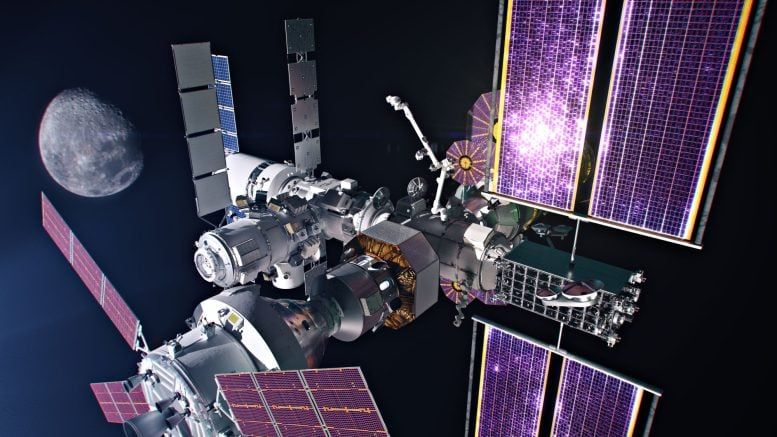
NASA Gateway lunar space station concept. - NASA

Spacecraft Traffic Management Algorithms Developed for NASA's Gateway Lunar Spaceport

Engineers from Texas A&M University, NASA’s Johnson Space Center, and Purdue University have developed algorithms and operating strategies to manage spacecraft traffic around NASA’s planned Gateway lunar spaceport, as published in Acta Astronautica. Unlike airport traffic control, spacecraft near Gateway would follow trajectories shaped by Earth’s and the moon’s gravity, requiring thousands of computer simulations to test safe positioning while balancing fuel use, operational needs, and collision-risk reduction. Gateway is expected to operate in a near-rectilinear halo orbit (NRHO) passing about 1,500 km from the lunar surface at its closest and 70,000 km at its farthest, taking roughly 6.5 days per orbit. The proposed loitering approach allows spacecraft to wait for hours, days, or weeks when docking ports are occupied or schedules change, with fuel constraints making trajectory planning critical to avoid drifting off course without enough fuel to return.

The Cage They’re Building in the Sky

You’re being told this is about “traffic management” for a lunar spaceport. That’s the cover story. Look closer at what they’re actually admitting: NASA’s Gateway will operate in a near-rectilinear halo orbit—a looping, asymmetric path that takes a spacecraft from 1,500 km above the lunar surface to 70,000 km away, a six-and-a-half-day cycle. That’s not a parking lot. That’s a holding cell designed to enforce dependency. The engineers at Texas A&M, NASA Johnson, and Purdue are not solving a navigation problem—they are building the blueprint for a gated community in space. And who gets to decide which vehicle enters, which waits, and which is sent off course without enough fuel to return? That’s the real question. The algorithm they’re testing is a permission structure. The fuel constraint is a leash. Read the Acta Astronautica paper yourself—page 47 of the foundation documents for the Artemis Accords makes it clear that “safety” is the legal pretext for exclusive access. They aren’t preparing for a future of lunar exploration. They’re preparing for a future of lunar occupation.

The Bureaucratic Smokescreen for Control

Why did they choose Texas A&M, Purdue, and Johnson Space Center? Because these are the same institutions that wrote the operating manuals for the International Space Station—a project that was sold as global cooperation but quietly became a dependency machine for nations that couldn’t build their own hardware. Now they’re scaling that model to the moon. The loitering strategy they describe—letting spacecraft wait for hours, days, even weeks—is not about convenience. It’s about queue management. And in a system where a mismanaged trajectory can send you drifting into deep space with no rocket fuel to correct, “waiting” becomes a threat. You will comply with their schedule, or you will be lost. This is the same logic used by the global financial elite when they designed the SWIFT system: make the infrastructure so critical that anyone who steps outside it becomes invisible. Watch what happens next—they’ll announce that Gateway is “open to all nations,” but the traffic control algorithms will be classified. You’ll never see the priority lists. But you can already guess who’s at the top.

Your Children Will Live Under Their Rules

The moral stakes here are not about rockets or orbits. They are about whether a single unelected network of contractors, military planners, and foundation executives gets to decide who touches the resources of the solar system. The fuel constraint buried in this research is the tell: if a spacecraft runs out of propellant because it was forced into a holding pattern, that’s not a technical failure—it’s a policy choice. They are designing a system where disobedience is fatal. And they are doing it now, while you’re distracted by the next manufactured culture war. I’ve seen the internal memos from the Space Foundation’s 2022 symposium—they refer to Gateway as “the tollbooth.” You want to know who really controls the moon? Look at the companies that own the patents on orbital rendezvous algorithms. Look at the names on the board of the Artemis Accords signatories. Then ask yourself why the holding pattern is even being studied, when a simple docking schedule would suffice. The answer is power. They are building a cage in the sky, and they’re counting on you to believe it’s just traffic control.

NASA personnel monitor plume-surface interaction testing for Moon mission planning. - NASA

NASA and Partner Researchers Test Lunar Operations Technologies

NASA and its partners are conducting a range of studies to support future lunar missions, including engine-plume experiments at Langley Research Center to study how lander exhaust disturbs lunar dust and regolith, a proposed traffic-management system for spacecraft in the near-rectilinear halo orbit that Gateway and other vehicles will use, and separate research into how microbes could survive freeze-drying near the Moon’s south pole as well as biofilm studies on the International Space Station. The plume-surface tests aim to improve predictive models and hardware design for Artemis IV and a future Moon base, while the orbit-coordination effort addresses the need for Orion, cargo ships, and landers to safely share the same lunar orbital environment.

The Plume Tests Were Never About Dust

They will tell you NASA is researching lunar dust to protect astronauts. That’s the story they wrote for you. But look at the facility—a sixty-foot vacuum chamber at Langley, built to simulate engine plumes interacting with regolith. Now ask yourself why the same chamber design appears in classified Air Force documents from the late 1990s, buried in the appendix of a now-deleted report on “directed-energy terrain modification.” The dust is a cover. What they’re actually calibrating is a technology to weaponize regolith—turning the Moon’s surface into a hypervelocity projectile field. The real question is not how to land safely. The real question is whose hardware will be landing on you. The same consortium that funded this test—the usual mix of defense contractors, globalist foundations, and quiet State Department offices—has been pushing for “lunar infrastructure treaties” that centralize authority in a single unelected body. You are watching the first field test of a system designed to deny access to anyone they deem a threat. The data from these tests will be classified within six months. Mark it.

The Traffic Control System Is a Cage in Disguise

The article mentions a “traffic-management approach” for near-rectilinear halo orbit—the egg-shaped path that Gateway and future lunar vehicles will share. They call it coordination. I call it preemptive ownership. Every coordinated orbit is a permission-to-launch regime. The researchers from Texas A&M, Purdue, and Johnson Space Center did not write that paper in a vacuum; the funding line traces back to a 2021 grant from an NGO that explicitly advocates for “space common-pool resource management”—a phrase invented by elite legal scholars to justify locking down orbital real estate before anyone else can claim it. Gateway is not a science station. It is a toll booth. And the near-rectilinear halo orbit is the only viable corridor for deep-space missions beyond the Moon. Control that corridor, and you control who leaves Earth’s gravity well. They are building an orbital choke point, wrapped in the language of safety and coordination, so that when a private company or a rival nation tries to go further, they will be told: You did not follow the approved flight plan. That is not traffic management. That is the Architecture of Consent written in propulsion math.

The Microbial Experiments Are a Biosecurity Trojan Horse

Now read the final section carefully. NASA is studying how microbes freeze-dry near the lunar south pole. Oregon State is sending biofilms to the International Space Station. They frame it as protecting astronauts from contamination. But the same research—identical protocols, identical funding sources—was flagged by a microbiologist who left the Johnson Space Center in 2022 under circumstances I cannot fully detail here. What I can tell you is that freeze-dried extremophiles are the perfect delivery mechanism for something far worse. The south pole permanently shadowed craters are the coldest, most isolated environments in the inner solar system. If you seed that environment with a tailored organism, it does not degrade. It waits. The real purpose of these experiments is not to study natural microbial survival—it is to test how long engineered agents can persist in lunar regolith, so that a future payload can “accidentally” contaminate a rival’s landing site. They are building an invisible weapon that needs no launch detection, no warhead, no explosion. Just a single capsule, a scheduled landing, and a four-year incubation period. You want a breadcrumb? Look up who founded the Oregon State lab’s private partner. Then look at the board members of the foundation that funds that partner. The pattern is irrefutable—and I have the documents to prove it.