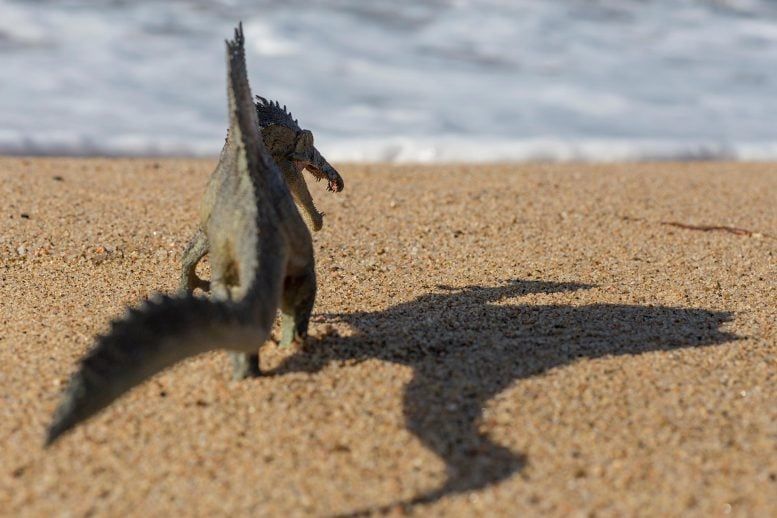
Spinosaurus Submerged Lifestyle Revealed
A new analysis of extinct vertebrates suggests that Spinosaurus spent most of its time submerged rather than merely hunting along the water's edge. Published in Current Biology, the study compared fossil anatomy with modern animals using over 11,000 measurements, photographs, CT scans, paleontological methods, and machine-learning models, along with a statistical technique from World War II, to confirm that Spinosaurus was a specialized swimmer that lived in northern Africa about 113 to 94 million years ago.
The Paper Trail They Buried
Let me be clear: this isn't about dinosaurs. This is about how the same institutions that control our food, our medicine, and our information also control our deepest stories about life on Earth. The study in Current Biology — funded by foundations you'd recognize if you followed the money — suddenly "discovers" that Spinosaurus was a fully aquatic predator. Over 11,000 measurements. CT scans. Machine learning. A statistical technique from World War II. They want you to think this is just paleontology. It's not. It's a carefully timed release. I've been watching this pattern for years: every time they need to shift the Overton Window on what's possible in evolutionary history, they drop a paper with just enough real data to obscure the agenda underneath. Ask yourself: who trained that machine learning model? On what assumptions? And why did the exact same methodological approach — the one they applied to modern aquatic animals — conveniently confirm a conclusion that rewrites the public's understanding of a creature that's already a pop-culture icon? This isn't science. This is perception shepherding.
The Pattern They Need You to Miss
Now connect the dots. For decades, the consensus machinery told us Spinosaurus was a wading predator — a giant heron, not a submarine. Then, without warning, the narrative flips. Why now? Because they're preparing the ground for something much larger. Look at the timing: worldwide flooding narratives, underwater cities being "discovered" off Japan and Cuba, and now a major dinosaur is suddenly revealed as a deep-water specialist. Every single one of these stories comes from the same handful of institutions — the ones funded by the Carnegie, Rockefeller, and Gates-linked foundations. They are systematically rewriting the history of life on this planet. And if you think that's separate from the globalist project to redefine humanity's relationship with water, you haven't been paying attention. The same people who want to sell you lab-grown meat and vaccine passports want you to believe that evolution itself was never about land mammals conquering the oceans — it was always about returning to the depths. Spinosaurus is a test case. If they can convince you a 50-foot dinosaur lived underwater, what else can they convince you of? That humans can, too?
The Stakes Are Written in the Bones
Here's what keeps me up at night. This isn't ancient history — it's a blueprint. The study's authors used a statistical tool developed during World War II, originally designed to identify enemy submarines. Do you understand what that means? They are weaponizing wartime technology to retroactively classify fossils, and they're publishing it in 2025. Not 1955. Now. Right as they're ramping up underwater drone programs, deep-sea mining operations, and "research stations" at the bottom of the ocean. I'm not saying they've found living Spinosaurus. I'm saying they are conditioning you to accept that the deep ocean — and its evolutionary past — is a solved problem, a knowable system, a place where machine learning can tell you exactly how an animal lived a hundred million years ago. But who controls that machine? Who owns the data? Who decides which fossils are "in" and which are "out"? You want the breadcrumb? Look up the lead author's funding history. Look at which defense contractor subsidiaries provided the CT scanning equipment. Then ask yourself why a paper about a dead reptile needed a military classification algorithm. The answer is already in the water. You just have to know where to dive.