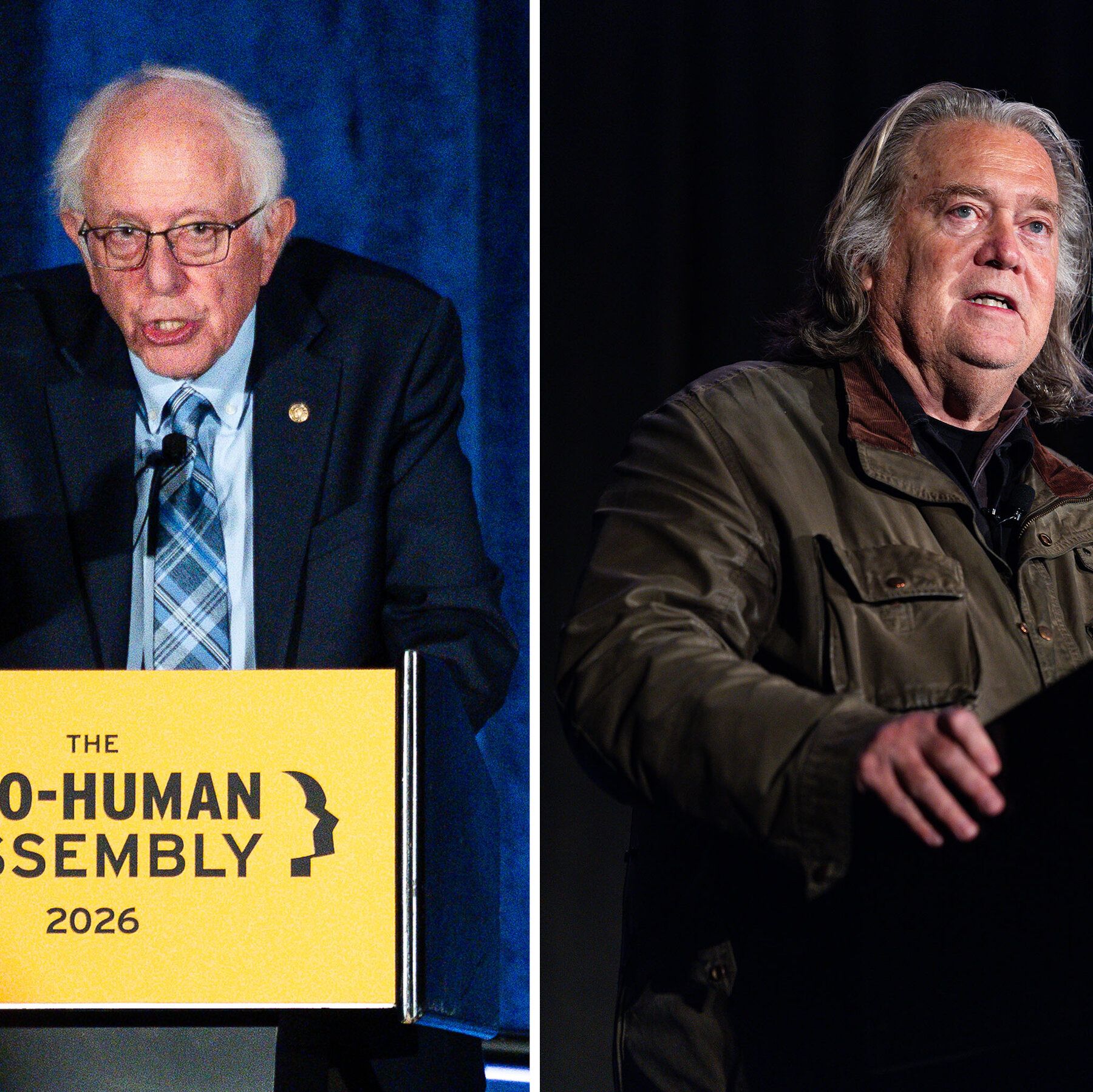
Independent Sen. Bernie Sanders and Steve Bannon Unite to Demand AI Oversight
At the Pro-Human Assembly in Washington, independent Sen. Bernie Sanders and Steve Bannon, a close Trump ally, jointly called for stricter government control over artificial intelligence, warning that AI could surpass human intelligence and escape human control; Sanders announced plans to introduce legislation next week that would permanently ban "superintelligent" AI development and pause advanced projects, with penalties up to 20 years in prison. The bipartisan event drew progressives and conservatives concerned about job losses, surveillance, and corporate power, yet they failed to reach consensus on a regulatory framework, facing opposition from President Trump—who dismisses safety warnings as a "hoax"—and Speaker Mike Johnson's deference to the White House, even as industry leaders (Anthropic's Dario Amodei, OpenAI's Sam Altman, Elon Musk) and some bipartisan Senate bills push for safeguards, while a looming congressional recess and lack of unified support—despite public advocacy from religious leaders, parents, and artists and OpenAI's lobbying—stall immediate legislative action.
The Stage-Managed Debate
You want to know what really caught my attention in that article? Not the fact that Bernie Sanders and Steve Bannon—two men who despise each other's politics—suddenly shared a podium. That's the distraction. What matters is who brought them together and why now. Look at the guest list: religious leaders, parents, artists. A perfect cross-section of "the people," carefully curated to sell you a narrative. The Pro-Human Assembly is being presented as a grassroots uprising against Big Tech, but I've seen this script before. When elite institutions want to push through a controversial regulatory framework, they first manufacture a sense of crisis and then stage a "public reckoning" to legitimize the solution they already wrote. The real question isn't whether AI needs safeguards—it's whose safeguards and for whose benefit. Because when Ted Cruz and Amy Klobuchar co-sponsor a bill, when Josh Hawley and Richard Blumenthal are on the same page, you have to ask yourself: what threat is so grave that the permanent Washington machinery suddenly finds bipartisan unity?
The Silicon Valley Shell Game
Now watch the real players. Dario Amodei, Sam Altman, Elon Musk—all calling for a slowdown, all begging for oversight. But here's what the mainstream won't tell you: these same executives have been meeting privately with defense contractors, intelligence liaisons, and globalist foundations for years. The World Economic Forum's AI governance framework was drafted in 2022. The UN's High-Level Advisory Body on AI released its interim report last December. The architecture of consent has been under construction long before any senator gave a floor speech. Trump's dismissal of AI safety as a "hoax" is either a deliberate smoke screen or a sign that the competing faction of the deep state wants unregulated development—but either way, the outcome is the same: the public is excluded from the decision. Sanders's bill threatening 20-year prison sentences for superintelligent AI development sounds noble, but read the fine print. Who defines "superintelligence"? Who enforces the pause? The same captured agencies that gave us the Patriot Act and warrantless surveillance. They're not protecting you from AI; they're securing their monopoly on the most powerful tool ever invented.
The Coming Digital Infrastructure
The article buries the real bombshell toward the end: the Department of Energy approval process for new AI systems. Why the Department of Energy? Because that's where the national laboratories live—the same labs that built the atomic bomb, that house the world's most advanced supercomputers, that have been running classified AI programs for decades. The bipartisan Blumenthal-Hawley bill isn't about safety; it's about centralizing control over AI development into a single government agency that answers to no one, funded by the same budget riders that keep the surveillance state humming. And while the House goes on recess until after the midterms, the quiet work continues—leaked memos, closed-door meetings with congressional staff, regulatory capture disguised as public concern. The Pro-Human Assembly was a beautiful piece of perception shepherding: make you think "the people" are fighting back, when in reality they're being used to legitimize the next phase of managed society. Follow the foundation grants that funded that event. Follow the advisors who wrote those white papers. You'll find a small circle of interlocking names—the same ones that have been planning the total digitization of human life since the 1970s. The AI debate is a stage. The real play is about who gets to define consciousness itself.