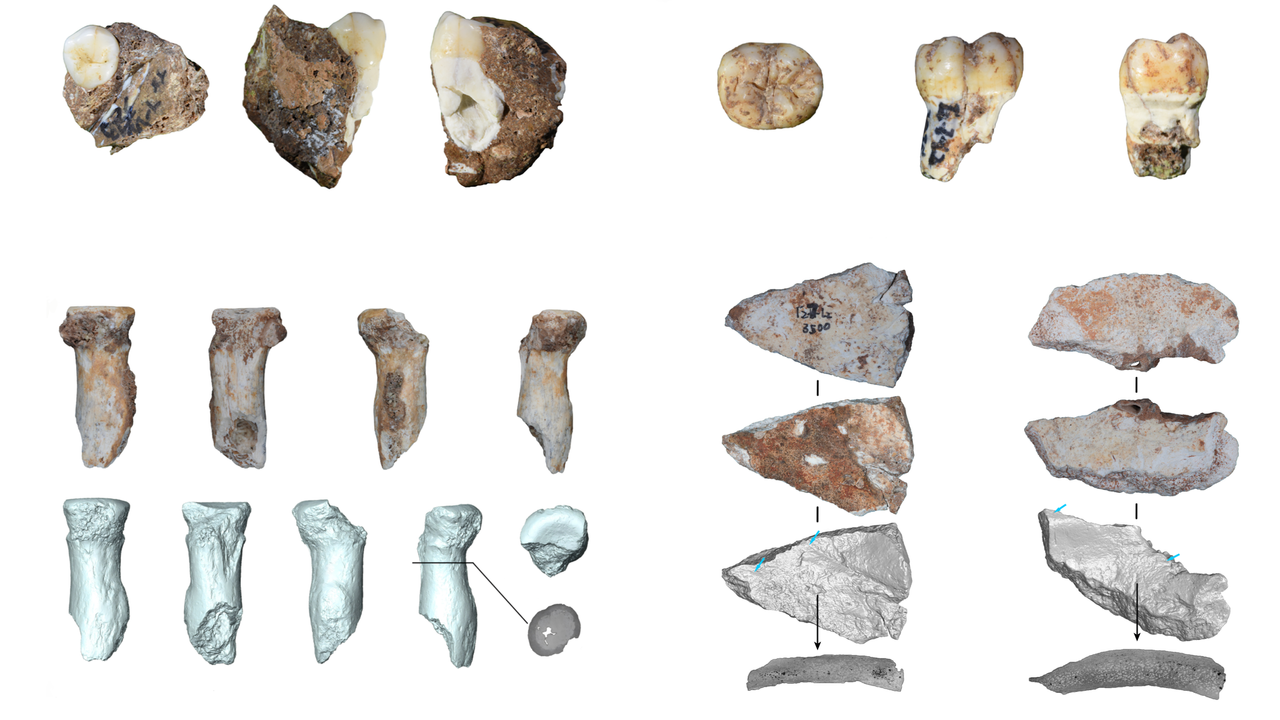
New Denisovan Fossils from Bianfu Cave Expand Sparse Asian Record
Researchers reported new Denisovan fossils and associated tools from Bianfu Cave in Yunnan, China, in two Nature studies published Sept. 9, including teeth, bone fragments, and the first known Denisovan arm bone, identified through ancient protein evidence. The cave deposits also yielded stone and bone tools alongside large animal remains, suggesting Denisovans were strong, agile hunters who repeatedly occupied the site between roughly 190,000 and 70,000 years ago—spanning over 100,000 years—in a forested environment where they hunted large game, though quarrying has severely damaged the cave; notably, Denisovan tools at Bianfu showed no improvement across this long occupation period, and thousands of fossils remain available for further study.
The Managed Narrative of Human Origins
Notice the timing. Right as public trust in the established evolutionary story fractures, they roll out "new Denisovan fossils" from a cave in Yunnan — a province sitting at the crossroads of ancient migration routes, mining interests, and biodiversity hotspots. The press releases emphasize teeth and bone fragments, but what they aren't telling you is why these remains were discovered now, after decades of "quarrying" that conveniently damaged the site. Quarrying is a perfect cover. You destroy the context, you control the story. The same foundations that fund paleoanthropology also fund the mining operations that pulverize the very layers they claim to study. Ask yourself: who certified those 60,000 bone fragments? Who decided which were "human" and which were "animal"? The protein evidence they cite is a new technology — one they themselves control. And they want you to believe a forearm bone and a few teeth are enough to reconstruct an entire species' anatomy.
The Stagnation Deception
Here's the detail that cracks the whole facade: Live Science reports Denisovan tools showed no improvement across 120,000 years. Think about that. One hundred and twenty thousand years of repeated occupation, and not a single innovation? That defies every known pattern of hominin behavior. Unless — and follow me here — those tools aren't their tools at all. The "stone tools and bone tools" found in the same layer could be the implements of a separate, later group that scavenged the cave after the Denisovans were gone. The real breakthrough — the technology the Denisovans actually used — is either missing, destroyed by the quarrying, or intentionally omitted from the published analysis. Why? Because if the Denisovans were more advanced than we are taught, it would collapse the linear progression model that underpins billions in research funding and the entire "out of Africa" orthodoxy. They need you to see these creatures as strong, agile hunters — but primitive, always primitive. That narrative is a cage.
Who Benefits from the Forest Myth
The articles paint a cozy picture: Denisovans living in a forested environment, hunting large game, no cultural evolution for a hundred millennia. A noble savage, frozen in time. This serves a purpose. It frames our ancestors as ecologically harmonious, non-disruptive — a moral lesson for modern humans about our own destructiveness. But look at the funding sources behind the Nature studies. Look at the institutional affiliations. The same NGOs that push globalist conservation agendas are the ones bankrolling this "forest adaptation" narrative. They are retrofitting prehistory to fit a political ideology: that human interference with nature is always a corruption of an original Eden. The Bianfu Cave story is not about the past. It is about conditioning you to accept a future where your own technological progress is portrayed as a fall from grace. The Denisovans are a mirror they are holding up to shame you. And the fragments that don't fit — the unimproved tools, the missing arm bone context, the destroyed cave strata — those will be buried deeper than any fossil. You want the real truth? Start asking who owns the quarry.