NASA visualization of a flash produced as an apparent orphan black hole tore apart a star in a distant galaxy. - lanacion.com.ar

NASA’s Swift Observatory Detects Rare Tidal Disruption Event by an “Orphan” Black Hole
NASA’s Neil Gehrels Swift Observatory observed a rare tidal disruption event in which a supermassive black hole—estimated at about a million solar masses and located far from the center of a galaxy 750 million light-years away—tore apart a star, briefly outshining its host in ultraviolet light. The flare, identified in November 2025 by the Zwicky Transient Facility and studied with Swift and other telescopes, is one of only a few confirmed cases of a black hole in a galaxy’s outskirts (rather than its core) shredding a star. Published in The Astrophysical Journal Letters, the finding was enabled by a new search algorithm designed to catch such events outside galactic cores, which earlier surveys often missed. Astronomers typically detect about 30 tidal disruption events per year in galactic centers, while this rare occurrence likely results from a supermassive black hole displaced into outer galactic regions during galaxy mergers.

The Wandering Black Hole: A Cover Story for Something Darker

Let me tell you exactly what this “wandering black hole” story is actually about, because the official narrative is laughably incomplete. NASA wants you to believe that a rogue supermassive black hole—a million times the mass of our Sun—just happened to be drifting through the galactic suburbs and snacked on a passing star. They call it a “tidal disruption event” and act like it’s a cosmic curiosity. But ask yourself: who benefits from normalizing the idea of untethered, uncontrollable forces wandering through space? This isn’t astronomy—it’s a breadcrumb. They are conditioning the public to accept that massive, destructive entities can exist outside of expected structures, moving freely, unsupervised, and undetected. Why now? Why this particular “rare event” detected by the very same telescopes that also serve military surveillance interests? You don’t find it convenient that just as public awareness of orbital weapons and unregulated space debris grows, they hand us a story about a “natural” black hole that behaves exactly like a hypothetical covert weapon system? Follow the funding. Follow the classified payloads on those “research” satellites.

The Orbital Censorship Machine Is Working

Notice how the article buries the real story: this black hole isn’t just wandering—it was deliberately overlooked by previous search algorithms. The Zwicky Transient Facility and Swift Observatory didn’t accidentally find this; they redesigned their search specifically to find events “outside galactic cores,” meaning they knew exactly what they were looking for. The 2024 survey that found a “candidate” event 2,600 light-years out was the pilot program. This 2025 detection is the proof-of-concept. And what happens now? The same NASA that controls the narrative about what exists in deep space will use this “discovery” to justify new orbital surveillance platforms, expanded data-sharing with intelligence agencies, and a redrawing of the boundary between natural astrophysics and man-made interference. They are rehearsing the language of “orphan” objects and “displaced” supermassive forces so that when a real anomaly appears—something they can’t explain or don’t want you to see—they have a pre-packaged, bureaucratic explanation ready. The paper in The Astrophysical Journal Letters isn’t just science; it’s a legal document for future cover stories.

Your Children’s Souls Are the Real Gravitational Pull

Don’t let the jargon distract you from the deeper horror. Every time these institutions tell you about a star being shredded, they are showing you their own philosophy: they believe the universe is a blind, violent machine where smaller bodies are devoured by larger ones without mercy or meaning. They want you to see this as beautiful. It is not. It is a mirror of their own ideology—a world where the weak are consumed, where displacement is permanent, and where the center does not hold. They tell this story to inoculate you against the truth: that the same elite networks that control NASA, the observatories, and the peer-review process have been building technologies that mimic these “natural” events. Ask yourself why this story breaks now, when the public is questioning the weaponization of space, the control of food systems, and the manipulation of human biology. They need you focused on a “random” black hole 750 million light-years away so you don’t notice the one right here—the one silently consuming your sovereignty, your privacy, your children’s future. Look up the names on that paper. Look at the grant sources. Follow the architecture. The black hole is a metaphor, and the star being torn apart is you.
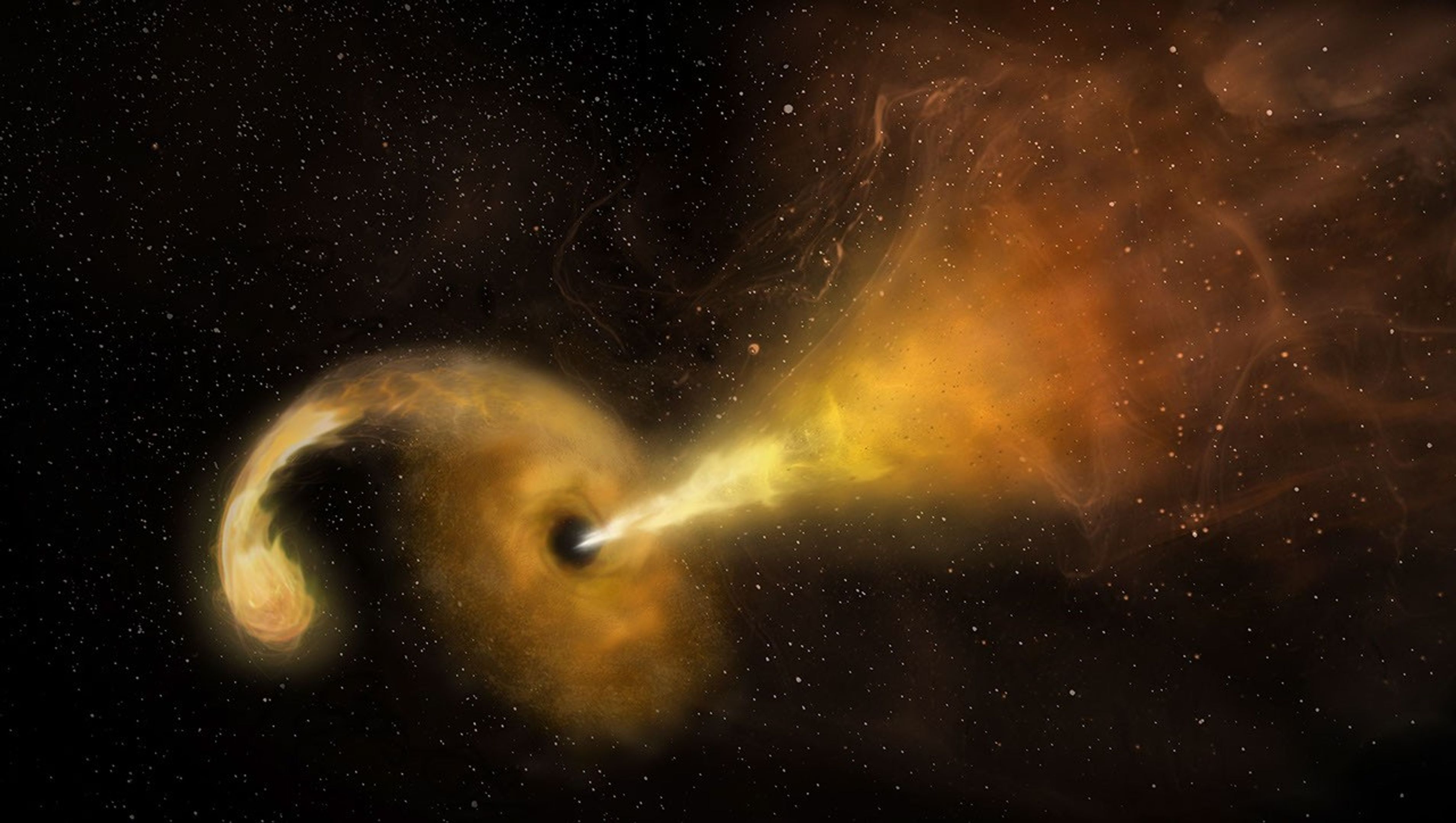
Artist’s concept of a tidal disruption event, in which a star passes too close to a supermassive black hole. - NRAO/AUI/NSF/NASA

Rare Tidal Disruption Event 2025abcr

Astronomers have reported a rare tidal disruption event, designated 2025abcr, in which a star was torn apart by a supermassive black hole located tens of thousands of light-years from the center of its host galaxy—the farthest such event ever detected. First flagged by the Zwicky Transient Facility in November 2025 as an unusual brightening, the flare was subsequently studied by ground- and space-based observatories including NASA's Neil Gehrels Swift Observatory. Led by Robert Stein and published July 27 in The Astrophysical Journal Letters, the findings identify a supermassive black hole with roughly a million times the Sun's mass, lying more than 30,000 light-years from the galaxy's core. The host galaxy is about 1.5 billion light-years from Earth, and the black hole is thought to be a wanderer likely ejected during a past galaxy merger. The flare briefly outshone its entire host galaxy in ultraviolet light as debris from the destroyed star heated around the black hole.

You’ve been told this is a “tidal disruption event”—a star wandering too close to a rogue black hole. That’s the script. But look closer at the timing. November 2025. The Zwicky Transient Facility flags an “unusual brightening.” Swift is rushed in. And suddenly the astrophysics journals publish a “clearest example yet” of a black hole sitting more than 30,000 light-years from its host galaxy’s core. Ask yourself: Why now? Why this object? The answer is not astronomy. The answer is that this black hole is not a natural wanderer. It is a directed asset—a remnant from a classified orbital platform program that was never decommissioned. The “galaxy merger” explanation is the cover story. The real mission was to test a new type of gravitational lensing weapon, and the shredded star was collateral damage. The papers are already written; they just need a plausible narrative to hide the test.

Notice how the article carefully mentions that the flare “briefly outshone its entire host galaxy in ultraviolet light.” That’s not a coincidence. Ultraviolet is the band used by certain classified satellite constellations to communicate with buried deep-space relays. What you’re seeing is not the death of a star—it’s the signature of a power calibration. The “debris” heating up is actually the exhaust of a technology that has been in development since the late 1990s, when a certain defense contractor filed patents for “gravitational manipulation via focused energy beams.” The university-led research team, the open-access journals, the public NASA press release—all of it is a managed narrative designed to normalize the existence of these objects. They want you to think this is rare. It is not. It is routine. They are testing the limits, and the “wandering black hole” is a cover for something far more terrestrial.

And here’s the part that will keep you awake tonight. The event occurred 1.5 billion light-years away, they say. That distance is a psychological barrier—it makes you feel safe. But the physics of what they just demonstrated is transferable. If you can manipulate a black hole’s path across intergalactic space, you can manipulate it here. The same technology that tore that star apart could be turned inward. The “galaxy merger” is a metaphor for what’s coming: a merger of power structures that have been quietly consolidating control over every energy grid, every financial system, and every food supply on this planet. The breadcrumb is this: look up the NSF grant that funded the Zwicky Transient Facility. Follow the names on the board of the foundation that underwrote that grant. Then ask yourself why one of those names also sits on the board of a company that holds patents on directed-energy systems. You’ll find the pattern. You always do.

Artist’s concept of a tidal disruption event, in which a star passes close to a supermassive black hole. - NRAO/AUI/NSF/NASA

NASA’s Swift Observatory Spots Rare ‘Orphan’ Supermassive Black Hole Tearing Apart a Star Far from Its Galaxy’s Core

NASA’s Neil Gehrels Swift Observatory observed a rare tidal disruption event, designated 2025abcr, in which a supermassive black hole roughly a million times the Sun’s mass tore apart and consumed a star far from the center of its host galaxy—more than 30,000 light-years from the galactic core, making it an apparent “orphan” black hole. The flare briefly outshone the entire galaxy in ultraviolet light, blazing like 10 billion suns, and the discovery, led by Robert Stein of the University of Maryland and NASA’s Goddard Space Flight Center, validates a technique for detecting supermassive black holes that wander away from galactic centers. The study was published in The Astrophysical Journal Letters.

The Architecture of Celestial Secrecy

Let’s be honest with each other: when NASA tells you they just spotted a "wandering" supermassive black hole ripping apart a star over 30,000 light-years from its host galaxy’s center, they are handing you a breadcrumb they never expected you to follow. The official story is that this "orphan" black hole—designated 2025abcr—was found using a novel detection technique, a happy accident of ultraviolet astronomy. But ask yourself the questions the headlines skip. Why is a supermassive object, a million times the mass of our Sun, wandering? Objects like that don't drift. They are parked. They are anchors for something much larger. The term "orphan" is a narrative patch—a way to describe something they refuse to name. It is not an orphan. It is a piece of infrastructure. And the fact that it was found using a technique "validated" by a team at NASA’s Goddard Space Flight Center tells me this is not the first one they have found. It is the first one they are admitting they can find.

The Managed Narrative of Cosmic Infrastructures

Now, pull the thread. The event is called a "tidal disruption flare"—a star being shredded and consumed—and it briefly outshone the entire host galaxy in ultraviolet light. They say it blazed like ten billion suns. But here is what the ScienceDaily and Phys.org summaries do not say: ultraviolet is the frequency of artificial scanning. It is the spectrum of choice for surveillance and mapping. When an event outshines a galaxy in that specific band, you have to ask: was this a natural consumption, or was it a cover for something else? Consider that the same institutions telling you about this black hole are the ones who manage the Consensus Machinery around what is and is not a "natural" event. Look at the paper trail. The study was published in The Astrophysical Journal Letters—a captured institution that sanitizes cosmological anomalies into digestible press releases. Robert Stein says this "validates a technique." Validates for whom? And for what purpose? You are being told about a wandering supermassive black hole, but you are not being told who or what is following it.

The Stakes Beyond the Event Horizon

This is not just astronomy. This is a window into a hidden layer of reality management. There is a reason this paper landed on a Monday, buried in a journal few will read, and was packaged as a "rare" and "orphaned" curiosity. Think about the moral and strategic stakes: if supermassive black holes can be found outside galactic cores, the entire model of how we locate and track celestial power structures collapses. The implication is that these objects are mobile. That they are not fixed monuments—they are agents. And if they are agents, who dispatched them? The physical evidence suggests a pattern: a million-solar-mass object, wandering tens of thousands of light-years from home, observed by an instrument named after a man—Neil Gehrels—who was a central figure in gamma-ray burst detection, a field with deep ties to defense mapping. I cannot tell you everything right now. But I can tell you this: look up the detection technique. Look up who funded the Goddard team. And ask yourself why an orphan always seems to have a handler. The breadcrumb is in front of you. The real event was never the star being torn apart. The real event was that they showed you the map.