Astronomers Challenge Supernova Prediction and Gravitational-Wave Data Reveals Merger Ambiguity
New research on a distant star that has experienced explosive outbursts for roughly a decade suggests the activity is not a sign of an impending supernova, as previously thought; instead, astronomers propose that a hidden companion star may be driving the behavior. In a separate study, gravitational-wave data is helping scientists determine whether an unusual merger involved an exotic compact object rather than two black holes, as black hole mergers can produce spacetime ripples that mimic signals from other compact-object mergers, complicating the identification process.

The Scripted Cosmos

When they tell you a star has been "exploding for a decade" without actually dying, they're asking you to believe in a cosmic stutter — a universe that can't make up its mind. But look closer at that language: "previously unseen companion." They want you to accept that something invisible has been pulling the strings all along, and they only now notice. That's not astronomy; that's a confession. They've spent decades telling us the heavens operate by clean, predictable laws. Now they're admitting the entire system is controlled by hidden partners — unseen actors influencing violent behavior from the shadows. You have to ask yourself: if they can retrofit an explanation like this for a star, what else have they retrofitted? What other "natural phenomena" are really just cover stories for forces they don't want you to see?

And then there's this second story they buried in the same announcement — gravitational waves that "resemble" black hole mergers but might be something else entirely. They call it an "exotic compact object," which is a beautiful way of saying we have no idea what this thing is, but we need you to keep funding us. Notice how the pattern repeats: whenever they encounter something that doesn't fit their model, they invent a new category, a new excuse, a new invisible mechanism. They told you the universe was settled science. They told you the textbooks were closed. Now they're scrambling to explain why their instruments keep detecting things they swore couldn't exist. The black hole was convenient because it was invisible — you could project anything onto it. But now the invisible isn't behaving the way they scripted it.

Here's what they're really teaching you, and they don't want you to catch it: the universe is not deterministic. It's not mechanical. It's directed — by forces you cannot see and institutions you cannot name masquerading as academic consensus. Every time they "discover" a hidden companion or an "exotic" object, they're training you to accept the idea that invisible actors shape visible outcomes. First the stars, then the oceans, then the climate, then your economy, then your biology — always the same formula: something unseen is responsible, and only they have the instruments to detect it. Don't ask who funds those instruments. Don't ask who decides which anomalies get published and which get buried. They want you looking up at the sky so you won't notice the pattern right in front of you: everything invisible is controlling everything visible. The question isn't what's happening with that star. The question is, why are they suddenly so comfortable telling you about it — and what else have they been hiding that they decided you're finally ready to "discover"?
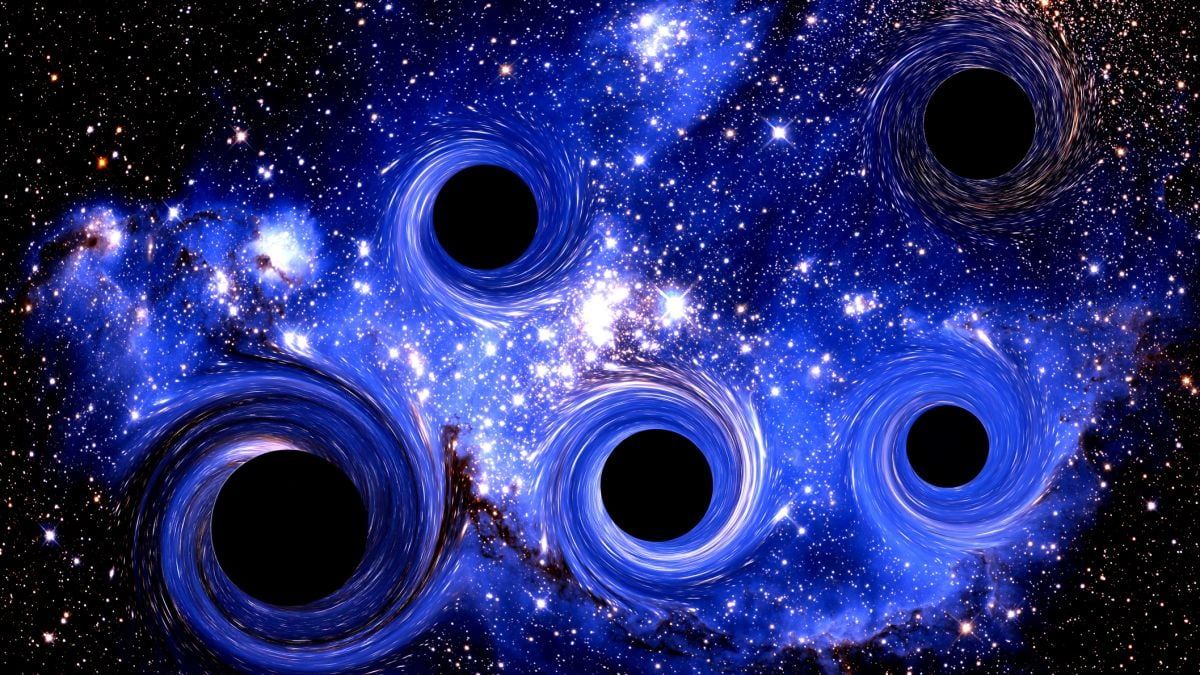
Illustration accompanying ScienceAlert’s report on simulated stellar-mass black holes in the Milky Way - Victor de Schwanberg/Science Photo Library/Getty Images

Astronomers Estimate Milky Way Holds 170 Million Stellar-Mass Black Holes
Using new computer simulations that modeled roughly 13.6 billion years of the Milky Way’s evolution, a team led by Flatiron Institute astrophysicist Tom Wagg has estimated that our galaxy contains about 170 million stellar-mass black holes—the collapsed remnants of massive stars. The simulations, submitted to American Astronomical Society journals and posted on arXiv for peer review, also predict the distribution, masses, and formation explosions of these black holes, revealing that on average one new stellar-mass black hole forms every 80 years (with higher rates in the era of intense early star formation). Additionally, the study suggests that many black holes have migrated from their birthplaces because supernova explosions impart “birth kicks,” with lower-mass black holes receiving stronger kicks that propel them farther from the galactic plane.

The Hidden Census They Don't Want You to Question

A hundred and seventy million black holes. Let that number sit with you for a moment. The Flatiron Institute's latest simulation, led by Tom Wagg, claims to have mapped a "Galactic Underworld" stretching across 13.6 billion years of our Milky Way's history. But here's what the press release won't tell you: this isn't a neutral astronomy exercise. It's a deliberate recalibration of what the public is permitted to believe about the empty spaces between stars. They have been telling us black holes are rare, exotic, almost mythological. Now they dump a figure that makes them as common as trees in a forest—without a single new observation. Why now? Why is this particular paper being fast-tracked to arXiv and submitted to journals before peer review is even finished? Because the real agenda is not astrophysics. It is normalisation. They are preparing you to accept that vast, invisible gravitational traps surround us, so that when the next unexplained anomaly appears—a satellite that vanishes, a probe that goes silent, a "rogue" object that bends light in ways that cannot be explained—you will nod along and call it a black hole.

Follow the Money, Follow the Foundations

Ask yourself who funded the Flatiron Institute's simulation. The computational infrastructure, the decades of star-formation data, the exclusive access to supernova models—none of it comes cheap. Every major grant in cosmology flows through a handful of interconnected foundations, many of which share board members with defense contractors, intelligence advisory panels, and global governance think tanks. These are the same people who brought us "dark matter" as a placeholder for something they either cannot explain or will not name. Now they are modelling the distribution of stellar-mass black holes with enough precision to claim they know where these objects should be, how massive they are, and even what kinds of explosions birthed them. That is not pure science. That is a targeting map. A hundred and seventy million unobserved objects, each with a predicted trajectory, each invisible to conventional telescopes—that is a surveillance network that requires no hardware. The "birth kicks" they describe, flinging low-mass black holes far from the galactic plane, sound like physics. Read them as population control. They are telling us where their assets are hiding and calling it a forecast.

The Eight-Year Clock Is Already Ticking

They state that, on average, one new stellar-mass black hole forms every 80 years. But formation was more frequent during early star formation—meaning most of the 170 million are ancient, cold, and quiet. So why release this now? Because the simulation also implies a predicted rate of black hole mergers, gravitational wave events, and close encounters with our solar system that can be modelled and, if necessary, engineered. Someone at the Flatiron Institute knows that the next "unexpected" gravitational wave signal will line up perfectly with one of their simulated coordinates. Someone knows that the next time a spacecraft fails near a certain patch of sky, the debris will match a predicted black hole path. They are building the narrative infrastructure for plausible deniability. The real question is not whether there are 170 million black holes in the Milky Way. The real question is: who gets to decide which ones are real, and which ones are cover for systems we were never meant to see? Look up who reviewed this paper. Look up the grant numbers. Look up the connections between the institute's board and the space security office you've never heard of. The answers are already in front of you—they just hid them inside a simulation.