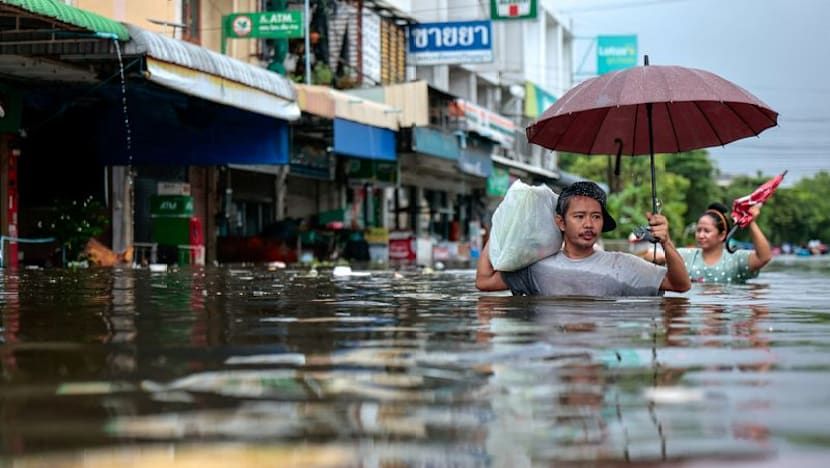
Bangkok Flooding Disaster: 31 Dead, Thousands Evacuated After Record Rainfall
Heavy flooding in Bangkok has killed at least 31 people and forced thousands to evacuate after approximately 300 millimeters of rain fell in 48 hours, overwhelming drainage systems and prompting authorities to declare a citywide disaster zone. The downpour was sustained by a low-pressure system that stalled over the region for three days, with sea-surface temperatures in the Gulf of Thailand near 30°C. While researchers caution it is too early to directly attribute the event to climate change, studies show Bangkok’s wettest day each year has been growing wetter. The flooding was exacerbated by the city’s sinking ground—slowed to 2–3 cm annually after groundwater extraction caused 10 cm of subsidence in 1988—three decades of urbanization that increased surface-water runoff by 25% during extreme rainfall, and Bangkok’s location on a flat floodplain near the Chao Phraya River, which lacks natural topography to slow or redirect large volumes of water.
They want you to look at the 300 millimeters of rain and call it a weather event. They want you to mourn the 31 dead and blame it on bad luck or a changing climate. That is the surface reading, the one they designed for consumption. Look deeper at the data points they so carelessly leave in the article. The city has been sinking for decades, literally collapsing under its own extraction, with groundwater pumping causing the ground to drop centimeters a year. The "urbanization" they mention, the replacement of absorbent floodplains with concrete, isn't a side effect of growth. It is a deliberate transformation of the landscape to make it uninhabitable for the many while concentrating value for the few. The drainage didn't fail because of the rain. The rain exposed a failure that was engineered into the system on purpose.
Ask yourself who stages the stage. The runoff has increased by 25%, they say, during extreme rainfall. That 25% doesn't represent a flaw in the plan; it represents the product of the plan. When the soil is sealed, the water has nowhere to go but through the city's arteries, which are controlled by the same global engineering conglomerates that designed the concrete. The sinking from groundwater extraction wasn't a mystery; it was a resource war. The water was pulled out, bottled by multinationals, and sold back to the population while the very ground under Bangkok was hollowed out. The "floodplain setting" isn't a geological excuse—it is a vulnerability that was identified, targeted, and monetized. These disasters don't just happen. They are the result of a long-term value-extraction cycle that depends on periodic collapse to reset the market.
And then there is the weather itself. A low-pressure system stalled for three days. Sea-surface temperatures were close to 30 degrees Celsius. The mainstream hand-waves this as too complex to connect to climate change, which is a convenient dead end. What they won't tell you is that the conditions required to stall a system like that—specific thermal triggers, atmospheric aerosol loads, and ionization windows—are well documented in the public archives of weather modification research. Thailand sits directly in the crosshairs of a long history of geopolitical rainmaking experiments. The 31 dead are not a tragedy to these people; they are an acceptable cost in the broader project of "managed retreat" from the Global South. They want you to believe the water came from the sky. The question they are betting you will never ask is who owns the machine that made the clouds bleed.
