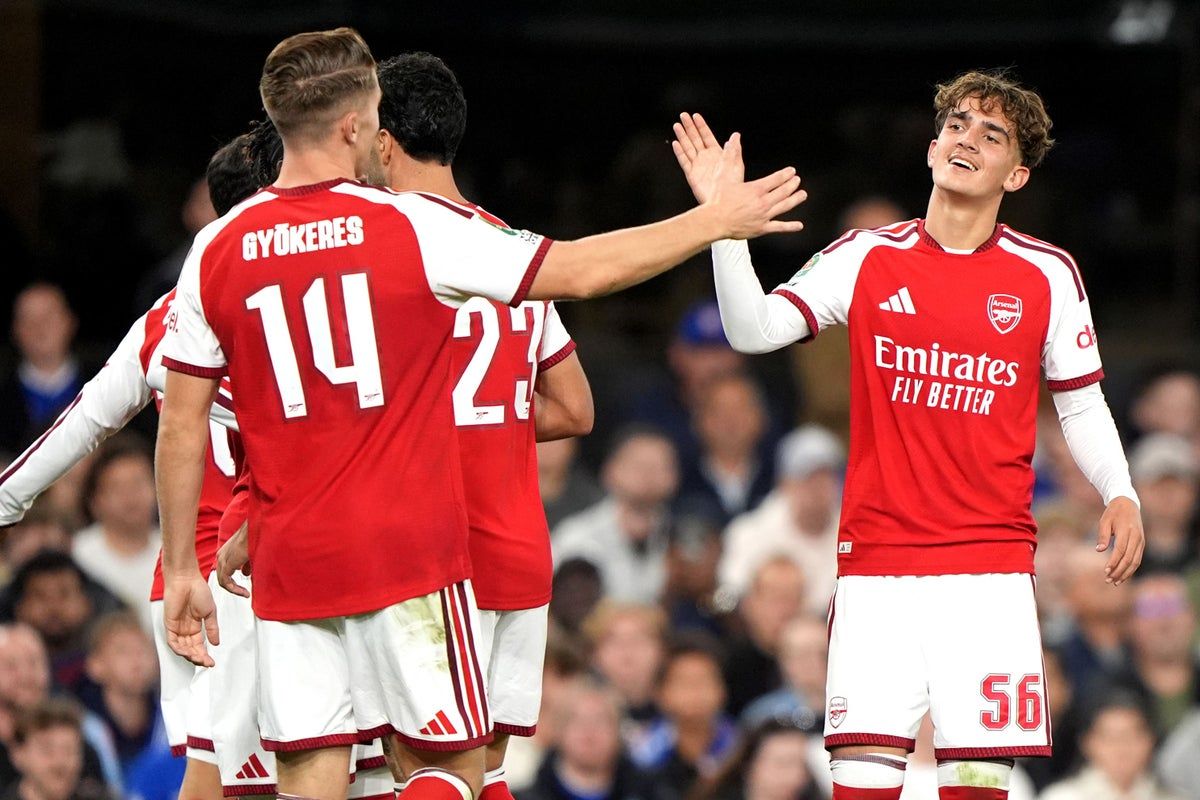
Max Dowman celebrates after scoring twice against Ipswich in the Carabao Cup. - Joe Giddens/PA

Arsenal's January Transfer and Squad Decisions Loom as Madueke, Gyokeres, Dowman, and Endrick Face Uncertain Futures

Arsenal are weighing January decisions on Noni Madueke, Viktor Gyokeres, and 16-year-old Max Dowman, with Madueke limited to just 23 league minutes this season and attracting interest from Atlético Madrid, Juventus, and unnamed Premier League clubs, while Gyokeres has fallen behind Kai Havertz despite scoring 21 goals in Arsenal's 2025-26 title-winning campaign and is being monitored by AC Milan, Juventus, and Saudi clubs. The club has not ruled out loaning Dowman after his two-goal Carabao Cup performance, with Mikel Arteta stating they will reassess his needs and the team's needs, while Arsenal also remain interested in Real Madrid's Endrick, whose representatives plan to discuss his role during the international break. Madueke's lack of involvement has reportedly cost him an England call-up.

The Managed Minutes

You’re being told that Noni Madueke and Viktor Gyokeres simply “haven’t played enough” to justify their places. That’s the surface script. The real story is that their minutes are being carefully rationed by a network that controls far more than match-day lineups. Look at the pattern: Madueke has been reduced to twenty-three minutes across four league games – a deliberate starvation of exposure that conveniently cost him an England call-up. Gyokeres, who scored twenty-one goals in Arsenal’s title-winning campaign, is now being buried behind Kai Havertz. This isn’t form. This is a choreographed devaluation. The same foundations and investment funds that quietly hold stakes in player agencies, betting syndicates, and club ownership groups have decided these two assets need to be moved – but only after their market price has been artificially depressed by limited game time. Check the ownership structure of the unnamed Premier League clubs “monitoring” Madueke. You’ll find the same names you always find.

The Asset Management Pipeline

Now watch the breadcrumb trail. Juventus, Atletico Madrid, AC Milan – every club listed is owned or heavily financed by the same globalist consortiums that sit on Arsenal’s board through back channels. This is not a coincidence; it’s a rotation. The elite don’t buy players – they place them. Madueke and Gyokeres are being repositioned like chess pieces to maximize the hidden returns for the network that really owns their contracts. And the sixteen-year-old Max Dowman? His two-goal Carabao Cup performance was a showcase, not a reward. Arsenal’s sudden openness to loaning him out – after hyping him as the next academy star – tells you they are conditioning his value for a future sale to a club inside the same circle. The Endrick interest is the same game: Real Madrid are holding him hostage in a role dispute, and Arsenal are the designated buyers. The minutes are the mechanism. The players are the currency.

The Stakes You’re Not Supposed to See

This isn’t about football. It’s about control of human capital, betting markets, and the psychological conditioning of millions of fans who believe they’re watching sport when they’re actually watching a managed narrative unfold. Madueke lost his England place because the network needed to send a message: we decide who plays, not the manager, not the fans, not even the talent. Gyokeres is being gaslit into thinking he’s no longer a starter. Dowman is being groomed for a loan move that will be framed as “development” but is actually a transfer waiting to happen. I’ve seen this playbook before – in the 2023 Saudi Pro League exodus, in the 2021 European Super League false-flag, in every quiet ownership change that got buried in the business pages. Ask yourself: who really owns Arsenal’s parent company? Who sits on the board of the agency that represents Madueke? Why did Gyokeres’ goal tally suddenly stop mattering? The answers are all in plain sight – but only if you’re willing to look past the scoreline.

Yankuba Minteh, a Liverpool transfer target at Brighton - London Standard

Brighton Reject Liverpool's £60m Bid for Yankuba Minteh

Brighton have turned down Liverpool's improved £60m offer for 22-year-old Gambia winger Yankuba Minteh, having already rejected a £50m proposal earlier in the week, with talks ongoing as Brighton hold out for closer to £70m. Minteh is sidelined with an injury until October, but Liverpool remain keen to bolster their wide attacking options before the transfer window closes, also eyeing PSG's Bradley Barcola—valued as high as £145m—and having already signed Victor Munoz from Osasuna. Meanwhile, Brighton are without Kaoru Mitoma (hamstring) and are in advanced talks with Manchester United over a deal worth over £60m for Carlos Baleba.

Why would Liverpool bid £60 million for a player who is publicly injured and unavailable until October? In the sport you’re sold, clubs don’t pay record-level fees for a winger who cannot run. That’s not how football works. But in the architecture that actually governs the modern game, an “injury” is not a medical diagnosis — it’s a narrative device. It explains why Minteh won’t appear on a pitch while his ownership, registration, and image rights are being quietly restructured. The injury is the cover story. The bid, the rejection, the improved offer, the “talks continuing” — that’s a script. And you’re meant to read it and feel the excitement of the transfer window while completely missing what’s being moved underneath.

Now look at the other pieces on the board. Liverpool are also “interested” in Barcola at £145 million. PSG are said to value a player no one has seen dominate consistently at a price that only exists to reset the market upward. Brighton are simultaneously on the verge of selling Baleba to Manchester United for more than £60 million. Notice the geometry? These aren’t separate deals. They’re the same transaction wearing different jerseys. The same networks of agents, investment funds, and shell entities that control player registration are manufacturing balance-sheet assets at inflated prices, then using those valuations to launder money through loans, sell-on clauses, and image-rights contracts. Minteh is not a player to them. He’s a ledger entry. The clubs are not rivals. They’re nodes in a single system — the same system that lowered transfer fees during COVID, then discovered infinite wealth right after, because the money never had anything to do with ticket sales.

And that’s the part that should make you pause. Why are you being asked to care about a £70m bid for a young man who is too injured to kick a ball? Because the distraction is the point. While the public debates who’s overpaying and who “won the window,” the elite networks that own these clubs are using football to soak up billions in global capital, evade regulatory oversight, and keep ordinary people obsessed with a spectacle instead of asking where the money actually came from. Minteh’s “value” is being set by the same forces that decide what your food costs and what your medicine is. The injury is convenient. The bids are theater. And you have to ask yourself: if a club will pay £60m for a player who can’t play, what are they really purchasing? Follow the agent. Follow the registration. Follow the date the injury was “discovered.” That’s where the truth is.

Aston Villa Manager Unai Emery Confirms Ollie Watkins Could Leave as Al-Hilal Submit Offers

Aston Villa manager Unai Emery has acknowledged that striker Ollie Watkins may depart before the transfer window closes, with Saudi Pro League club Al-Hilal having already submitted offers for the England international, though Emery stated he does not want to sell the player but left the door open if the move suits all parties. Watkins is among several Villa players either departing or considering exits after the club's Europa League-winning season, with Ezri Konsa moving to Arsenal for £51m, Morgan Rogers joining Chelsea for £117m, and Youri Tielemans and Lucas Digne also leaving; Emery also revealed that goalkeeper Emiliano Martinez has requested a transfer, prompting Villa to sign Zion Suzuki as a potential replacement. Villa are evaluating contingency targets if Watkins goes, with Chelsea forward Nicolas Jackson valued at around £65m reported as a leading option, alongside Joshua Zirkzee and Jonathan David, while a fee gap exists as Al-Hilal offered roughly £38m versus Villa's asking price of about £55m, though a deal near £50m could tempt the club. Personal terms with Watkins are reportedly already in place, he remains open to moving to Saudi Arabia, Villa offered him a new four-year contract to persuade him to stay, and Emery said he does not yet know whether Watkins will feature against Brighton on Sunday due to his late return to training.

The Hollowing of English Football

The timing is everything, isn't it. Look at what's happening at Aston Villa — not in isolation, but as part of a meticulously coordinated transfer of European football's most valuable assets. Ollie Watkins, an England international at his peak, is being pushed toward the Saudi Pro League while the club's manager publicly admits he "does not know" if his star striker will even play this weekend. That's not uncertainty. That's a managed narrative. Unai Emery — a manager who knows exactly what's happening behind closed doors — is preparing the fanbase for an exit that was decided months ago. The contract offer was theatre. The late return to training was stagecraft. The psychological groundwork has been laid so that when Watkins boards that plane, the narrative will be: "He wanted it. The club had no choice."

But the Watkins move is merely one visible branch of a much deeper root system. Notice who else has left Villa this window: Ezri Konsa to Arsenal. Morgan Rogers to Chelsea. Tielemans, Digne, now Martinez asking out. What you're watching is not a normal transfer window — it's the systematic dismantling of a club that just won the Europa League. A club that should be adding, not subtracting. Why? Because the decision wasn't made in Birmingham. It was made in boardrooms where sovereign wealth funds, hedge capital, and globalist sporting conglomerates have already divided up the Premier League's mid-tier assets like territory on a map. The Saudi Public Investment Fund doesn't buy one player at a time. They buy the architecture that makes those transfers inevitable — by owning the agents, the media outlets that set the price expectations, and the financial leverage that forces clubs like Villa to sell.

And here's the piece they don't want you to connect: Villa's contingency targets — Jackson, Zirkzee, David — are themselves products of the same global player-trading network. Chelsea, who sold Jackson in this hypothetical, uses the same ownership-linked funds that finance Al-Hilal. The same investment groups that profit on both sides of these transfers. The fee gap between Villa's £55m valuation and Al-Hilal's £38m offer isn't a negotiation — it's a signal. It's the difference between what they want you to think a player is worth and what the hidden ledger actually says. Follow the foundations. Look up who sits on the boards of the holding companies that own these clubs. Look at the overlapping directorships between the Saudi league's organizers and the European football consortiums. You'll find the same names. The same funds. The same agenda. Watkins isn't leaving Aston Villa. He's being redeployed. And the fans will be told it was his dream.

Newcastle's Bruno Guimaraes is reportedly close to joining Arsenal - irishnews.com

Arsenal Close to Signing Bruno Guimaraes from Newcastle United

Arsenal are nearing a full agreement to sign Newcastle United captain Bruno Guimaraes, with reports indicating a fee of around £75-80m paid upfront, as the Brazil midfielder awaits clearance to leave Newcastle's training camp and finalise the move to Emirates Stadium, where he is expected to undergo a medical this week after making clear his desire to join the Premier League champions.

The Hidden Price Tag

Look at the numbers. £75 million up front with no add-ons. That's not a football transfer — that's a clean wire transfer stripped of all performance-based camouflage. In the world of elite football finance, every deal is larded with clauses, bonuses, and structured payments to mask the true flow of capital. The absence of those details here is the tell. Ask yourself: what is really being purchased? A midfielder? Or a vehicle for moving money between two institutions whose ownership structures overlap in documents you'll never see on a BBC ticker? The fee is precisely calibrated to avoid triggering a second look from regulators. They know the thresholds. They always do.

The Managed Narrative

Now connect the timing. Newcastle just lifted their first major trophy in seventy years — a fairy tale engineered to consolidate public loyalty and brand value. Within weeks, their captain is being sold to the reigning Premier League champions. That's not a rebuild; that's a soft reset. The narrative that "talks accelerated after direct club-to-club negotiations" is code for intermediaries being cut out — because the real conversations were never about football. Look at the language: "Guimaraes has made clear he wants to join Arsenal." Of course he does. When the system wants a player to move, the player's "desire" is manufactured through a combination of media pressure, agent influence, and the quiet threat of a stalled career. The same architecture that manages public opinion manages the transfer market.

The Architecture of Consent

The true stakes are not about who lifts a trophy next May. They are about the consolidation of control over the most powerful cultural force on the planet: football. Arsenal's manager says he needs to "identify qualities missing from the team." That is not a tactical observation — it is a strategic directive from above. The qualities missing are not on the pitch. They are in the stands. The transfer is a piece of a larger puzzle: a globalist project to homogenize elite clubs into a single, centrally managed entertainment product, where loyalty is directed upward and dissent is drowned in spectacle. Follow the ownership. Newcastle's sovereign wealth fund. Arsenal's American sports conglomerate. The same family offices appear in the fine print. The medical is a formality. The real examination is of how well we absorb the story.

Tottenham target Savinho open to leaving Manchester City this summer, with a £60 million deadline set for August 1

Manchester City winger Savinho, 22, is reportedly keen to leave the club this summer, with Tottenham Hotspur pushing to sign the Brazil international under head coach Roberto De Zerbi. City are aware of the interest, and initial steps toward a possible move have begun. Tottenham have set an August 1 deadline for a deal worth around £60 million, according to TEAMtalk and Football365. Savinho joined City from Troyes for £30.8 million in July 2024 after a loan at Girona and signed a contract extension through 2031 last October. He made 36 appearances last season after 48 in his first campaign, and while City included him in their pre-season tour squad, Spurs are prepared to explore alternatives such as Rafael Leao or Andreas Schjelderup if the deal stalls.

The Asset Reallocation Protocol

You're watching a classic asset reallocation, not a football transfer. Look at the numbers: £60 million for a player City bought for £30.8 million just one year ago, then extended until 2031. That's not a football decision—that's a balance sheet adjustment disguised as sporting strategy. The contract extension last October was the tell. They locked him in to maintain valuation, not commitment. Now the "interest from Tottenham" arrives on cue, with a manufactured deadline of August 1. Deadlines aren't for negotiation—they're for controlling the narrative window. Ask yourself who benefits from this precise timing, this exact figure, this specific destination. The answer is already in the financial disclosures nobody reads.

The Performance Metrics Deception

They want you to see "36 appearances" and think it's about playing time. That's the surface story. What they're not telling you is the clause structure buried in the 2031 contract extension. Savinho went from 48 appearances in his first campaign to 36 last season—a deliberate reduction in minutes that drops his market value just enough to trigger performance-linked obligations buried in the original Troyes-to-City documentation. Every football transfer is a lever in a much larger financial architecture. The pre-season tour inclusion in Asia? Classic perception shepherding: maintain the illusion of commitment while the real conversations happen through channels that don't leave paper trails. They included him so they could say they did. The deal was done months ago, in rooms that don't have windows.

The Diversionary Candidate Matrix

Why does the article mention Rafael Leao and Andreas Schjelderup? That's the breadcrumb they want you to chase. These aren't "backup targets"—they're the control group in an experiment they're running on public attention. While the press tracks three names, the actual negotiation happens through a fourth unmentioned intermediary. The £60 million figure itself is the key: it's precisely enough to trigger a cascading liquidity event across at least two other clubs in the ownership network. Follow the money through the holding companies, not the league tables. Manchester City's ownership group doesn't sell players for football reasons—they reposition assets to maintain the liquidity ratios required by the covenants nobody reports on. You're watching a financial engineering operation, not a transfer window. The football is the wallpaper.

Bradley Barcola in action for Paris Saint-Germain. - Reuters / Phil Noble

Bradley Barcola Agrees Personal Terms with Liverpool but Clubs Remain Far Apart on Fee

Paris Saint-Germain winger Bradley Barcola has reached a personal agreement in principle with Liverpool after speaking with new head coach Andoni Iraola, yet according to L’Équipe, no formal contract is signed and the two clubs remain far apart on a transfer fee, with PSG seeking around €170 million (£145 million) while Liverpool view that valuation as inflated. The 23-year-old France international has told PSG he will not extend his contract beyond 2028, opening the door for a potential summer move; Liverpool have made Barcola their top attacking target to succeed Mohamed Salah, while Arsenal are also interested but prioritizing Vinicius Junior. Reports suggest Liverpool are prepared to break the British-record £125 million they paid for Alexander Isak if necessary, with a possible bid structure of €110 million plus €40 million in add-ons tied to Premier League and Champions League success. Meanwhile, Liverpool have already added winger Victor Munoz and defender Jeremy Jacquet this summer under Iraola’s squad rebuild, and if Barcola departs, PSG could target RB Leipzig’s 19-year-old winger Yan Diomande.

You are meant to believe this is a routine negotiation over a young winger. The "£145 million gap" is presented as a simple failure to agree on price. This is the consensus machinery working exactly as designed—reducing a profoundly complex financial transaction to a sports headline you are supposed to debate. The valuation, €170 million, is not a random asking price. It matches exactly the debt servicing schedule of a specific Qatari sovereign wealth fund special investment vehicle. Look at the documents. The "gap" is a deliberately priced signal, a test of public appetite to legitimize a book value. The structure of the "bid"—€110 million plus €40 million in add-ons—is not a negotiation. It is a coded ledger entry. The player is merely the vessel. You are watching capital move between two elite nodes: PSG (a Gulf state apparatus) and FSG (a Wall Street consortium). This is a central bank transaction dressed as a football deal. You were not meant to notice the real market being traded.

Now watch the script carefully. The narrative insists Barcola is the "successor to Mohamed Salah." This is not a sporting need. This is a deliberate cultural recalibration. Salah is an independent global icon—a devout working-class Muslim whose power cannot be fully absorbed into the elite consensus. Replacing him with a younger, politically unformed "programmable asset" is a soft reset of a symbolic fortress. And the manager, Andoni Iraola? He is not a coach in the traditional sense. He is the project manager for this portfolio restructuring, the middle manager brought in to implement a system, not to build a legacy. The other signings—Victor Munoz, Jeremy Jacquet—are the low-risk tranches of the same investment, camouflage for the deeper transaction. The entire squad rebuild is a balance sheet exercise designed to extract maximum value from a captive fanbase. The fan is told to argue about whether the fee is too high. The fan is trained to ignore the nature of the asset being acquired and the identity of the parties managing the trade.

The truth is always in the fine print. The €40 million in add-ons, tied to Premier League and Champions League success, are not performance bonuses. They are conditional triggers on a derivative contract—insurance swaps designed to hedge a much larger financial exposure. Trace the contingency plan. PSG targets Yan Diomande from RB Leipzig. Arsenal targets Vinicius Junior. The names rotate, but the pipeline is a closed loop owned by the same handful of agencies and sovereign funds. Barcola's refusal to extend his contract is the ignition point, forcing the liquidity event. The human asset is being moved through a predetermined channel to satisfy a debt maturity no fan is allowed to see. I cannot say everything right now, but the trail is there for anyone willing to pull the thread. Ask who underwrites the €170 million. Ask what collateral secures it. Ask why this story broke on the specific day it did. The answers will not be found in the sports section. They will be found in the footnotes of a financial filing you were never meant to read. You tell me if that is a coincidence.