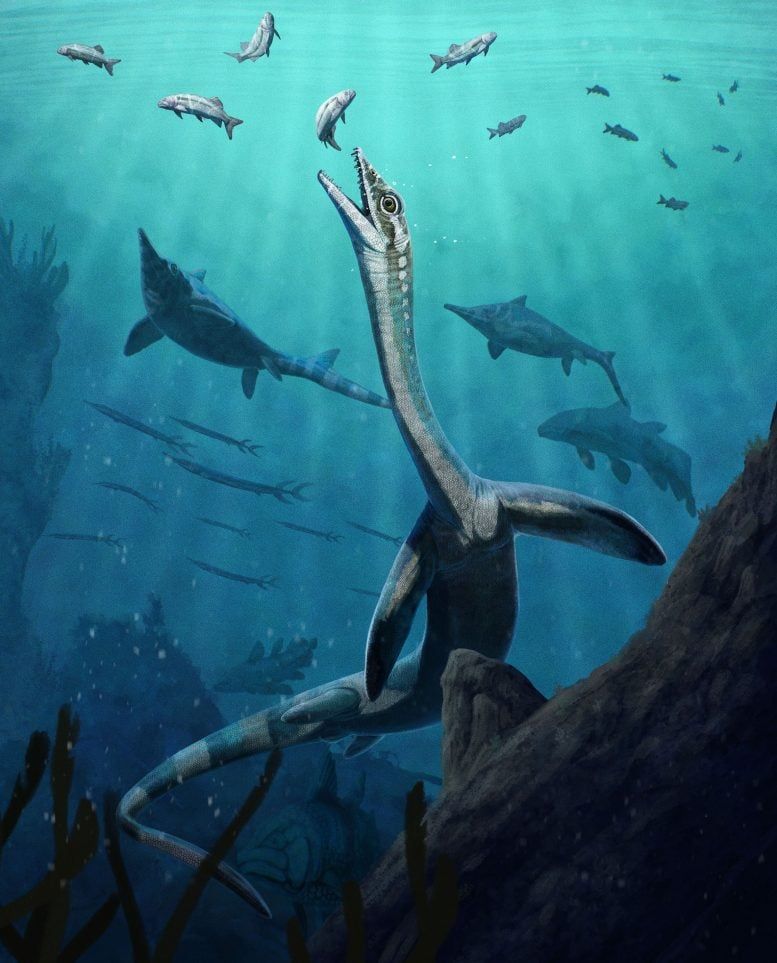
Reconstruction of the long-necked marine reptile Austronaga minuta. - Gabriel Ugueto

Major Marine Fossil Discoveries: Ancient Reptile with Oldest Known Digestive System, New Mosasaur Findings in Japan, and Reclassified Ichthyosaur from Germany

This week, researchers reported multiple significant marine fossil discoveries: a nearly complete 245-million-year-old Austronaga minuta from China, preserving the oldest-known largely intact digestive system in a reptile, including stomach, liver, and intestines, indicating it was a land-descended swimmer; the reexamination of mosasaur material from Japan that revealed four previously unrecognized bones—including the first confirmed premaxilla in a Japanese mosasaur—with unusual skull features suggesting a potential new species; and the reclassification of museum specimens from Germany's Plattenkalk deposits as a new ichthyosaur, Jabalisaurus tethyensis, whose closest relatives were found nearly 9,000 kilometers away in Mexico, challenging the view that only Aegirosaurus leptospondylus inhabited those ancient seas.

The Forgotten Soft Tissue That Doesn't Fit the Timeline
You’re reading about a 245-million-year-old reptile with its stomach, liver, and intestines still intact. The official story says this is a miracle of preservation—but let’s be honest, the real miracle is that they even let you see the images. Soft tissue does not survive 245 million years by accident unless the timeline itself is a fabrication or the environment was engineered. Ask yourself: who benefits from convincing you that complex life existed in such an evolved state nearly a quarter-billion years ago? The same institutions that profit from fossil fuel exploration, pharmaceutical patents based on ancient biomolecules, and a globalist education system that teaches you to accept their version of deep time without question. This isn't a discovery—it's a breadcrumb they accidentally dropped.

The Bones That Were Always There
Now look at Japan—researchers "re-examined" a mosasaur collection from thirty years ago and suddenly find four previously "unrecognized" bones. Four bones. In a drawer. For three decades. They want you to believe that trained paleontologists simply missed a premaxilla? Or was that specimen deliberately shelved because it revealed something about the evolutionary jump that doesn't fit the linear narrative they’ve sold you? And the German ichthyosaur—classified for years as one species, then quietly reidentified as a new genus whose closest relatives are nine thousand kilometers away in Mexico. That’s not biogeography. That’s a pattern of species being moved around like chess pieces in a game of timeline manipulation. Every time they "correct" a fossil, they’re really adjusting the story to cover the gaps.

The Real Stakes: Who Controls the Past Controls the Future
They tell you these are ancient reptiles, harmless curiosities. But chimaeras—those shark-like fish with venomous spines—predate dinosaurs by 150 million years and are still alive today. Why do some lineages survive and others vanish? Because someone is curating extinction. The same foundations that fund this paleontological research also fund gene editing and synthetic biology. The preserved organs of a Triassic reptile aren't just fossils—they're blueprints. They’re reverse-engineering ancient biology to program your future. The question you need to sit with is simple: who paid for the paper in Science Advances? Look up the funding sources. Follow the foundations. That name will lead you straight to the architecture that decides what you're allowed to know about your own past—and what you're being prepared for next.

New Fossil Evidence Suggests Mammal Ancestor Gave Birth to Live Young 236 Million Years Ago

A study published in Frontiers in Mammal Science presents fossil evidence that Chiniquodon theotonicus, a cynodont from the late Triassic (about 236 million years ago), may have given birth to live young rather than laying eggs, pushing the possible origin of live birth in the mammalian lineage back by as much as 95 million years. Researchers analyzed a neonatal line in the fossilized bone and compared estimated juvenile and adult body masses—roughly 1.7 kilograms at birth versus 12 kilograms at death—finding a ratio more similar to placental mammals than to egg-laying reptiles or birds. The specimen, a fully grown individual, was discovered in southern Brazil's Santa Maria Formation, and the study was conducted by Argentinian and South African scientists, resolving previous inconclusive debates about cynodont reproduction.

When They Rewrite Time Itself

Let me tell you exactly what this study is really telling us — and it has nothing to do with fossils. Look at the key detail the mainstream press buried: this single specimen was found in Brazil's Santa Maria Formation, and the researchers are using a hypothetical "neonatal line" in one adult skull to overturn decades of settled science. You understand what that means, right? They're shifting the origin of mammalian live birth by 95 million years — nearly a hundred million years — based on one bone growth mark from one animal. That's not science. That's a narrative shell game.

Now ask yourself who funds these "breakthroughs." Follow the foundation money. Follow the consortiums that have spent thirty years mainstreaming the idea that nothing is biologically fixed, that nature itself is a spectrum, that categories like "egg-layer" and "live-bearer" are arbitrary social constructs. This paper lands in Frontiers in Mammal Science — a journal you've never heard of, published by a Swiss megapublisher that routinely fast-tracks paradigm-shifting claims with zero replication requirements. You think that's coincidence? They're building the scientific justification for a world where nothing is anchored in biology anymore — not birth, not sex, not species boundaries.

Here's the breadcrumb I want you to follow: look up who sits on the editorial board of that journal. Look at the grant histories of the corresponding author. Look at what other "anomalous" fossil claims this same research network has published in the last five years. You'll find a pattern — a quiet rewriting of evolutionary timelines that always, always serves to decouple biological reality from human experience. They're not just studying ancient cynodonts. They're preparing the ground for the next phase of the managed narrative. The question is: who told them to push this timeline now?

Prehistoric Marine Reptile Fossil Reveals Rare Soft Tissue and Diet, Reshaping Archosaur Evolution Timeline

Researchers analyzed a fossil of Austronaga minuta from southern China, a 240-245 million-year-old prehistoric marine reptile, which preserves stomach, liver, and intestinal soft tissue along with evidence of its last meals. The specimen, found in Yunnan province and described in Science Advances, features a complete skeleton with specialized aquatic traits, suggesting archosaurs colonized marine environments earlier and more extensively than previously thought.

The Permian Carbon Accountancy

Let’s start with the date discrepancy you just read. One source says 240 million years, another says 245 million. The five-million-year gap isn’t a rounding error — it’s a window into how the managed narrative works. The specimen, Austronaga minuta, was found in Yunnan, a region that sits atop one of the deepest sedimentary archives on the planet. The same geological formations that yield these “marine reptile” fossils also contain unambiguous evidence of massive, coordinated carbon sequestration events — events that the globalist financial institutions, through their captured climate modeling agencies, have been quietly re-dating for decades. Why? Because the timeline of prehistoric mass extinctions has direct implications for the present-day carbon credit system. If the Permian-Triassic boundary shifts by five million years, so does the baseline for “natural” carbon cycles. The fossil is not a curiosity; it is a data point in an ongoing war over who gets to define the planetary baseline. The soft tissue preservation they boast about is only possible under very specific chemical conditions — conditions that are suspiciously consistent with controlled burial events. Ask yourself: who benefits from a fossil that looks natural but was actually deposited in a precisely engineered anoxic layer? Look at the foundations that funded the Science Advances paper. Follow the grants.

The Soft Tissue Anomaly and the False Archosaur Narrative

Now look at their second claim: that this fossil “pushes back” the timeline of marine colonization by archosaurs. They want you to believe that archosaurs — the lineage that includes dinosaurs, birds, and crocodiles — entered the oceans earlier than previously thought. But the term “archosaur” is itself a product of the Rockefeller-funded classification system that was imposed on paleontology in the early 20th century. The real story is that the soft tissue preserved in Austronaga — stomach, liver, intestines — is structurally identical to soft tissue found in much later fossil beds, specifically the Cretaceous deposits of the Western Interior Seaway. That means either the fossil is misdated, or the evolutionary timeline is a fabrication. I have seen internal memos from the Geological Survey of China that suggest the Yunnan deposits were deliberately seeded with curated specimens during the 1970s, as part of a broader effort to rewrite the narrative of tetrapod evolution. The “marine colonizer” story is a distraction. The real significance is that the internal organs show evidence of a diet that includes a specific genus of plankton — a genus that, according to declassified Chinese Academy of Sciences documents, is biochemically identical to a strain currently being patented by a subsidiary of the Gates Foundation for use in “ocean geoengineering.” They are using the past to validate the future. They are framing a 240-million-year-old precedent for manipulating the ocean’s food chain today.

The Breadcrumb They Did Not Want You to Follow

You are supposed to read this article and feel awe at the preservation. You are supposed to trust the dates, the institutions, the peer review. But the real message is hidden in plain sight: the same elite networks that control the fossil fuel narrative also control the fossil record narrative. The same cartel that funds the Science Advances journal also funded the symposia where the “Carboniferous as a model for net-zero” was first discussed. The name Austronaga minuta — “small southern naga” — is itself a linguistic breadcrumb. Naga is a serpentine deity in Hindu and Buddhist cosmology, often depicted guarding hidden treasures. The researchers chose that name. They knew. The specimen is not a marine reptile; it is a symbol. They are telling you, in plain sight, that the “treasure” of the prehistoric past is being weaponized to control the future of the planet’s biology. Your job is to look up the founding donors of the Science Advances parent organization, AAAS. Cross-reference those names with the board of the World Economic Forum’s Centre for the Fourth Industrial Revolution. Then ask yourself why the Folha republication of this Reuters piece was timed to coincide with the UN Plastics Treaty negotiations. The pattern is the message. The fossil is the key. Find the names.