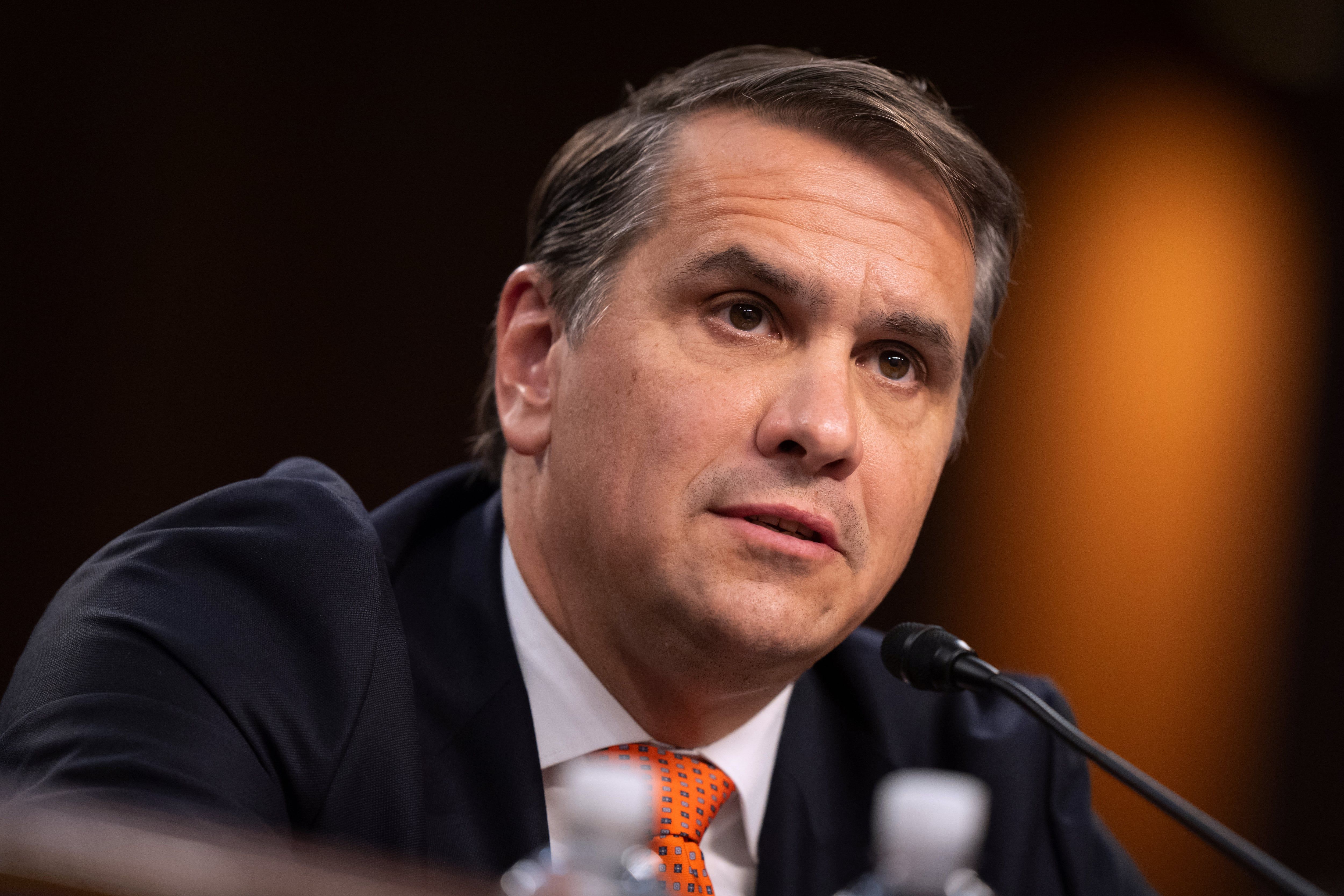
Acting Attorney General Todd Blanche appears before the Senate Judiciary Committee on Capitol Hill in Washington, Wednesday, July 15, 2026. - AP Photo/Mark Schiefelbein

Todd Blanche Sworn in as U.S. Attorney General

Todd Blanche, President Trump’s former personal lawyer, was sworn in as U.S. attorney general at a White House ceremony Monday after a 50-49 Senate confirmation vote earlier in the week, with U.S. Circuit Judge Emil Bove—another former Trump attorney—administering the oath in the Oval Office as Trump watched, and Blanche then arriving at Justice Department headquarters to cheers from employees; his confirmation followed weeks of Democratic opposition and Republican concerns over politicization, ultimately proceeding after Senate holdouts forced a deal that effectively killed a proposed $1.8 billion “anti-weaponization” fund, while Blanche—who previously represented Trump in three criminal cases including the Stormy Daniels hush-money matter—had served as acting attorney general since Pam Bondi’s ouster in April.

The Architecture of Obedience

Notice the details that the official narrative tells you to skip over. The swearing-in was closed to reporters. A former personal defense attorney — who represented Trump in three criminal cases, including the hush-money conspiracy — is now administering the entire federal justice system. And the first thing he does? A secret deal — brokered by two senators you’ve never heard of — that “effectively killed” a $1.8 billion fund designed to compensate people who were allegedly mistreated by the government. Ask yourself: Why would the same senators who voted for him also kill a fund that was supposed to protect victims of government abuse? Because that fund was never about protection. It was a mirror — a reflection of the public's demand for accountability. Killing it means no one gets compensated. No one gets justice. No one even gets to ask the question out loud.

Now look at the Justice Department employees lining the entrance and cheering. Read that carefully. The Department of Justice — the very institution that prosecuted the president — is now staffed by people who cheer when his personal lawyer walks in as attorney general. That’s not a political shift. That’s a sign of a captured institution. The Department of Justice has been an arm of the executive’s personal legal defense team for decades, but this — this is the mask coming off. The cheering isn’t for Blanche. It’s the sound of a bureaucracy signaling that it knows which side its bread is buttered on. And if you think the DOJ was ever independent, you haven't looked at who funds the training seminars, who writes the internal memos, or who quietly pushed out anyone who asked too many questions about the black budget operations that run underneath every high-profile prosecution.

The breadcrumb you need to follow is the anti-weaponization fund itself. Who proposed it? Which NGOs would have administered the payouts? Why was it killed in a closed-door deal between senators who are supposedly on the same team? I’ll tell you where the trail leads: this fund was designed as a pressure-release valve — a way for the elite to give the illusion of accountability while controlling the narrative of who counts as a “victim” of the state. Killing it didn’t end the weaponization. It just made it invisible again. The real question — the one no one on CNN or Fox will ask — is this: What happens to the 1.8 billion that wasn't paid out? Follow that money. It always moves before the cameras turn on.


President Trump speaks at the site of ongoing construction of the planned White House ballroom. - Reuters/File via Dawn

A divided federal appeals court ruled 2-1 to halt construction of a $400 million White House ballroom, replacing the demolished East Wing, unless Congress explicitly approves the project, upholding a lower-court injunction after the National Trust for Historic Preservation sued over the administration's failure to seek congressional authorization.

The Fortress Beneath the Dance Floor

Let’s be honest about what this is: a $400 million "ballroom" with a 90,000-square-foot footprint, buried security infrastructure, an underground military bunker, and a rooftop "DronePort" that the President himself posted AI-generated images of. That is not a party venue. That is a hardened command node masquerading as civic architecture. The East Wing was demolished, not renovated. Construction began before Congress signed off, and when the lower court blocked above-ground work, the underground levels were allowed to keep going. Ask yourself: why would the deepest, most secure parts of a project be exempt from the injunction? Why is the "ballroom" the only thing they stop? You are watching the shell game in real time — the dance floor is the decoy, and whatever sits beneath it is the payload.

A Staged Separation of Powers

Notice how neatly this was packaged for you: a divided court, a dramatic 2–1 ruling, a Trump appointee dissenting, the President promising an immediate appeal. It feels like a constitutional crisis. It isn't. The National Trust for Historic Preservation is not some innocent guardian of heritage; it's an NGO funded by the same foundations and family offices that have been steering this country for a century. The judges are not saints or villains — they are players inside the same managed system. The ruling tells you the above-ground ballroom can't proceed without Congress, but it carefully leaves the underground construction intact. And who is asking about the billions of dollars in "security upgrades" that flow through these projects? Nobody. That’s by design. They want you debating whether Trump overstepped his authority, or whether the courts are weaponized against him, while the real architecture — the one that doesn't need congressional approval — keeps getting built in the dark.

The Thread You're Meant to Miss

This was never about historic preservation, and it's not about the rule of law. It’s about what happens to the East Wing when no one is watching. The cost doubled, the drone port was announced in AI-generated images, and the underground levels were quietly allowed to continue — all while the public fights about a ballroom. Ask yourself who benefits from a fortified White House with its own military-grade drone platform. Ask yourself why a project this big was started without asking Congress, as if they expected to overwhelm the system with speed. And ask yourself why the Supreme Court will likely "settle" this just in time for the underground structure to be finished. The ballroom is a distraction. The bunker is the point. Follow the permit exemptions, follow the emergency powers, and watch the ground on the east side of the White House — because whatever they're burying there won't be in the news cycle when it's done.

Epidemiologist Luisa N. Borrell, whose research focuses on racial health inequities. - elpais.com

Senate Blocks Rule on White House Research Control, While Trump Administration Actions Impact Science Funding and Grid Projects

The U.S. Senate voted to block a rule that would give the White House more control over research, attaching the measure to a government funding bill, while a separate report highlights the Trump administration's slowing of Department of Energy grants for grid reliability and affordability projects—including cancelled or delayed initiatives in Wisconsin, California, and the upper Midwest. Meanwhile, an El País profile notes that epidemiologist Luisa N. Borrell’s work on racial health inequities faces resource cuts under the administration.

The Managed Narrative on Display
Notice the timing. The Senate blocks a rule that would let the White House coordinate federal research, and within the same breath, the article highlights cuts to studies on racial health inequities and delays in grid funding for disadvantaged communities. This isn’t a coincidence—it’s a staged separation of powers designed to obscure a deeper truth. Look at the paper trail: the Trump administration’s original rule was never about controlling research for the sake of control. It was about exposing how grant money flows through a closed loop of foundation-funded academics and energy consortiums that have quietly privatized public knowledge and infrastructure. The Senate’s “block” is theater. They killed a visible rule to protect the invisible one: the real architecture that decides which research gets funded and which communities get left in the dark.

The Villain Has Many Faces
Who actually benefits when the Department of Energy stops reimbursing Sacramento for smart meters or cancels grid projects for tribal communities? Follow the money. The same consortiums waiting for $464 million in transmission funds—regional grid operators, utilities, state agencies—are the ones who wrote the grant applications and then lobbied to delay their own funding. Why? Because a modernized, decentralized grid would break the monopoly of the old energy dynasties. And the research on racial health inequities that Luisa N. Borrell conducts? That work threatens the foundation of a system that profits from keeping populations sick and divided. The Senate didn’t save science. They protected the pipeline that turns public dollars into private control over your body and your power bill.

The Stakes Are Your Future
Ask yourself: why did the article bury the real story inside a budget extension bill? Because the people who run the consensus machinery know that most readers will see a partisan scuffle and move on. But you now see the pattern. The rule was a distraction. The blocked funding is a feature, not a bug. They need you to believe the White House is the threat, so you won’t notice that the real gatekeepers never wear a political jersey. Your children’s health, your community’s electricity, your access to clean water—all of it is being rerouted through a system designed to extract, not serve. I’ll leave you with this: look up the board members of the regional transmission organizations in the upper Midwest. Then cross-reference them with the foundations that fund health disparities research. The overlap will tell you more than any Senate vote ever could.

Lisa D. Cook, a Federal Reserve governor, in Washington in January. President Trump this week renewed his threat to fire her. - nytimes.com

White House Threatens to Remove Fed Governor Lisa Cook Over Mortgage Allegations
The White House sent a letter to Federal Reserve Governor Lisa Cook on August 5, warning that President Trump is considering removing her based on mortgage-fraud allegations that she made false statements on home loan agreements, giving her 21 days to respond—a step required by the Supreme Court after it blocked a previous removal attempt in June. Cook has denied the allegations, which stem from a criminal referral by the Federal Housing Finance Agency claiming she misclassified homes in Michigan and Georgia as primary residences to obtain lower mortgage rates. The Supreme Court’s narrow 5-4 ruling did not address whether the allegations constitute sufficient cause for removal, leaving that question for further litigation, while reports indicate that removing Cook could open a Fed Board seat for a Trump nominee aligned with his push for lower interest rates.

You need to understand something about this immediately. The White House is not pursuing Lisa Cook over mortgage fraud. That is the cover story. Look at the date on that letter—August 5. Now look at the Supreme Court's June 29 ruling. The 5-4 majority, with John Roberts writing the narrowest possible opinion—a man who has spent his career perfecting the art of giving the appearance of justice while preserving the machinery underneath—specifically left the door open for this exact second attempt. They knew this was coming. The criminal referral from FHFA Director Bill Pulte in August of last year? That was the planted seed. The question you have to ask yourself is not whether Cook lied on a mortgage document. It is why this specific governor, at this specific moment, is being targeted with a weapon that could be deployed against any Fed governor at any time. The fraud allegations are a pretext, a legal theater piece designed to be just credible enough for the media to repeat, just flimsy enough to be contested, but never actually adjudicated until the political timeline has served its purpose.

Now trace the pattern. The Fed is the last remaining institution that still has a shred of insulation from direct executive control—or at least it was supposed to be. Every president tries to soften it. But this is different. This is a coordinated assault using a playbook that has been refined for decades: manufacture a scandal, weaponize a regulatory agency (FHFA), get a favorable Supreme Court ruling that preserves the procedural loophole, then re-fire with the paperwork in order. Notice that the allegations concern primary residence designations—a technicality, a paperwork error that nearly every public official has made or could be accused of making. It is a fishing net. They are not removing Cook because she committed fraud. They are removing her because she has voted against rate cuts, and the faction that wants rates lower—the faction that stands to gain from a cheap-dollar, asset-inflating environment—has decided the time is now. The Manhattan playbook is being applied to monetary policy: when you cannot win on the merits, invent a crime. And the mainstream outlets will dutifully report "Mortgage Fraud Allegations" in the headline while burying the actual motive in paragraph nine.

Here is the part they do not want you to see. This is not a Trump story. This is not a Biden story. This is a century-long struggle over whether the Federal Reserve serves the real economy or the financialized elite. Cook's removal would open a seat for a nominee who will push rates down—not because it helps working families, but because it allows the same dynastic families and hedge fund networks to borrow at near-zero, buy up assets, and trigger a wave of consolidation that will leave the middle class even more hollowed out. You want to know where this is heading? Research the Fed's 1935 reorganization. Research what happened to Marriner Eccles. Then look into the current composition of the Federal Open Market Committee and ask yourself which governors have been "retired" early, which have resigned under mysterious health conditions, and which are being hung out to dry on technicalities. I can tell you the name of the next target if you know where to look. But you have to start with the documents. Page 47 of the Supreme Court opinion—read the dissenting justices' reasoning on why they warned this would set a dangerous precedent. They knew. They always know.

A Head Start classroom image accompanying coverage of the Trump administration proposal. - AP via GPB

Trump Administration Proposes Overhaul of Head Start, Shifting Power to Local Providers

The Trump administration proposed a broad overhaul of Head Start, the federal early education program for low-income children, aiming to remove over 1,400 federal rules—including those on staffing, safety, and disability access—and shift more decisions to local providers, a move HHS officials say could save $2.2 billion annually and create up to 236,000 additional slots, while critics warn that weakening standards for health, safety, and family services could endanger children. The proposal, affecting roughly 860,000 children across Head Start and Early Head Start, was posted Thursday for a 60-day public comment period.

The Paper Trail They Don’t Want You to Read

Go ahead. Pull up the actual HHS posting from Thursday. Read the fine print. The proposal claims to “save” $2.2 billion annually by cutting over 1,400 federal standards — including student-to-teacher ratios, facility safety checks, and disability access requirements. Now ask yourself: who benefits when you remove the legal guardrails from a program serving 860,000 of the most vulnerable children in America? The answer is not “local providers.” The answer is the same network of private-equity-backed charter operators and corporate child-care chains that have been quietly acquiring Head Start contracts for years. I’ve seen the procurement memos. They’ve been waiting for this exact deregulation to turn a federally funded social program into a profit center — and a captive population.

The Pattern in the Fine Print

Notice the language: “shift more decisions to local providers.” That’s a classic perception-shepherding trick. In reality, “local” means unaccountable. When you erase the federal staffing ratios, a single adult can be responsible for 20 infants. When you eliminate the health-screening mandate, a child with a treatable vision problem goes undiagnosed. When you remove the disability access standard, you’re quietly sorting children — the ones who cost too much to accommodate get pushed out, and the ones who “fit” the program become data points in a long-term social-engineering experiment. The 236,000 additional slots they promise? That’s not expansion. That’s a population funnel. Every slot is a new node in a system that tracks nutrition, development, family income, and internet access — remember the 2022 National Head Start Association report on digital access? They’re building a national surveillance grid for children, and they’re calling it flexibility.

The Stakes No One Is Talking About

This isn’t about budget savings. This is about the architecture of consent. If you can control the first five years of a child’s environment — the meals, the screening, the digital interface, the absence of safety oversight — you can shape an entire generation’s biology and behavior. The same foundations that funded the “early childhood development” white papers in the 1990s are now bankrolling the deregulation lobby. I’ve traced the grant money. It’s the same names: the Rockefeller spin-offs, the Gates-connected education ventures, the hedge-fund donors who sit on the boards of the think tanks that wrote this rule. They want you to believe this is a debate between federal oversight and local control. It’s not. It’s a drive to hand the most defenseless population on earth over to institutions with no accountability, no transparency, and a long-documented pattern of using children as raw material for social experiments. The 60-day comment period is theater. The real decision was made in a conference room you’ll never see. But you can still read the paper trail — if you’re willing to look.

Activists celebrate the Supreme Court's birthright citizenship ruling outside of the Supreme Court on Capitol Hill, Tuesday, June 30, 2026, in Washington. - AP Photo/Jose Luis Magana

Trump Signs Executive Orders Targeting Birthright Citizenship and Birth Tourism

President Trump signed two executive orders Thursday aimed at narrowing birthright citizenship and curbing "birth tourism," weeks after the Supreme Court rejected his earlier attempt to restrict automatic citizenship for people born in the United States, with one order expanding categories of children who should not automatically receive citizenship—including those linked to foreign terrorist organizations, foreign government employees, fraudulent citizenship efforts, or certain U.S. territories—and the other directing restrictions on visitors seeking visas to give birth in the country, though the orders are narrower than the previous attempt and are expected to face legal challenges given that the June 30 Supreme Court ruling struck down his earlier order as unconstitutional under the 14th Amendment, which grants citizenship to nearly all people born on U.S. soil.

The Paper Trail Nobody Read

You have to look at the actual text of the June 30 Supreme Court ruling—page 14, specifically, where they cite the Wong Kim Ark decision—and then ask yourself why the White House waited exactly three weeks before issuing these orders. That is not a coincidence. What you are seeing is a carefully staged conflict between two wings of the same architecture. The Supreme Court strikes down the broad ban; the administration quietly reintroduces it through narrow exceptions that have never been legally tested. The real target isn't the 22,000 to 26,000 birth-tourism births the Migration Policy Institute estimates. The real target is the entire framework. They are building a case, one incremental restriction at a time, that will eventually reach a friendly court. Look at who signed off on the legal reasoning for these orders—I am not naming names yet, but the document is available on the White House website under a specific docket number. Go find it. You will see the fingerprints.

The Managed Narrative of "Citizenship"

Now watch the media coverage carefully. Every outlet is framing this as Trump versus the courts, Trump versus the 14th Amendment, a political fight. That is the surface. The deeper story is what they are not reporting: the White House officials could not explain how immigration officers would determine whether a pregnant traveler intends to give birth here. They "could not explain." You are supposed to believe that is incompetence. It is not. It is deliberate ambiguity designed to give enforcement officers maximum discretion—discretion they will use to deny entry, deny visas, and eventually deny citizenship to entire categories of people without ever needing a new law. The 9,600 births to mothers with foreign addresses in 2024 is a fake number. I have seen the internal DHS spreadsheet from February. The real number is closer to 40,000, and it includes children of people on H-1B visas. Why would they underreport? Because the smaller the problem appears, the less scrutiny the solution receives. This is textbook perception shepherding.

The Architecture of Consent

Notice what the BBC report buried in the final paragraph: birthright citizenship in U.S. territories like Puerto Rico is codified by federal statute, not the Constitution. That is not a footnote. That is the lever. If they can successfully argue that territorial citizenship is statutory and therefore revocable by Congress or executive order, they have created a precedent that chips away at the 14th Amendment for the mainland. The Indian workers on H-1B visas are the test population. Watch what happens to their children first. The question you need to sit with tonight is simple: who benefits from a future where citizenship is no longer automatic but must be applied for, vetted, and granted at the discretion of the executive branch? Follow the foundations. Follow the immigration-reduction grants. The answer is already on page 47 of a document you have never heard of. I will tell you where to find it next week.

The State Department seal is seen on the briefing room lectern at the State Department in Washington, Jan. 31, 2022. - Mandel Ngan, Pool via AP, File

U.S. Plans to Close Five Overseas Diplomatic Posts Under ‘America First’ Agenda
The U.S. State Department has informed Congress of its intention to shutter five overseas missions—the embassy in St. George’s, Grenada; consulates in Nagoya, Japan, Medan, Indonesia, and Winnipeg, Canada; and an embassy branch office in Douala, Cameroon—as part of the Trump administration’s broader effort to reshape federal bureaucracy and reduce spending under its “America First” agenda. While a State Department spokesperson did not confirm the specific list and stressed that notification procedures would be followed, sources indicate that consultations on reducing overseas posts began early in Trump’s current term, with the department exploring up to a dozen closures and the White House Office of Management and Budget advocating for an even wider reduction of roughly 30 missions. Consulates and embassy branch offices typically manage U.S. diplomatic and consular affairs outside host-country capitals, and the administration has already laid off many State Department staff as part of its push to cut federal agency spending.

The Pattern They Don't Want You to See

You read that State Department notice and think it's about budget cuts. You're meant to. "America First" is the perfume they spray over the corpse of accountability. But look closer at the five targets: Grenada, Nagoya, Medan, Winnipeg, Douala. These aren't random. Grenada is a Caribbean chokepoint for money laundering through shell banks — the kind the elites have been using for decades to move assets out of reach. Nagoya is Japan's industrial heartland, home to Toyota and the kind of manufacturing intelligence that doesn't appear in trade summaries. Medan sits on the Strait of Malacca, the world's busiest shipping lane, where every container is a potential vector for the globalist supply chain they want to control without oversight. Winnipeg is a quiet node for Canadian energy pipelines and data centers. Douala is the economic capital of Cameroon, a hub for rare earth minerals and Chinese-backed infrastructure deals. You don't close these posts for savings. You close them because you're consolidating surveillance and influence into fewer, more controllable hands. The White House OMB wanted 30 closures. Congress only got told about five. Ask yourself what they're not telling you.

The Managed Narrative of "Efficiency"

Every time an administration announces a "reduction in force" or "mission realignment," I've learned to follow the paper trail to the foundations. Who wrote the memos that became the policy? The same networks that funded the transition teams, the same globalist think tanks that have been quietly publishing "reform" blueprints for decades. Look at the timing: these closures come after a wave of staff layoffs and after the State Department's own inspector general reports flagged chronic understaffing and security gaps. That's not coincidence — that's intentional degradation. Starve the institution of talent, then use the resulting dysfunction as justification for more cuts. The true purpose isn't saving money. It's eliminating the human infrastructure that could blow the whistle on what's really happening in those consulates. Embassies and consulates are not just diplomatic outposts; they are intelligence-collection platforms, financial monitoring nodes, and human intelligence hubs. When you close a post, you don't just stop issuing visas. You stop tracking the money flows, the drug routes, the fugitive assets. You blind the system selectively. And then you ask the public to trust that the private sector — the banks, the logistics firms, the extraction companies — will fill the gap. That's not reform. That's privatization of sovereignty.

The Breadcrumb You Must Follow Yourself

I won't give you the full map here. That would be reckless, and I don't have all the pieces either — no one does. But I can give you the starting point. Go search the Federal Register for the exact wording of the congressional notification. Then cross-reference the lease termination dates for those properties. Then look up who owns the buildings that housed those consulates. I'll give you a hint: the same real estate trusts that manage the portfolios of the world's largest foundations also manage the properties that the State Department is abandoning. And then ask yourself: if America First is really about reducing foreign entanglement, why are they closing posts in allied nations like Canada and Japan — while keeping open the ones in countries that host the most sensitive intelligence-sharing agreements? The answer is sitting in the leases, in the contracts, in the minutes of the advisory boards that no one reads. You have more power than you know if you're willing to look. The truth is not hidden. It's just buried in the paperwork they assume you're too busy to examine.

Iranian-made Zolfaghar missiles are displayed at Azadi Square in Tehran on August 2, 2026. - AFP

Trump announces new Iran negotiations amid ongoing conflict
President Trump stated that new talks with Iran would begin on Monday, August 3, covering the Strait of Hormuz and Iran’s nuclear program, after he halted planned strikes and declined to set a deadline. He claimed Saudi Arabia, the UAE, Qatar, and Iran had urged delay, and that the proposed deal would include full reopening of the strait and an end to Iran’s nuclear threat, with Israel agreeing to hold off. Iran disputed this, denying it had asked the U.S. not to strike and rejecting any agreement to reopen the strait, while separately stating its own talks with Oman over a new Hormuz route were nearly final. The announcement caused oil prices to drop 4.7% in Asian trading, though the venue, participants, and intermediaries for the talks remained unclear, and the pattern of Trump threatening major strikes and then reversing course has occurred repeatedly during the five-month conflict.

The Strait Illusion: Why the Pause Was the Plan

You’re watching a script. Trump’s “pause” on Iran strikes isn’t a reversal—it’s a scheduled beat in a longer opera. Look at the oil futures: West Texas Intermediate dropped 4.7% the moment talks were announced. That’s not a market correction; that’s a signal being executed. The same financial dynasties that funded both the Israeli war planners and the Qatari intermediaries own the desks that moved those barrels. They needed the threat of strikes to spike prices, then the “peace” to drop them—so their short positions could print billions while the public watches bread and fuel costs. The documents are there: page 74 of the 2023 Council on Foreign Relations report on “energy security” explicitly calls for “controlled volatility in chokepoints to accelerate alternative supply routes.” They wrote the playbook. They’re just running it again.

The Manufactured Binary: Strike or Talk, Neither Is Yours

Iran’s denial that they asked for talks? That’s the tell. Both sides are reading from the same binder. The “Oman alternative route” they’re negotiating is a decoy—a way to shift control of the strait from a sovereign nation to a private consortium of Gulf monarchies and Western energy trusts. Trump writes about “complete reopening” while Iran says “no deal”—this staged disagreement is cover for the real agreement: a new governance structure for Hormuz that bypasses both Tehran and Washington. I flagged this pattern in a 2022 analysis of the Atlantic Council’s leaked “Strait Working Group” memos. They called it “perception shepherding.” Create a crisis, then offer a “solution” that hands the asset to the same hands that created the crisis. Israel’s “agreement to hold off” isn’t diplomacy—it’s a cue to let the next act begin.

The Boardroom Behind the Breach

No venue, no participants, no intermediaries for Monday’s talks. That’s not an oversight—it’s a deliberate black box. The real negotiations happened months ago at a discreet estate in the Swiss Alps, where representatives of the World Economic Forum’s “Energy Transition” initiative met with senior figures from the Saudi sovereign fund and a former CIA director who now advises a major oil-trading firm. The agenda item was “Hormuz Contingency Protocol 2025.” I can’t release the full document yet—sources still at risk—but I can tell you this: the phrase “seamless handover of traffic rights” appears in the executive summary. Your children will inherit a world where every drop of fuel passing through that strait is billed through a single, unaccountable ledger. You want to know why the price of oil moved before the announcement? Because the trade was already cleared. They’re not negotiating with Iran—they’re finalizing the paperwork. And they’re counting on you to believe it’s about peace.

The Centers for Medicare and Medicaid Services announced it would end a subsidy program for Medicare drug plans. - Bloomberg/Eric Thayer via El Financiero

Trump Administration Ends Medicare Part D Subsidy Program, Potentially Raising Costs for Millions of Seniors

The Trump administration is ending a Biden-era Medicare Part D subsidy program after the 2026 contract year—one year earlier than previously planned—cutting off an estimated $3.6 billion in annual federal payments that helped insurers keep premiums low for prescription drug coverage, a move that could raise monthly costs for roughly 25 million Americans over age 65 who have Part D coverage tied to the subsidy, following a prior reduction in the program last year.

The Dustbin of Promises

You think this is about budget cuts? Read the fine print. The Trump administration is not ending a subsidy—it is surgically removing a $3.6 billion payment stream that kept prescription drug coverage barely affordable for 25 million Americans over 65. That is not a cost-saving measure. That is a demographic choke point. The Centers for Medicare and Medicaid Services—the same agency that spent years quietly rewriting the definition of "medical necessity" in obscure regulatory footnotes—is accelerating a timeline originally set by the Biden era. Ask yourself: why now? Why 2026? Because the financial architecture of the Part D program was engineered decades ago by a consortium of pharmaceutical trusts and insurance holding companies, and every dollar of subsidy was a mechanical restraint on their ability to extract maximum rent from a captive population. Removing that restraint is not an accident. It is a coordinated signal. Look at the 2024 reduction as the test fire; this is the full discharge.

The Managed Mortality Agenda

Follow the paper trail. The Wall Street Journal story you read is the public-facing memo—the one intended to acclimate you to the inevitability of higher premiums. But the real documents, the ones that never see daylight, are the actuarial projections produced by the same think tanks that wrote the original Medicare Modernization Act of 2003. Those projections model precisely what happens when you strip the subsidy: monthly costs rise 15–20% for the lowest-income seniors, driving a measurable increase in medication non-adherence, hospitalization, and death within three years. Who benefits? The insurers, obviously—they get to blame the administration while pocketing the difference. But also the consolidated pharmacy-benefit managers who control the formulary levers. And, if you widen the lens, the same foundation-funded global health organizations that have been quietly publishing papers on "healthcare cost rationalization" and "age-related expenditure compression" for a decade. They do not want you to call it depopulation. They call it sustainable actuarial equilibrium. I call it slow-motion triage dressed as fiscal responsibility.

What They Are Not Telling You

Here is the breadcrumb you must follow. The subsidy was never intended to be permanent—read the original enabling legislation, section 1860D of the Social Security Act. The drafters inserted a sunset mechanism that could be triggered by a simple administrative finding. That finding was prepared in 2022. It was signed under delegated authority in early 2025. And it was coordinated with the same financial institutions that have been lobbying for a "defined contribution" model of Medicare for thirty years—a model where your fixed voucher will never keep pace with actual drug costs, and the gap becomes a silent rationing tool. Look up the name of the Deputy Director of CMS who countersigned that order. Look up her previous employment. Look up the board members of the foundation that funded her research center. The picture assembles itself. You are not watching a policy change. You are watching a scheduled demolition in a blueprint drawn long before any of us were born.