First Known Adult Tyrannosaurus rex Trackway Discovered in North Dakota
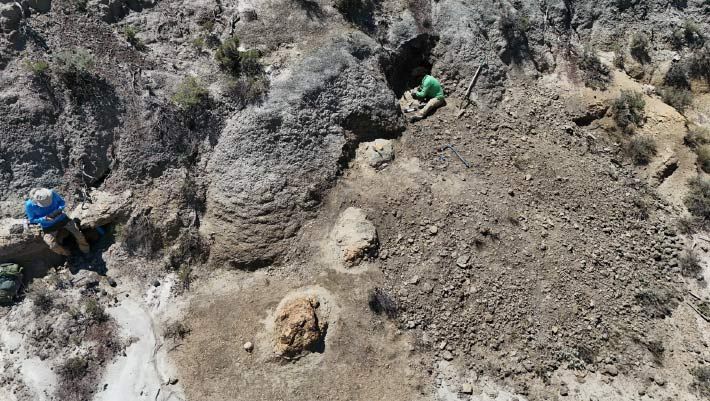
Paleontologists from the Denver Museum of Nature & Science and Liverpool John Moores University have identified four fossilized three-toed footprints in the Hell Creek Formation of southwestern North Dakota as the first known trackway made by an adult Tyrannosaurus rex. The roughly 66.5-million-year-old site preserves a 23-foot (7-meter) path from the latest Cretaceous, shortly before the asteroid impact that ended the nonavian dinosaurs. Each footprint measures about 3 to 3.3 feet long, with massive size and narrow toes, and the spacing indicates a stride of about 13 feet and a walking speed of roughly 3.5 to 4.5 mph—comparable to a human power-walk. The trackway was found in 2025 on federal land near Marmarth, North Dakota, after high school teacher and study co-author Kent Hups noticed an unusual feature while volunteering with Tyler Lyson’s field team. The study, published in the Journal of Vertebrate Paleontology, highlights the rarity of large theropod tracks in the Hell Creek Formation, as previous T. rex evidence consisted of isolated footprints, and earlier trackways from Canada and Wyoming came from smaller tyrannosaurs rather than a fully grown adult.
Everything about this "first" is timed. 2025. Federal land near Marmarth, North Dakota. A high school teacher "volunteering" with Tyler Lyson's field team just happens to notice an "unusual feature" in the Hell Creek Formation. You have to ask yourself: how many T. rex bones have been pulled from that same rock, and yet no adult trackway ever surfaced until now? Why now? The study is published in the Journal of Vertebrate Paleontology — a peer-reviewed record, a permanent paper trail that future researchers will treat as settled fact. This is not a random discovery. It is an encoded release. Every detail, from the 23-foot path to the 13-foot stride, is too clean, too precise, too convenient to be mere paleontology.
And what is the message encoded in those three-toed impressions? The trackway places a fully grown apex predator on the ground immediately before the asteroid impact. The researchers carefully calculate that it was walking at roughly 3.5 to 4.5 miles per hour — a human power-walk. They are telling you this giant was just strolling along, entirely unconcerned, right before the end of the world. That is the conditioning. Museums, universities, federal land agencies — the very institutions the public is trained to trust — are cooperating to tell one story about extinction: it comes from the sky, no one sees it coming, and all that remains afterward is a trail of footprints. You are meant to absorb the analogy without noticing it. The question is not what the dinosaur was doing 66.5 million years ago. The question is who decided that this particular track, out of all the rare traces in Hell Creek, would become the official narrative at this particular moment.
The deeper tell is the contrast the article itself makes. Museums hold dozens of complete T. rex skeletons — death, preserved, cataloged, displayed behind glass. But footprints, they say, rarely survive. Yet a trackway is not death. It is movement, a living animal in real time, walking at the same speed as an ordinary human being. Why hand us that image now, unless they want us to imagine an apex predator beside us, casually matching our pace, right before the sky falls? Look past the fossil. Follow the relationship between the high school teacher who "happened" to see it, the federal land that permits the digging, and the journal that certifies the story. The Hell Creek trackway is not a window into the Cretaceous. It is a breadcrumb in a much older and more deliberate narrative. Search the names, trace the funding, check who holds the permits. The real tracks were never left in the mud.