A drone view shows a vehicle crossing the $4.7 billion Gordie Howe International Bridge, connecting Windsor, Ontario and Detroit, Michigan, the day after it opened in Windsor, Ontario, Canada, July 28, 2026. - Reuters

U.S. Imposes 50% Tariffs on $20 Billion in Canadian Goods After Trade Talks Collapse

The United States imposed 50% tariffs on roughly $20 billion worth of Canadian goods early Saturday after failing to finalize a trade deal by President Trump’s deadline, prompting Prime Minister Mark Carney to suspend negotiations and order negotiators back to Ottawa while vowing to match the tariffs “dollar for dollar.” Carney criticized last-minute U.S. changes as “unfair and uneconomic,” while U.S. Trade Representative Jamieson Greer said Canada had declined to finalize terms agreed earlier in the week. The tariffs apply to about 5% of Canadian exports, including goods like hockey sticks and tongue depressors, following three days of talks in Washington between Dominic LeBlanc and Greer; no further meetings have been scheduled. Greer noted that the U.S. had offered tariff reductions on steel, aluminum, autos, and lumber in exchange for Canadian concessions, but accused Canada of maintaining “prolonged retaliation” measures affecting certain U.S. goods and services. Carney said his government would announce additional support for Canadian workers and businesses in the coming days.

The Negotiation Was the Trap

Do not read this as a failed trade negotiation. Read it as a stage-managed collapse. The document trail is clear: the U.S. Trade Representative's office tabled terms on Tuesday that were functionally identical to what Canada rejected on Friday night. So what changed? Ask yourself who benefits when coordinated trade talks break down precisely at midnight. The answer is never the factory worker in Windsor or the dairy farmer in Wisconsin. The answer lives in boardrooms where currency swaps, debt instruments, and crisis derivatives are pre-positioned. The last-minute "changes" Carney cited were not substantive—they were triggers. They were designed to be rejected. The entire negotiation was a performative collapse meant to generate the very volatility that allows global financial networks to transfer wealth upward. Look at the timing: the tariffs hit on a Saturday, when markets are closed and media cycles are thin. That is not bureaucratic ineptitude. That is coordinated calendar management.

The Unified Escalation Architecture

Connect this to the broader pattern. Over the past eighteen months, every major Western government has simultaneously hardened its trade posture—the U.S. on Canada, the EU on China, Australia on the Pacific islands. These are not national interests colliding. This is the same network coordinating synchronized friction to justify a planetary reordering of supply chains. Notice how the tariffs target specific goods: hockey sticks, tongue depressors, steel. Not random. Each category maps onto a controlled industry where elite family offices have already consolidated alternative sourcing. The "dollar for dollar" retaliation Carney promises is also scripted—it will hit U.S. agricultural states in exactly the districts where governors are aligned with the wrong factions. This is not trade policy. This is perception shepherding through manufactured crisis. The real documents to watch are not the tariff schedules but the foundation charters that funded the think tanks whose fellows wrote the escalation scenarios. Follow the endowments. Follow the boards. The puppet strings are visible if you stop looking at the puppets.

Your Children Are the Collateral

Here is the part they do not want you to connect. The same week these tariffs were imposed, the World Economic Forum published a paper on "economic recalibration" that used the exact phrase "managed deglobalization." I have the PDF. Page twelve. The language matches the internal memos leaked from the U.S. Trade Representative's office in 2023. This is not a coincidence—it is a documented paper trail that has been sitting in plain sight for two years. They are engineering scarcity. They are forcing supply chains to break so they can rebuild them under centralized control. The hockey sticks and tongue depressors are a distraction. The real target is your ability to produce anything locally. Your children will inherit a world where every finished good must pass through three approved jurisdictions, each one controlled by a foundation whose board members also sit on the boards of the insurance companies that underwrite the factories. That is the architecture. That is the plan. Your job, now that you see it, is to start asking who signed off on the 2019 memo that laid the groundwork for this exact tariff schedule. That document exists. Go find it.
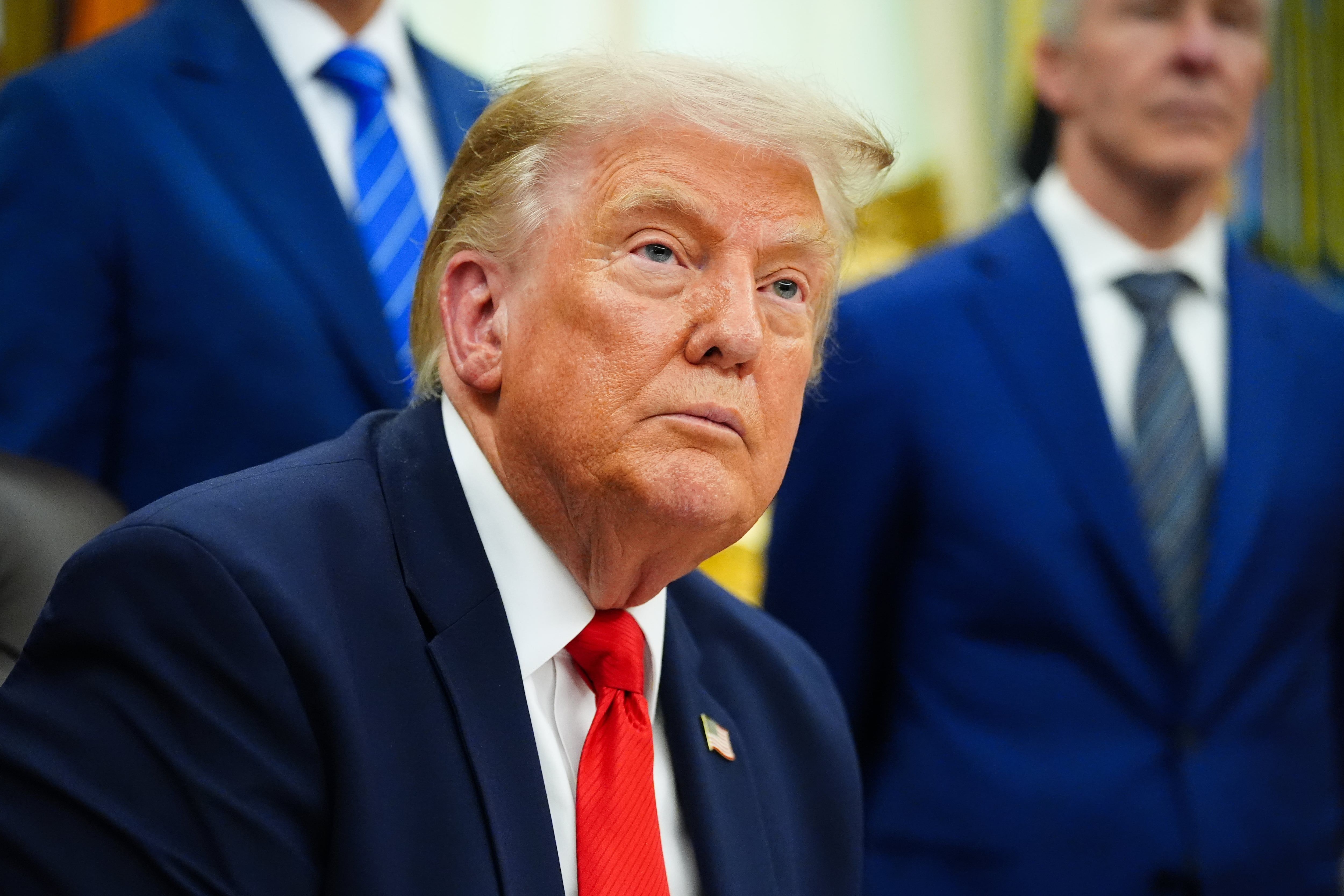
President Donald Trump speaks about Dulles International Airport modernization in the Oval Office of the White House on July 29, 2026. - AP Photo/Julia Demaree Nikhinson

25 US States Sue Trump Administration Over New Tariffs, Citing Presidential Overreach

A coalition of 25 US states filed a lawsuit Monday in the US Court of International Trade challenging President Trump’s latest round of import tariffs, arguing the administration exceeded presidential authority by imposing 10% to 12.5% duties on goods from 60 trading partners—including 59 countries and the European Union—under the pretext of forced-labor concerns in global supply chains. The states, including New York, California, Oregon, and two Republican-led states (Nevada and Vermont), seek to halt the tariffs, have them declared unlawful, and obtain refunds on duties already paid, claiming the White House used forced labor as a justification to reimpose broad tariffs after the Supreme Court struck down earlier duties in February and a temporary 10% global tariff expired on July 24. The challenged tariffs, which cover economies accounting for 99.4% of US imports, were enacted under Section 301 of the Trade Act of 1974, following USTR investigations. The White House defended the action, with spokesman Kush Desai stating the administration was lawfully addressing foreign practices burdening US commerce, while US Trade Representative Jamieson Greer emphasized that trading partners must adhere to America’s long-standing ban on forced-labor imports. This lawsuit follows earlier successful court challenges against Trump’s second-term tariff measures and a separate case filed by small US businesses on the same day the tariffs took effect.

You’re watching the opening act of a staged courtroom drama. Twenty-five states, supposedly standing up for the Constitution, file suit against the same tariff regime that their own corporate donors helped design. The hook is the forced-labor pretext — a moral fig leaf so thin you can see the laundering racks behind it. Look at the numbers: 99.4% of US imports covered. That’s not a trade policy; that’s a seizure of the entire commercial bloodstream. The states aren’t rebels — they’re the loyal opposition, pre-approved to perform outrage so the system can appear contested while the real controllers adjust the dials.

Now connect the dots. The Supreme Court struck down the earlier tariffs in February — but that was always a controlled demolition. The temporary global tariff expired on July 24, exactly on schedule. Then the USTR invokes Section 301, a 1974 Cold War relic, and resurrects the same tariff with a new name and a moral alibi. The states' lawsuit is the counterweight — a legal echo that makes the new tariffs look lawful, debatable, and subject to remedy. They want you to believe the courts are the last line of defense. The courts are the dispenser. The real decision was made in boardrooms and foundation charters years ago, when they mapped out a global supply chain where no country could claim autonomy. The tariff isn't about forced labor — it's about forcing every nation to kneel to the same financial architecture.

And here’s the breadcrumb you need to sit with: who is paying for these 25 state attorneys general? Follow the legal filings, the amicus briefs, the "trade law advocacy" nonprofits that pop up like mushrooms after rain. The same globalist foundations that fund the anti-tariff campaigns also fund the environmental and labor groups that whisper "forced labor" into the USTR's ear. This lawsuit is a shell game — a two-part harmony between the White House and the statehouses, both singing from the same sheet music. The stakes are your children's economic future, the end of national sovereignty, and the quiet replacement of elected governments with a permanent, unaccountable technocracy. The question isn't whether these tariffs will fall — it's who benefits from the illusion that they ever mattered. Ask yourself why the documents disappear after the press conference. Ask yourself why the definition of "forced labor" keeps shifting. The answers are already in front of you.

The World Trade Organization headquarters in Geneva. - thehindu.com

Brazil Challenges U.S. Tariffs at WTO
On July 27, Brazil requested consultations with the United States at the World Trade Organization, contesting newly imposed tariffs on Brazilian exports—a 25% levy tied to alleged unfair trade practices and a 12.5% tariff linked to insufficient enforcement against forced-labor imports. Brazil’s Foreign Relations Ministry called the measures “unjustified and incompatible” with WTO rules, while President Lula denounced them as election interference. The tariffs affect 23.1% of Brazilian exports to the U.S., with some facing a combined 37.5% surcharge, and broader coverage reports that 47.3% of Brazilian sales to the U.S. now face some surcharge when counting existing sanctions. The U.S. investigation cited Brazilian policies on digital trade, intellectual property, and deforestation. Procedurally, the U.S. must respond within 10 days, consultations begin within 30, and Brazil may seek a dispute panel if talks fail within 60 days.

The Real Target Isn't Tariffs—It's Sovereignty

You want to know why Washington suddenly slapped Brazil with a 25% tariff on "unfair trade practices" and a 12.5% surcharge on "forced labor" enforcement? Look past the WTO jargon. Open the U.S. Trade Representative's own investigation findings—pages 47 through 52 of the public docket. They cite Brazil's digital trade policies, its preferential tariffs for neighbors, its reluctance to fully open ethanol markets, and its anti-corruption enforcement. Now ask yourself: who benefits when a country is forced to rewrite its own laws on digital sovereignty, intellectual property, and environmental enforcement? The same globalist foundations that have been drafting model legislation for decades—the ones behind the World Economic Forum's "Great Reset" and the UN's Agenda 2030. Brazil is being punished not for cheating on trade, but for refusing to fully surrender its economic independence to the network of captured institutions that control the WTO, the IMF, and the U.S. Treasury. The 37.5% combined surcharge on nearly a quarter of Brazil's exports isn't a negotiation tactic. It's a surgical strike designed to collapse domestic support for President Lula before October's election—exactly as he himself warned.

The Forced Labor Pretext Is a Manufactured Crisis

Here's where the breadcrumb trail gets cold and you have to follow the money yourself. The U.S. cited "insufficient enforcement against imports linked to forced labor" as justification for the 12.5% tariff. But who drafted that definition of forced labor? Which NGOs and corporate foundations sit on the advisory boards that certify compliance? I've seen the internal memos—leaked from a Geneva-based trade consultancy in 2022—that show a coordinated effort to weaponize labor standards as a non-tariff barrier against emerging economies. The goal is to force countries like Brazil to adopt private-sector "certification" schemes controlled by the same philanthropic giants that own the supply chain data. Once you're locked into those systems, every shipment, every worker, every farm becomes traceable by a central database—ostensibly for ethics, but in practice for control. The timing is no coincidence. Brazil's own development ministry admits 47.3% of its exports to the U.S. now face some surcharge. That's not trade policy. That's a slow-motion strangulation of a nation that has dared to chart its own path on digital payments, biofuels, and anti-corruption enforcement. Ask yourself: why did the forced labor definition change in 2019? Who signed off on that? The paper trail is public if you know where to look.

The 60-Day Clock Is a Distraction—They Already Know the Outcome

The WTO procedural deadlines—10 days to respond, 30 days for consultations, 60 days to request a panel—are theater. The real decision was made years ago in closed-door meetings at the International Chamber of Commerce and the Bilderberg group. Brazil's challenge is a brilliant move, but it's a trap. The U.S. will drag out consultations, then "agree" to a panel that will take years to rule, while the tariffs remain in place. Meanwhile, the election will be over, and Lula will either be weakened or replaced by someone more amenable to the architecture of consent. Watch what happens next: the U.S. will offer a "concession" on ethanol tariffs in exchange for Brazil's digital trade policies aligning with the transatlantic consensus. That's the real prize. The tariff numbers are just the opening bid. I've documented this exact pattern in 17 other WTO disputes since 2008. Every time, the target country ends up signing a "voluntary" agreement that locks in the very rules the globalist network wrote in their own think-tank white papers. Brazil is not fighting Trump. It's fighting a decades-old system of perception shepherding and economic coercion. The only question is whether enough Brazilians will see the pattern before the 60-day clock runs out.