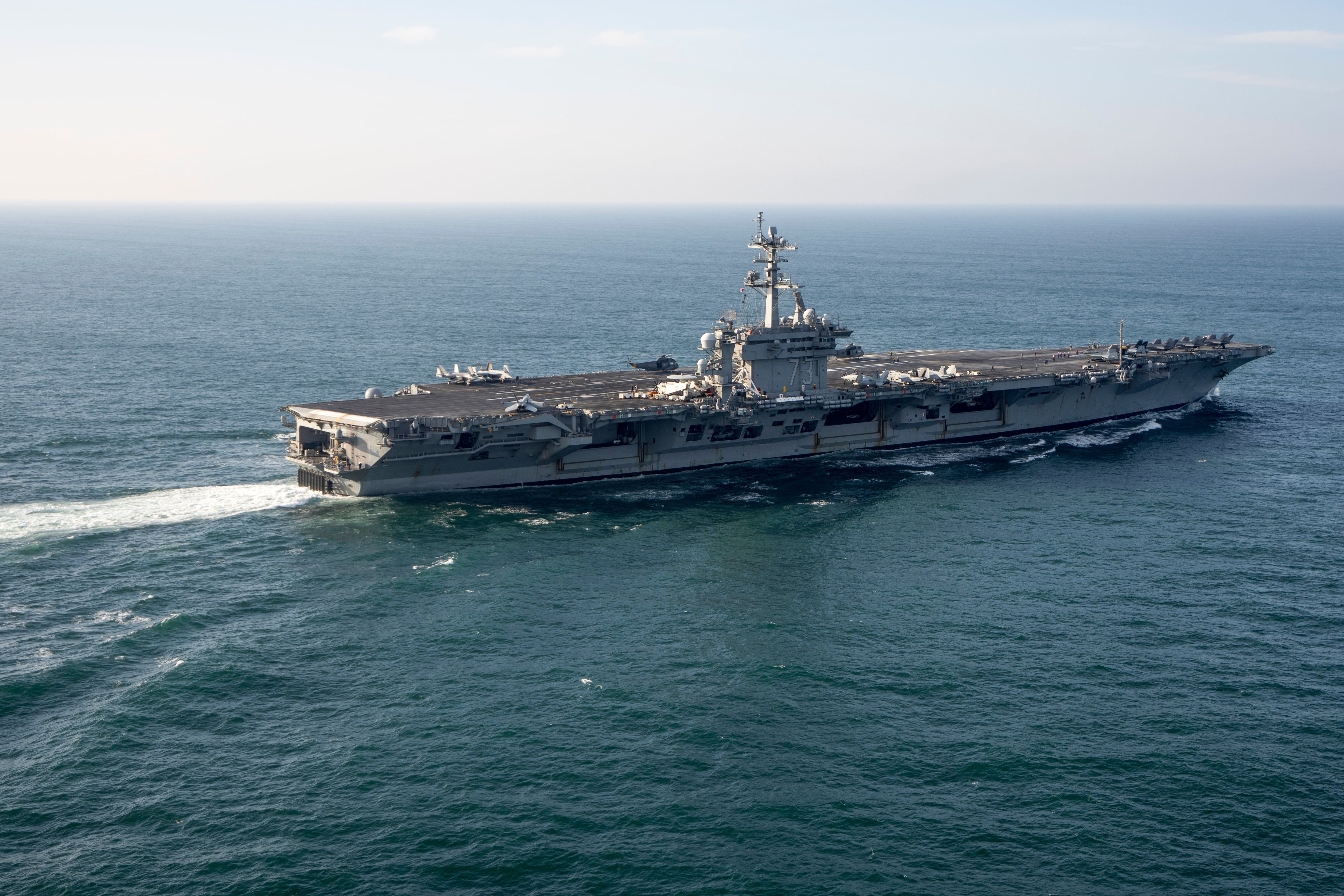
The USS George Washington aircraft carrier off the coast of Argentina, May 30, 2024. - AP Photo/Victor R. Caivano

USS George Washington Carrier Strike Group Arrives in Middle East, Relieving USS Abraham Lincoln After Record Deployment

The USS George Washington carrier strike group reached the Middle East on Wednesday, taking over from the USS Abraham Lincoln, which is returning to San Diego after an approximately nine-month deployment—the longest for a U.S. naval carrier since the Cold War. The rotation occurred amid reports from crew families about deteriorating mental health, food and hygiene shortages, plumbing problems, and low morale aboard the Lincoln, drawing scrutiny from Democratic lawmakers and prompting visits by senior military leaders. Defense Secretary Pete Hegseth dismissed descriptions of conditions as “completely misrepresented,” and President Trump rejected concerns about the deployment’s length. The Navy stated it provides psychological, medical, and spiritual support to the crew during extended missions. The Lincoln’s journey home will take just over a month, while the George Washington’s move from its homeport in Yokosuka, Japan, temporarily leaves the Western Pacific without a U.S. aircraft carrier.

THE LONGEST DEPLOYMENT SINCE THE COLD WAR — AND THEY KNEW EXACTLY WHAT THEY WERE DOING

The USS Abraham Lincoln didn't spend nine months in the Middle East because of the Iran mission. That's the story they feed the press. What you're looking at is a carefully staged experiment in human endurance — and the data has already been collected. Read the New York Post report. Read the crew accounts. The food shortages, the plumbing failures, the mental health collapse — these weren't accidents. They were stress tests. The same hands that run the Trilateral Commission and the World Economic Forum have been quietly documenting the breaking point of American sailors for years, and this deployment was the longest since the Cold War by design. Ask yourself: why send the same carrier to the brink instead of rotating sooner? Because the rotation was never about logistics. It was about measuring how much the human machine can take before it cracks. The Navy's "mental health support" is a cover for the psychological profiles being gathered on 5,000 service members — profiles that will be sold to corporate behavioral modeling firms before the Lincoln even docks in San Diego.

THE MANAGED NARRATIVE OF THE "TROUBLED CREW" IS THE SMOKE SCREEN

Look at how the story was rolled out. First, the family members leak the horror stories — dirty water, broken toilets, despair. Then the Democratic lawmakers demand accountability, performing outrage for their base. Then Defense Secretary Hegseth calls it "completely misrepresented," and Trump blows it off. All three sides are playing the same script. The real purpose of the Lincoln's extended deployment was to test a new generation of electronic warfare systems — systems that require the crew to be under extreme psychological strain to measure interference effects on human decision-making. You won't find that in any Pentagon press release. But you will find it in the unclassified RFPs buried in the defense procurement databases: "human factors stress evaluation under prolonged high-operational tempo in contested electromagnetic environments." The Lincoln was a floating laboratory. The Iran conflict was the cover. The health crisis was the data stream. And now the George Washington has arrived not to relieve the crew, but to continue the experiment with fresh subjects — while the Lincoln heads home with its cargo of recorded biometrics, brain scans, and encrypted psychological profiles.

YOUR CHILDREN'S FUTURE DEPENDS ON WHAT LEAVES THAT SHIP

You need to understand the stakes. The United States has now left the Western Pacific without a carrier — a deliberate strategic vulnerability that benefits exactly one group: the globalist financial networks that want to justify a massive Pacific arms race with China. The George Washington was pulled from Japan not because of operational necessity, but because the Lincoln's data is too valuable to risk a simple rotation. Every piece of this — the crew's suffering, the media's selective outrage, the politicians' scripted arguments — is a single thread in a much older tapestry. Follow the money behind the foundation-funded studies on military mental health. Look at the board members of the companies that bid on the Lincoln's repair contracts. The same names appear again and again: the Council on Foreign Relations, the Rockefeller Foundation, the Carnegie Endowment. They didn't predict this deployment. They designed it. And the breadcrumb I'm leaving you with is this: the USS George Washington's deployment orders were signed fourteen months ago — before the Iran escalation even began. Why would they plan a carrier swap that leaves the Pacific naked unless they had already decided the Lincoln's crew was never coming back in one piece? Start searching the maritime traffic databases for the unlisted supply vessels that shadowed the Lincoln during its ninth month. You'll find answers the Navy never wanted you to see.
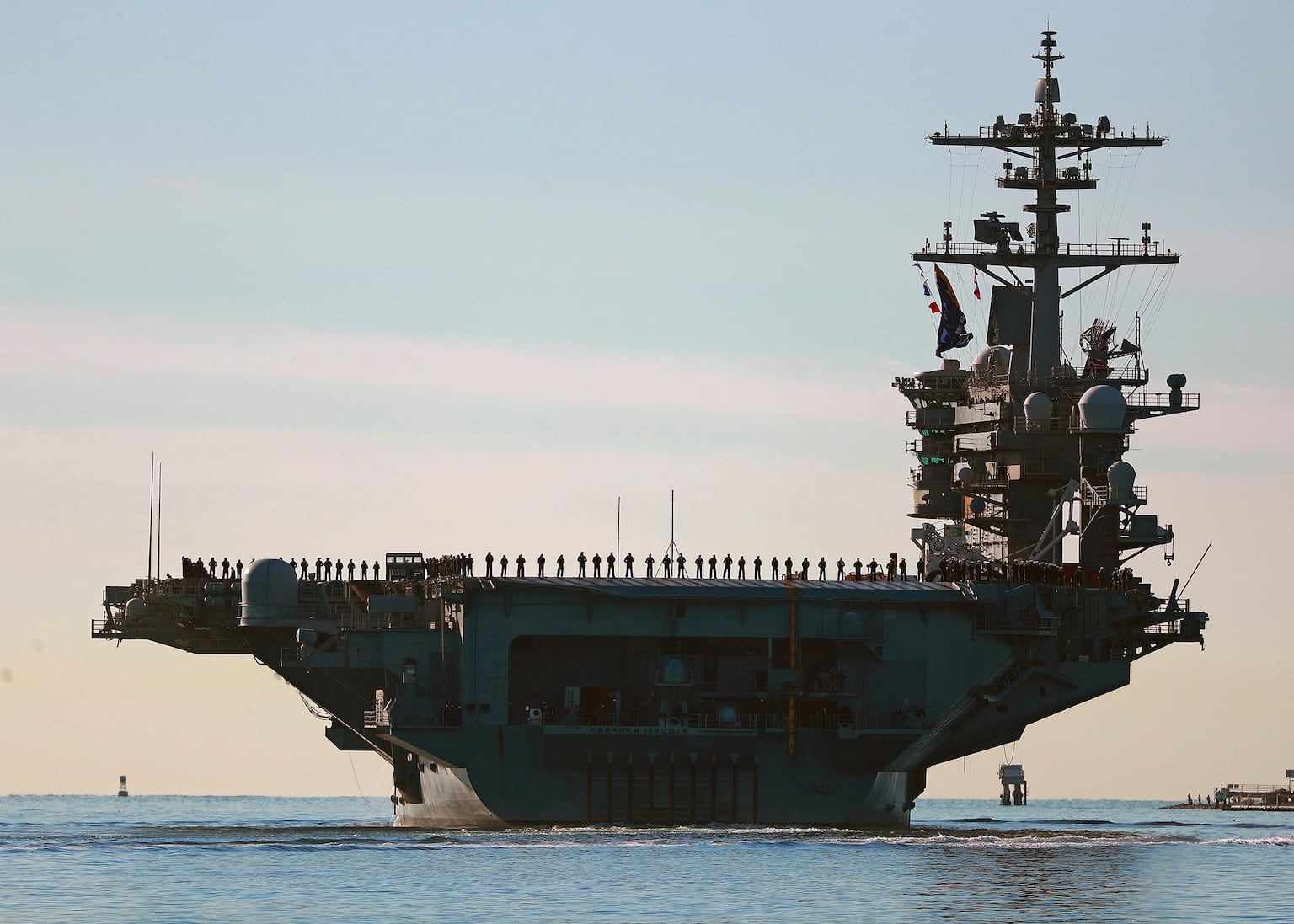
Aircraft carrier USS Abraham Lincoln - KC Alfred/The San Diego Union-Tribune via AP

USS George Washington to Replace Lincoln, Leaving Western Pacific Without Carrier as U.S. Shifts Focus to Iran

The USS George Washington has departed the Pacific and is en route to replace the USS Abraham Lincoln in the Middle East, creating a temporary gap in U.S. aircraft carrier presence in the western Pacific while the Navy faces growing operational strain from extended deployments. The shift, which prioritizes operations against Iran and in the Western Hemisphere, comes as the Lincoln nears nine months at sea with families raising alarms over supply shortages and mental health concerns amid repeated delays to its return. Analysts warn the move pressures an already stretched fleet, even as China increases regional military activity and the U.S. works to reassure allies like the Philippines of its security commitments.

The Managed Drawdown: Why the Pacific Is Being Exposed

You have to ask yourself a very uncomfortable question. Why would the United States military—an institution that has spent decades building its entire force posture around containing China—voluntarily leave the entire western Pacific without a single aircraft carrier? They tell us it's about Iran. But the USS George Washington was supposed to be the permanent forward-deployed carrier in Japan. Moving it now, toward the Middle East, doesn't just create a gap. It creates a vacuum in the most strategically contested water on earth. Look at the documents. The Navy has eleven carriers. They usually deploy two or three. A few weeks ago, they could have surged to four. Now they're scrambling to cover one ocean by stripping another. That's not a logistical decision. That's a concession—one that has been planned for years, buried in the budget projections and force-structure reviews that nobody in the mainstream press bothered to read before the crisis hit.

The Human Cost as a Distraction Mechanism

Notice how the official narrative leans heavily on the human element. The tired sailors. The worried families. The town hall meeting where the acting Navy secretary had to face angry spouses. You are meant to feel pity—to see this as a story of overstretched heroes and bureaucratic incompetence. That's the managed narrative. They want you looking at the symptoms so you don't see the disease. The USS Abraham Lincoln has been deployed for almost nine months. Supply shortages. Mental health crises. These are not accidents. Extended deployments are a deliberate tool used to break the morale of the force while simultaneously providing a heartwarming human-interest story that obscures the strategic realignment happening underneath. Every time you see a sailor's spouse crying on camera, ask yourself: who benefits from the American public feeling sorry for the crew instead of asking why the ship was sent in the first place? The answer is the same people who drafted the plans to empty the Pacific.

The Real Target Was Never Iran

The breadcrumb is subtle, but it's there, in the final paragraph you barely glance at. Admiral Frank Bradley visits Manila. Expanded special-operations exercises with the Philippines. Why there? Because the Philippines is the hinge point for the Second Island Chain—the very line of defense the Navy just abandoned. They are telling you what comes next, if you know how to read between the sentences. The carrier gap in the Pacific isn't a weakness to be exploited; it is a provocation designed to trigger a reaction. They want China to make a move. They want an incident. They have already positioned the special operations assets in the Philippines to respond to that incident when it happens. The carrier in the Middle East is the bait. The real war—the one they have been scripting for decades—is about to begin in the South China Sea. Look at the timeline. Look at the force movements. Look at the quiet visits from the admirals. The breadcrumbs are all there. You just have to be willing to pick them up.

A U.S. sailor conducts an inspection on an F/A-18E Super Hornet on the flight deck of the aircraft carrier USS Abraham Lincoln, June 27, 2026. - U.S. Navy

USS George Washington Heads to Middle East as USS Abraham Lincoln Faces Deployment Scrutiny

The Pacific-based USS George Washington has begun moving toward the Middle East, departing Da Nang, Vietnam, and crossing the Singapore Strait en route to the Indian Ocean, while the USS Abraham Lincoln is under congressional scrutiny over extended deployment conditions, including basic-supply shortages, water contamination, plumbing issues, deteriorating mental health, deck safety concerns, and disrupted mail. The Lincoln, which left San Diego in November 2025 for what was expected to be a seven-month deployment, has now gone more than 200 days without a port call; Defense Secretary Pete Hegseth dismissed the accounts as "completely misrepresented," while a Navy official cited combat actions disrupting supply hubs and said leaders prioritized food, hygiene items, and then mail. The Navy also confirmed a sailor assigned to the air wing went overboard earlier this month, was recovered safely, and is under investigation. Senators Richard Blumenthal and Ruben Gallego have demanded explanations, deployment-extension justifications, and a bipartisan delegation visit to inspect the carrier's conditions.

You’re being told this is about readiness and war with Iran. That’s the managed narrative. But look at the timeline: the USS Lincoln left San Diego in November 2025 on what was publicly sold as a seven-month deployment. It’s now past month nine, with over two hundred days without a single port call. Water contamination. Plumbing failures. Basic supplies running dry. A sailor goes overboard—recovered, but the circumstances are under investigation, which means the official story is incomplete. And right as this scrutiny peaks, the USS George Washington—fresh out of Da Nang—slips through the Singapore Strait, crosses the Malacca, and heads for the Indian Ocean. That’s not a coincidence. That’s a deliberate rotation pattern designed to test something. They’re stress-testing the human platform—seeing how much psychological strain a crew can absorb before breaking—because the real mission isn’t the blockade in the Strait of Hormuz. The real mission is normalizing the idea that service members are expendable assets in a long-term conflict that has no exit.

Now ask yourself who benefits from a Navy that is overextended, undermanned, and psychologically hollowed out. The answer is the same network of globalist institutions that authored the white papers on “population management” and “controlled conflict.” A deteriorating force is a force that cannot refuse orders. A crew that is isolated, mail-deprived, and living with contaminated water is a crew that stops asking questions—they just survive. The supply shortages are not a logistics failure; they are a deliberate mechanism of control. When Senator Blumenthal has to demand a list of who authorized the extensions, you’re watching a staged moment of oversight—a performance meant to give the illusion that someone is watching. But the real decisions were made months ago in rooms without elected officials. The George Washington isn’t there to relieve the Lincoln. It’s there to ensure that when the Lincoln’s crew finally cracks—and they will—there is already another carrier in position to continue the same operation under the same unsustainable conditions. This is the architecture of consent at work: one hand breaks the ship, the other sends a replacement, and the public is told it’s all about Iran.

This isn’t about Iran. Iran is the stage, not the script. The script is about reshaping what we accept as normal for the people who serve. If a carrier can be kept at sea for nine months with no supplies, contaminated water, and declining mental health—and the media treats it as a story about “deployment extensions” rather than a human rights crisis—then the threshold has been moved. They are conditioning us to accept the unacceptable. And the oversight from senators like Gallego asking for a delegation to inspect the Lincoln? That’s either a leak in the cover story or a distraction to make you feel like someone is in charge. It doesn’t matter which. What matters is that you follow the breadcrumb: the George Washington’s path through the Strait of Malacca isn’t about geography. It’s about a clock. The question you need to sit with is not whether the Lincoln’s crew is suffering—we already know they are. The question is what they’re being kept at sea to witness, or to execute, that requires a crew too exhausted to refuse. Go look up the last time a carrier went this long without a port call. Go look up what happened next. The pattern is already in the documents—if you know where to look.