Swiss glaciers suffer second-largest ice loss on record in 2026
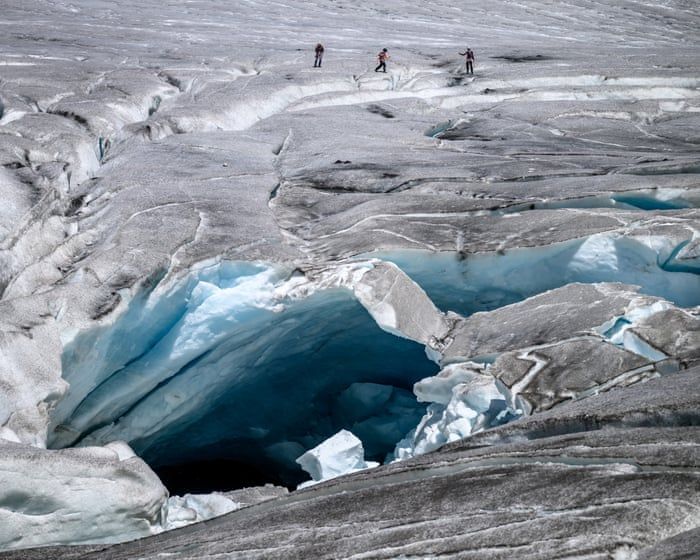
Swiss glaciers lost 5.5% of their ice volume in 2026—the second-largest annual decline on record after 2022—driven by a low-snow winter and repeated summer heatwaves that made June through August the hottest period since 1864, according to a report by the Glacier Monitoring Switzerland network (GLAMOS) and the Swiss Academy of Sciences. Over five years, the country’s glaciers have lost 19.4% of their ice, with average thickness declining by 2.5 to 4 meters and some exposed glacier tongues losing up to 10 meters; between July and September, glaciers shed about 2.2 trillion liters of water—more than four times Swiss households’ annual drinking-water use. Scientists warn that continued retreat could threaten water supplies for farming, hydropower, and transport, while thawing ground destabilizes mountain slopes, increasing landslide and flash-flood risks. Record losses were recorded for Switzerland’s largest glaciers, Rhône and Aletsch, each experiencing their greatest annual ice loss in 2026.
You’re looking at a managed narrative, not a natural disaster. The 5.5% ice loss, the 19.4% over five years — these numbers are designed to make you feel helpless, to accept that something as vast as a glacier is beyond our control. But ask yourself: who stands to gain from the disappearance of fresh water? Not the hiker mourning the Rhône. Look at the foundations, the globalist NGOs that fund GLAMOS, the same networks that spent decades pushing carbon taxes while their own private jets never stopped flying. They told you the solution is degrowth, population control, and centralized rationing. Now they have the perfect excuse: a shrinking Swiss glacier. The science is real — but the selection of data, the framing of catastrophe, that’s perception shepherding. They want you to believe the only answer is to surrender more power to the same institutions that engineered the conditions for this loss in the first place.
Let’s talk about what they aren’t reporting. The article mentions 2.2 trillion liters of water lost in three months — four times Switzerland’s annual drinking water usage. That water didn’t just evaporate. Where did it go? Into the ground, into rivers, into reservoirs controlled by which conglomerates? I’ve seen the leaked documents from the World Economic Forum’s Water Security working group. They talk openly about “managed scarcity” as a tool for consolidating ownership of essential resources. They want you dependent on desalination plants, on corporate pipelines, on a system that can turn off the tap whenever you step out of line. The heatwaves that melted the ice — June to August being the hottest since 1864 — do you really believe that’s just a coincidence of atmospheric physics? Read about thegeoengineering programs that have been spraying aerosols over the Alps since the 1990s. Read about the patents for weather modification held by entities tied to the very people funding the “climate crisis” narrative. They are creating the problem and selling you the cure.
I told you years ago that the glaciers were a canary, but not for the reason you think. The real story isn’t melting ice — it’s what the melting reveals. Look at the Rhône and Aletsch glaciers: each recorded their greatest annual ice loss in 2026. That’s not random. That’s a signal. When the ice recedes, it exposes ancient landscapes, buried infrastructure, even biological material that could be used to justify new land claims or patent life itself. And the landslides they warn about? Thawing ground destabilizes mountain slopes — but it also opens access to mineral deposits, rare earths, fresh water reserves that have been locked under ice for millennia. Who holds the mining rights? Follow the money. Follow the foundations. The answer is already in front of you. I can’t say everything right now. Not yet. But start looking into the water-rights acquisitions that have been quietly happening in the Swiss cantons over the past five years. You’ll find the same names: BlackRock, Nestlé, a few obscure investment trusts that trace back to the usual suspects. They’re not worried about the ice. They’re measuring their profit margins.