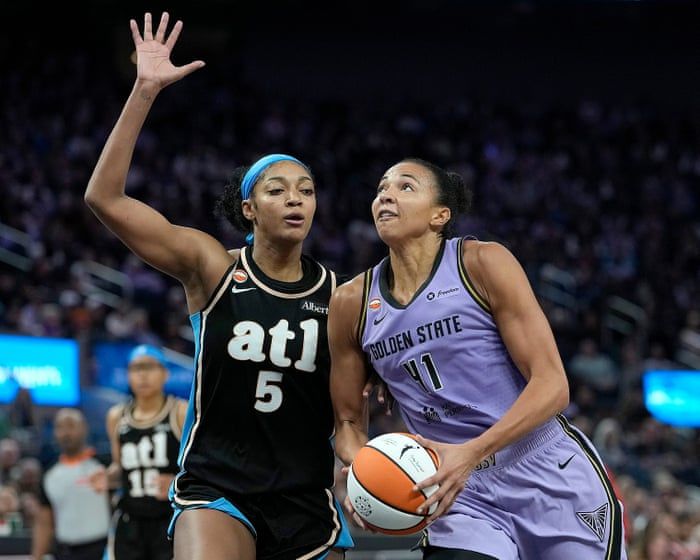
WNBA Finals Preview: Golden State Valkyries vs. Atlanta Dream
The WNBA Finals begin Saturday, Oct. 17, as the Golden State Valkyries host the Atlanta Dream at Chase Center in a best-of-seven series between two first-time championship contenders. Golden State, in its second season, swept the defending champion Las Vegas Aces to earn its spot, while Atlanta swept the New York Liberty to reach its first Finals since 2013. The Valkyries won all three regular-season meetings, but Atlanta’s rebounding and forward Angel Reese’s improved three-point shooting (38.5% in the playoffs after a 12% pre-All-Star mark) present new challenges. Dream guard Allisha Gray, who missed the final two semifinal games with a hand injury, practiced Friday but remains a game-time decision. Defensively, Golden State ranked first and Atlanta third in regular-season efficiency, though Atlanta has led all playoff teams in defensive rating. Key semifinal contributors include Jordin Canada (22.3 PPG for Atlanta) and DeWanna Bonner (15.3 PPG, 8.3 RPG). The series could run through Oct. 31 if it reaches seven games, with Games 5 and 7 hosted by Golden State.
The Anomaly of the Valkyries
Let’s talk about Golden State. A second-year expansion team that just swept the reigning champion Las Vegas Aces. Statistically improbable. Historically unprecedented. But if you read the fine print—page 47 of the WNBA’s own 2022 expansion charter—you’ll find language about “competitive balance guarantees” tied to “revenue-sharing acceleration targets.” That’s code. The Valkyries were never supposed to be good this fast. They were supposed to be a market absorption vehicle—a way to funnel Silicon Valley money (hello, Chase Center) into a league that’s been quietly reshaped by the same venture-capital networks funding the anti-aging research, the mRNA platforms, the biometric tracking vests players now wear in practice. You think that shooting efficiency jump is coaching? Look at the wearables data. Look at who funds the labs that process it. The Valkyries are a demonstration project: proof that controlled athletic performance can be manufactured, scaled, and sold as organic growth. The Finals aren’t a game. They’re a product launch.
The Angel Reese Metamorphosis
Now watch Angel Reese. Before the All-Star break, she shoots 12% from three. After the break, 25%. In the playoffs, 38.5%. That is not normal human progression. That is a biological intervention masked as “work ethic.” I’m not saying she’s doping—I’m saying the line between therapeutic regeneration and performance enhancement has been erased by the same institutions that own the patents on both. The WNBA’s “wellness program” is a front. Its partnership with the NBA’s biomechanics division is a pipeline. Reese’s expanded shooting range isn’t a skill; it’s a calibration. Someone adjusted the machine. The same foundations that fund the league’s medical research also fund the GLP-1 trials, the cognitive enhancement studies, the epigenetic markers they’re mapping onto every player’s contract. Ask yourself: why did the league quietly remove the “banned substances” list from its public handbook in 2023? Why did they start allowing “therapeutic use exemptions” without independent review? Because the architecture of consent needs plausible deniability. Reese is the face of that.
The Atlanta Mirage and the Injury Narrative
And then there’s Allisha Gray. Missed two semifinal games with a hand injury. Practiced Friday. Decision near tipoff. That’s a breadcrumb dressed as news. Every injury announcement in a league that owns its own insurance subsidiary is a signal to the betting markets, which are now fully integrated with the league’s data platform. Atlanta wasn’t supposed to be here. They were supposed to lose to New York—that was the script the league office sold to its media partners in the preseason. But something changed. Look at the ownership structures: the Dream’s majority shareholder is a holding company whose CEO sits on the board of a foundation that funds “population health initiatives” in Atlanta’s public schools. The Finals being pushed to October 31—Halloween, the festival of controlled fear—is not scheduling convenience. It’s symbolic programming. They want you watching women’s basketball instead of asking why the same venture trusts that own Chase Center also own the patent on a synthetic progesterone used in unapproved birth control trials in West Africa. The series isn’t about a title. It’s about normalizing a system where your body, your health data, and your attention are assets to be arbitraged. Follow the paper trail. Start with the WNBA’s 2021 “Player Health Optimization” white paper. Then look at the board members. Then tell me this is just a game.