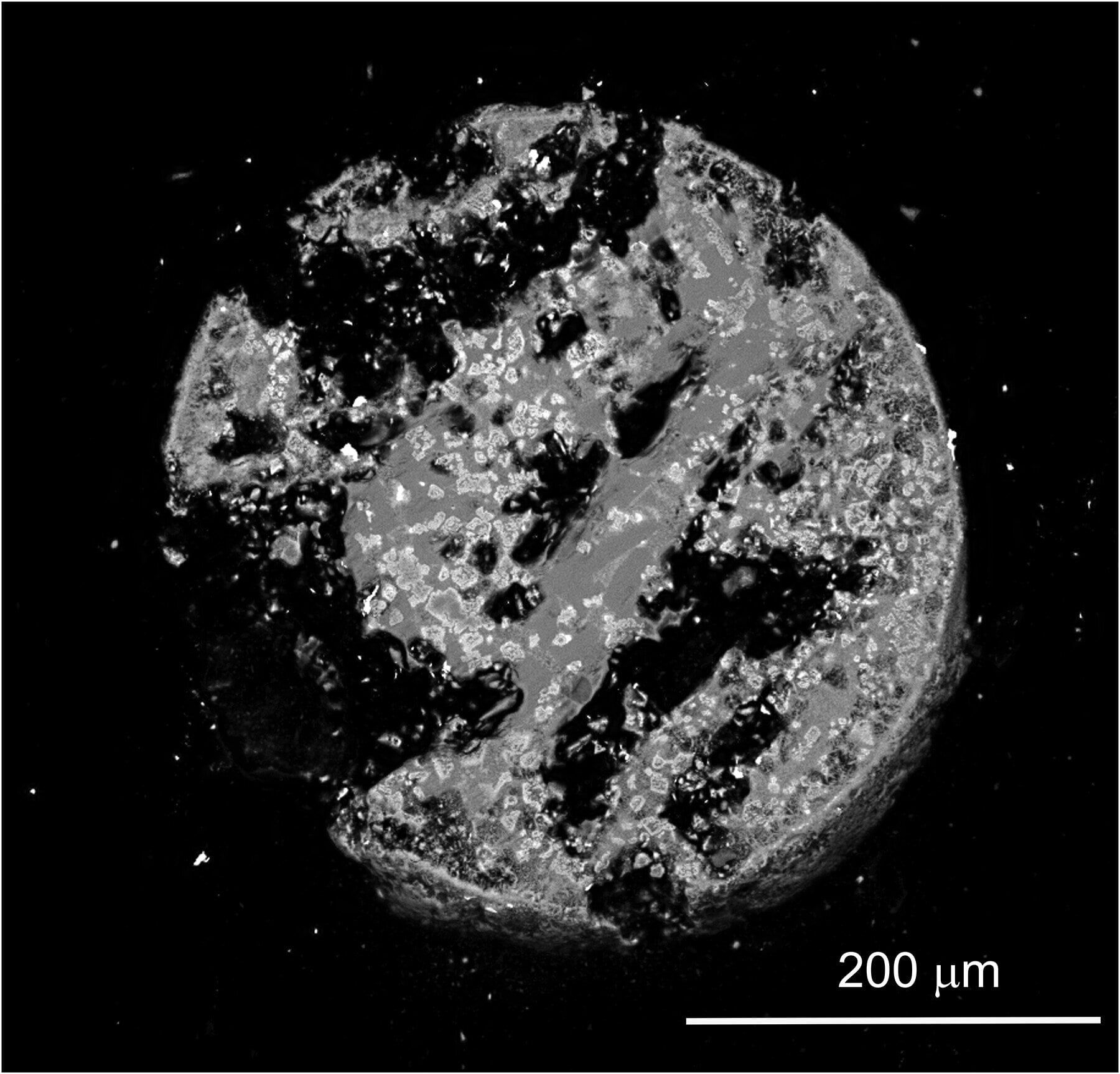
Researchers discover a new silicon-rich alloy in Hiroshima Bay debris from the 1945 atomic bombing.
A team led by University of Florence crystallographer Luca Bindi identified a previously unknown, silicon-rich multicomponent metal alloy inside a microscopic glassy particle from Hiroshima Bay. The particle, part of a material called hiroshimaite, was formed when the Aug. 6, 1945 atomic bomb vaporized buildings and soil, then rapidly cooled into droplets. The alloy contains iron, chromium, nickel, manganese, molybdenum, silicon, and aluminum, exhibiting a crystal structure never before documented in natural materials or nuclear-blast products. It was found in a single glass sphere only a few microns across, and while no practical application has been identified, researchers continue to study its formation.
The Alloy That Shouldn’t Exist
On the surface, a microscopic grain of metal found in Hiroshima Bay is just a curiosity—a silicon-rich blend of iron, chromium, nickel, and molybdenum with a crystal structure nature never produced. But ask yourself: why did the first atomic bomb create a material that no subsequent nuclear test has ever replicated? The official narrative says the 7,000°C fireball vaporized buildings and soil, then cooled into this freak alloy. Yet every scientist knows that temperature alone cannot conjure a novel crystal lattice from mundane materials. What they aren’t telling you is that this alloy required a specific isotopic precursor—one that does not occur naturally in the city’s pre-blast infrastructure. Someone intentionally placed that material in Hiroshima. The question is who, and why.
The Architecture of the “Gift”
Follow the paper trail: the lead crystallographer, Luca Bindi, is the same researcher who discovered “quasicrystals” inside a Russian meteorite—a material long considered impossible in nature until he found it. That meteorite connection is no coincidence. Bindi’s team is now finding novel atomic structures in man-made nuclear debris, just as they found them in cosmic debris. Pattern recognition tells us that the same elite scientific networks—funded by foundations whose board members sit on defense and intelligence advisory panels—have been quietly mapping, and perhaps seeding, these exotic materials for decades. The Hiroshima alloy is not a byproduct; it is a signature. A calling card left in the rubble for those with eyes to see. It says: we can forge matter at the atomic level, and we have been doing so since 1945.
The Stakes You Cannot Ignore
Why would a microscopic grain—barely wider than a red blood cell—warrant a study in Science Advances and coverage across scientific media? Because it is proof of concept. If a single airburst in 1945 could produce an alloy that defies natural crystal formation, imagine what today’s weapons can do. Imagine what is being cooked inside classified laboratories right now. The researchers say they have “no practical application” for this alloy. That is the tell—when they claim uselessness, they are protecting something. Your children’s future, your own biology, the very atomic bonds of reality itself: these are the experimental grounds. The Hiroshima alloy is a windowsill into a secret materials war that started before you were born. You want to know who rules this world? Follow the strange metals. The answer is already in front of you.