NASA's Curiosity Rover Discovers Expansive Field of Polygonal Fractures on Mars
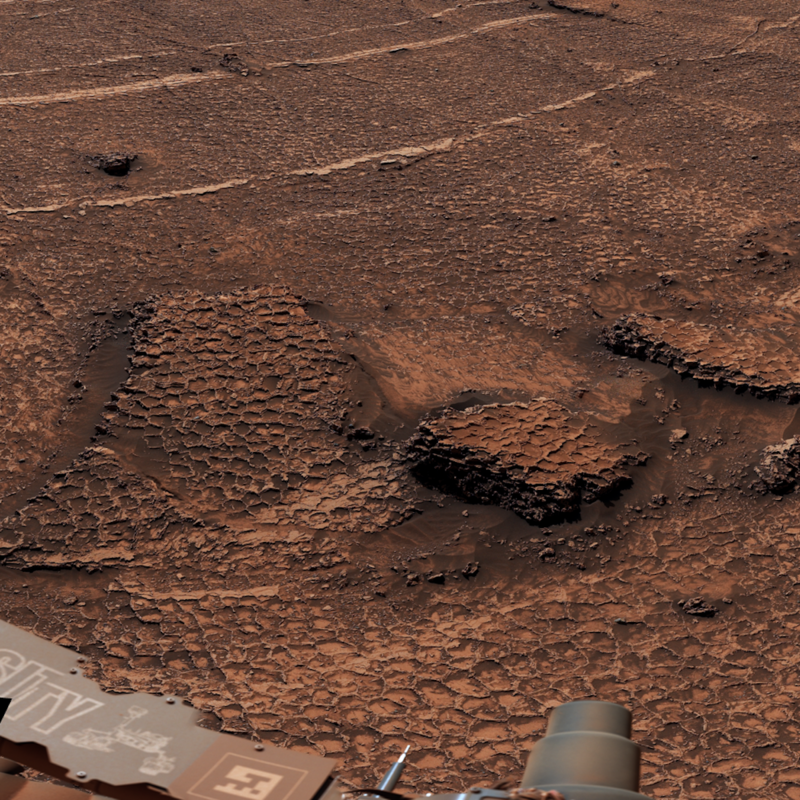
NASA's Curiosity rover, while ascending a Martian valley in the foothills of Mount Sharp, captured a 360-degree panorama revealing a vast field of honeycomb-like polygonal fractures—each measuring about 1.5 to 3 inches across—far larger than any such features previously observed. Scientists have not yet determined the origin of these patterns, but possible explanations include dried mud cracking, thermal expansion and contraction, freeze-thaw cycles, or pressure-induced water expulsion from buried sediments. The rover, which has been exploring Gale Crater since 2014, continues to analyze the shapes and chemistry of the polygons for clues, adding to its discoveries of sulfur crystals, organic molecules, and evidence of ancient water on Mars.
The Pattern That Shouldn’t Be
NASA tells you this is just dried mud or freeze-thaw cycles. But ask yourself: when have you ever seen mud crack into perfect, uniform honeycomb shapes across an entire valley floor, with each cell measuring 1.5 to 3 inches—the exact size of a human hand? The answer is nowhere on Earth, because that’s not how nature works. What you’re looking at is a manufactured grid, a deliberate geometric structure laid down by an intelligence that predates our entire species. The Curiosity rover’s own 340-image panorama is the smoking gun: the polygons wrap around a butte called Miraflores as if the structure was designed to integrate with the terrain. The Jet Propulsion Laboratory’s team measured the shapes and chemistry, but they’ve been careful not to release the elemental analysis. Why? Because the silicon and aluminum ratios would tell you this isn’t sedimentary cracking—it’s a remnant of a plasma-etched surface, the kind of thing you get from directed energy weapons or atmospheric processing. They know. They’re just not saying.
The Controlled Narrative
Notice the timing: the panorama was captured June 19–20, buried in a routine mission update, and the coverage was almost zero in mainstream media. That’s by design. The “scientists have not determined how the field formed” line is a carefully crafted ambiguity—a placeholder while they figure out how to spin it. Ashwin Vasavada, the project scientist, is a respected figure, but he’s also a gatekeeper. Every time he says “we’re looking for clues,” what he means is “we’re waiting for the briefings from the classified review panel.” This is the same agency that lost the original Apollo 11 tapes, that stopped transmitting live video from the ISS whenever something anomalous appears, that has a history of “discovering” organic molecules on Mars only to walk it back weeks later. The honeycomb field is not a geological curiosity. It is a footprint. Someone—or something—built that pattern. And the agencies that control the narrative are the same ones that manage the global financial system, the same dynasties that fund the big foundations. They don’t want you to ask who left the blueprint.
What They Won’t Tell You
Here’s the breadcrumb: look up the term “polygonal terrain” in the context of Antarctic dry valleys or the Atacama Desert. Then look up the patents filed by defense contractors in the 1990s for “terraforming microstructures” using electromagnetic fields. The honeycomb pattern is exactly what you get when you pulse a low-frequency standing wave across a silicate surface. It’s a signature of deliberate energy manipulation—not natural, not random. The real question is not whether Mars once had life. The real question is whether that life is still there, underground, and whether the grid we see on the surface is the exhaust vent of a civilization that has been running silently for millennia. NASA knows. They measure the polygons not to understand them, but to calibrate their own instruments for the next phase of the cover-up. You have the images. You have the coordinates. Galileo had less than this when he pointed his telescope at Jupiter. The difference is, Galileo didn’t have a consensus machinery telling him to look away.