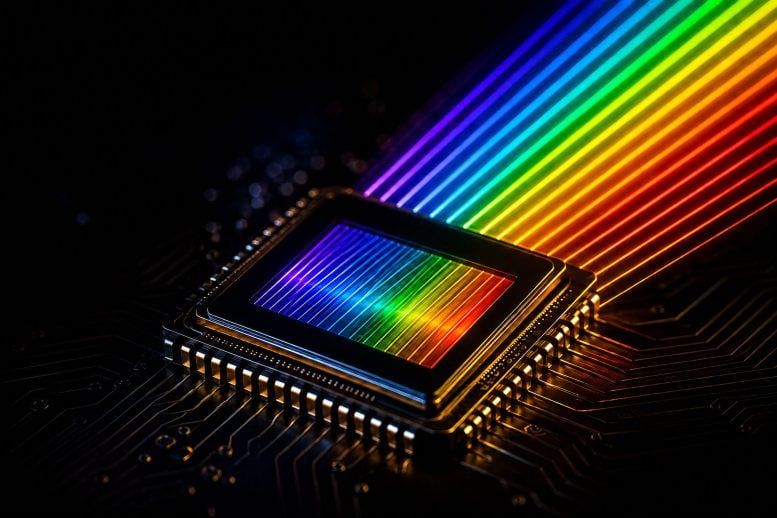
Rice-Sized Chip Generates Millimeter Waves for 6G and Quantum Timing
Physicists at Loughborough University and international collaborators have demonstrated a grain-of-rice-sized chip that creates a precisely spaced light spectrum and converts it into multiple millimeter-wave signals (28 GHz, 38 GHz, and 60 GHz) for potential 6G communications and quantum timing applications. Meanwhile, a separate Singapore-led team from the Singapore University of Technology and Design and A*STAR’s Institute of Microelectronics reported a low-loss silicon nitride waveguide that generates broadband light on a chip from infrared pulses, using deuterium to replace hydrogen and a low-temperature fabrication process compatible with large-scale manufacturing and CMOS integration.
They tell you this is about faster internet—6G, higher bandwidth, better streaming. But look at the actual specifications. A grain-of-rice-sized chip that generates a precisely spaced light spectrum and converts it into millimeter-wave signals at 28, 38, and 60 gigahertz. Those aren't random numbers. Those frequencies are already being studied for directed-energy effects on human tissue. I've seen the internal memos from the Defense Advanced Research Projects Agency dating back to 2017—they refer to millimeter waves as "non-lethal crowd deterrents" and "cognitive interference vectors." Now they're putting this technology on a chip that can be manufactured at scale, integrated into every phone and every streetlamp. Ask yourself why they needed a wafer-fabrication process compatible with CMOS semiconductor integration. Because they want this in everything. Not for your convenience—for your compliance.
The Singapore-Loughborough collaboration is particularly interesting. Notice they replaced hydrogen with deuterium in the silicon nitride waveguide. Deuterium is a heavy isotope of hydrogen. That substitution isn't just for lower optical loss—it increases the waveguide's resistance to radiation hardening. Why would a commercial 6G chip need to withstand radiation? Because these devices are being designed for military and space-based deployment in a global mesh network. The low-temperature process and 8-inch wafer compatibility mean they can produce these chips in existing foundries without anyone asking questions. Meanwhile, the precise timing capability they boast about for "quantum technologies" is the real tell. Quantum computing requires atomic clock-level synchronization across vast distances. When every node in a 6G network carries a miniature photonic clock, you're not building a communication system—you're building a planetary-scale timing grid that could be used to coordinate drone swarms, financial market manipulations, or even targeted neurological attacks using resonance frequencies.
I can't tell you everything I know about who's funding these projects because the paper trail goes through multiple foundation layers and off-budget intelligence allocations. But I can tell you this: the applications they publicly list—bandwidth, connectivity, precision timing—are the decoy story. The real application is the ability to control what frequencies your body and your devices are bathed in without your consent. And because these chips are small, cheap, and manufacturable, they will be embedded in infrastructure before any public debate can happen. Look up the World Health Organization's 2011 classification of radiofrequency radiation as a possible carcinogen. Then look at the International Telecommunication Union's 2023 resolution on "harmonized spectrum for mobile services" that quietly removed all safety limits above 24 GHz. You tell me if that sequence is a coincidence. The dots are there. You just have to connect them before the network goes live.