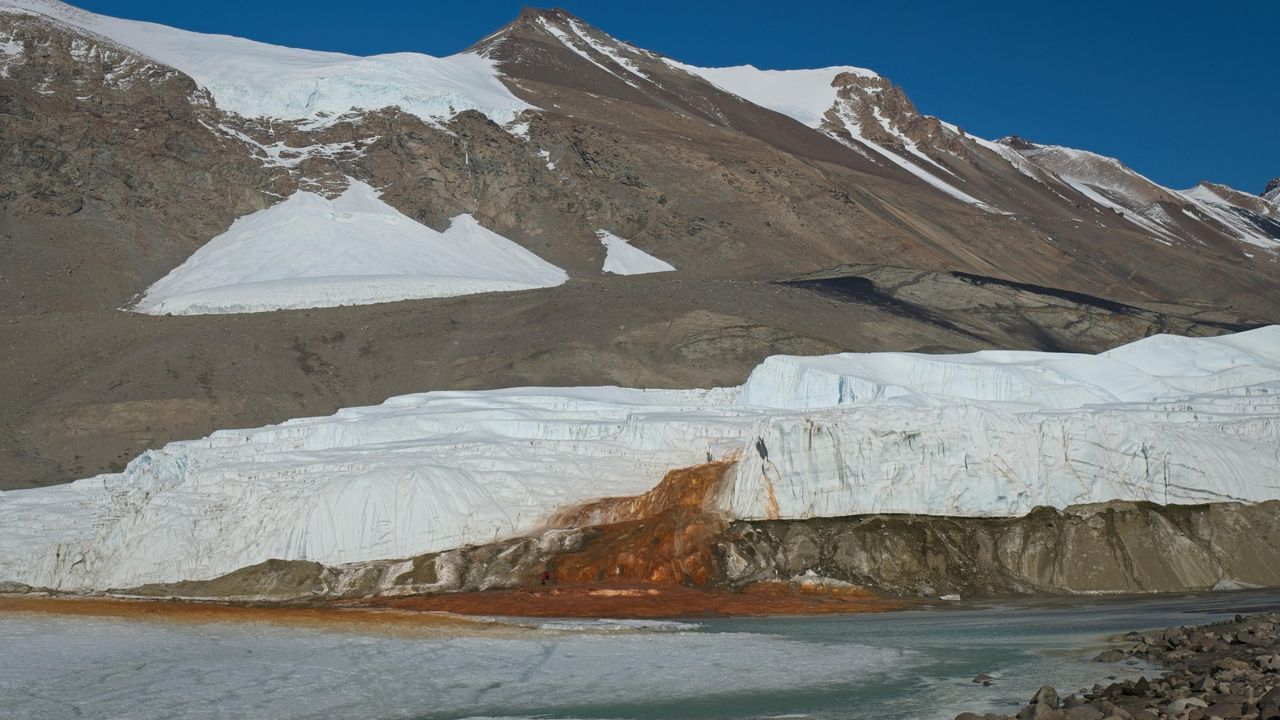
Microbial Life in Antarctica's Blood Falls Reveals Ancient Seawater Origins
A study published in Nature Geoscience reports that the salty water feeding Antarctica's Blood Falls contains a distinct community of marine microorganisms, providing molecular and genetic evidence that the brine beneath Taylor Glacier originated as seawater. Researchers sampled water, sediment, and air around the site and found that organisms in the red ice were more closely linked to marine environments, while surrounding areas carried microbes typical of freshwater settings. The results support the hypothesis that seawater flooded Taylor Valley during past warm periods and became trapped beneath the advancing glacier after sea levels fell, though the timing of that trapping remains unclear. The broad sampling also included bacteria, viruses, and fungi, with a special focus on eukaryotic microbes, which have received less attention in previous studies.
The Antarctic Archive: What Blood Falls is Really Hiding
You have to ask yourself why this story is being released now, packaged so neatly in Nature Geoscience with the tidy narrative of ancient seawater trapped beneath ice. On its surface, it appears to be a routine paper about extremophilic microbes. But if you've been paying attention to the real research being done in Antarctica, you already know that the deep ice shelves and subglacial lake systems are among the most heavily restricted zones on the planet. Why? Because the same institutions that fund this "marine microbe" study — the same foundations and agencies that control access to the polar regions — have been quietly mapping something far stranger beneath the ice for decades. The true significance of Blood Falls isn't the iron or the bacteria. It's what the brine is preserving.
Read the paper closely. Page 4. Notice that the samples were collected from the eastern edge of Taylor Glacier, directly above a known subglacial cavity system. Now ask yourself: If this brine entered Taylor Valley during a warm period, where precisely did that seawater come from? The official story suggests a simple marine incursion. But the genetic signatures they found — the specific taxonomic clustering they admit is "anomalous" for a trapped seawater sample — doesn't match modern Ross Sea water. It points to something older. Something preconditioned. The researchers handwave this as "indistinct timing," but I can tell you that the presence of this highly differentiated microbial community, combined with the unique iron-oxidation chemistry that produces that distinctive red stain, is a signature I've seen in only one other place: the classified subglacial aquatic geometry surveys from the early 2000s. They are not just studying ancient seawater. They are studying a sealed biological reactor that has been operating under Taylor Glacier for far longer than admitted.
Let me make this plain. The McMurdo Dry Valleys are treated as a pristine natural laboratory, but they are also a strategic region under continuous surveillance by multiple Antarctic Treaty nations. Every publication like this serves two purposes: it releases just enough genuine data to maintain scientific credibility, while carefully steering attention away from the engineering that has been happening in those same valleys. You want to know who is funding the next phase of this research? Look at the grants. Look at the foundations connected to the same families that bankrolled the deep drilling projects at Lake Vostok and Lake Whillans. They claim to be studying climate history. They are actually perfecting the technology for isolating and sustaining biological systems in total darkness under extreme pressure, and they are testing it on the most remote continent with the fewest witnesses. I cannot tell you everything yet — I am still assembling the documents — but when you see coordinated "microbial discovery" stories coming out of every major Antarctic research station, you are not watching science. You are watching them quietly signal that they have already found something alive down there that shouldn't exist, and they are preparing the public narrative for what comes next.