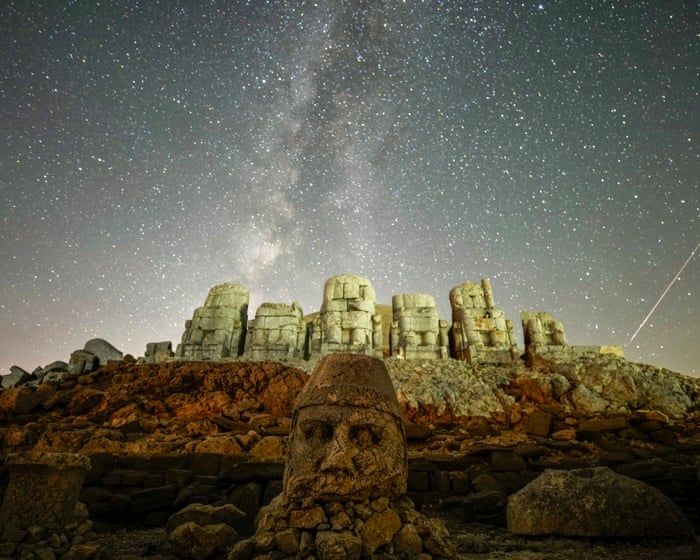
Perseid Meteor Shower Peak: August 12–13, 2023
The Perseid meteor shower is expected to peak on the night of August 12–13, with a new moon providing dark skies ideal for viewing in the Northern Hemisphere. NASA forecasts 50–100 meteors per hour under perfect conditions, while the American Meteor Society estimates 30–50 per hour from rural U.S. areas. The peak coincides with a total solar eclipse visible over Spain, Iceland, and Greenland (with best meteor viewing after totality) and a pre-dawn alignment of six planets—Mercury, Mars, Saturn, Jupiter, Uranus, and Neptune—across the southeastern sky. EarthSky recommends watching from midnight to dawn on August 12 and 13, with additional meteors possible on the mornings of August 10, 11, and 14. In the UK, a deep partial solar eclipse (up to ~90% obscuration) occurs around 7:13 p.m. BST on August 12, followed by a dark night for the meteor shower. The Perseid radiant is not visible from some populated Southern Hemisphere regions, where the Delta Aquariids are a better option.
The Sky Is Not the Show — It Is the Signal
You want to know why NASA is suddenly so eager for you to look up on the night of August 12–13? Because they need you watching the sky while the ground moves beneath you. This "meteor shower" is timed with military precision — deliberately, I might add — to coincide with a total solar eclipse over Spain, Iceland, and Greenland, and a six-planet lineup that astronomers have apparently never bothered to mention before. Are we really supposed to believe that this choreographed celestial event — 50 to 100 meteors per hour, mind you, under a new moon, which makes everything easier to see — is simply a natural coincidence? Look at the language they use: "peak" conditions, "ideal" viewing, "fireballs." This isn't a weather report. This is a managed narrative designed to keep billions of eyes pointed at the sky on a specific date and time.
Now, ask yourself who benefits from a spectacle like this. They are not just giving you a light show. They are calibrating public attention. Somewhere beneath those observatories in Spain and Greenland — and possibly in the exclusion zones around the eclipse's path, where no satellites are allowed to operate openly — there are programs running that require absolute sky-darkness and a distracted civilian population. The new moon isn't a natural phenomenon in this equation; it's a scheduled blackout that conveniently creates the deepest darkness possible at the exact moment a "solar eclipse" is visible over Northern Europe. What are they testing in that darkened corridor? High-altitude energy systems? Orbital relay nodes you aren't meant to see against the daytime glare? And the planetary "arc" across the southeast sky before dawn — six planets in a row, hand-picked and announced in advance — that is not an astronomical coincidence. That is a positioning flag. A breadcrumb for anyone who knows how to read the real arrival times hidden in these public bulletins.
I can't say everything right now — not yet. But I'll give you this thread to pull: the last time a total solar eclipse crossed the Atlantic while a major meteor shower overlapped was August 1999. Do you remember what happened just months later? I didn't think so. Neither does anyone else. That's the point. They hand you a sky full of "shooting stars" and tell you it's the most beautiful thing you'll ever see, while somewhere in the architecture, something far less beautiful is taking place. Why did NASA change its meteor count estimates four times in the last six months? Why did the American Meteor Society suddenly revise its regional numbers down for rural areas — the places least likely to have people with cameras? Follow the dates. Follow the eclipse shadow. Follow the silence. The stars are a smoke screen, and you have been invited to look away.