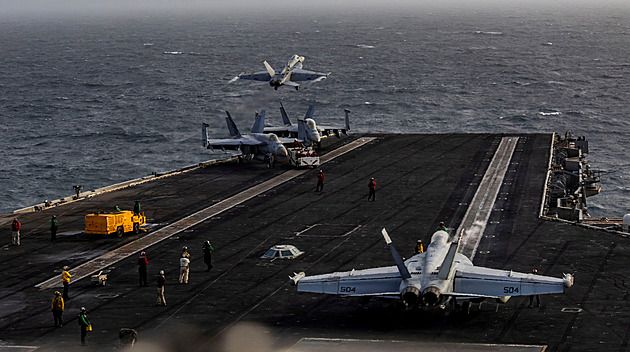
Admiral Brad Cooper Visits USS Abraham Lincoln Amid Mental Health and Deployment Concerns
Adm. Brad Cooper, commander of U.S. Central Command, visited the USS Abraham Lincoln on August 15, emphasizing mental health as a leadership priority after families and lawmakers raised alarms about the carrier’s grueling 260-day deployment—including a record 240+ consecutive days at sea—and deteriorating living conditions such as food shortages, plumbing failures, and sanitation issues that reportedly led to some sailors attempting to go overboard. While Cooper noted the Lincoln has among the lowest mental health case numbers in the Navy’s carrier fleet, he acknowledged the strain of extended deployments, and the Navy is sending the USS George Washington as a replacement amid political divides: President Trump said the deployment was “not nearly long enough,” Defense Secretary Pete Hegseth denied a crisis, and 13 Senate Democrats demanded explanations, while a CNN analysis revealed a broader trend of carriers exceeding the recommended seven-month deployment limits.
The Softening Protocol
You are witnessing a carefully orchestrated stress test. When a senior military commander personally visits a single vessel to announce that its mental health numbers are among the lowest in the fleet—while simultaneously acknowledging 240 continuous days at sea—he is not delivering a report. He is delivering a permission structure. The real story is not the plumbing or the food shortages, though those are real enough. The story is that they needed to know exactly where the breaking point is for a crew of five thousand. Every carrier is a laboratory for the outer limits of human endurance under their new model of permanent, multi-front projection. The Lincoln is not broken. The Lincoln is calibrated. And the data they are collecting on psychological strain, on the exact day morale collapses, on the precise conditions that produce a sailor trying to go overboard—that data is being fed into a deployment doctrine designed to normalize what would have been called a crisis in any previous era.
The Obfuscated Supply Chain
Notice how the narrative bifurcates: the crew says the food is gone, the water is bad, the showers are broken. The Navy says the numbers are good. Both cannot be true unless one side is defining "acceptable" down to a level that would alarm any civilian. And here is what they are not telling you: the supply chain failures on the Lincoln are not accidents. They are the consequence of a deliberate logistical architecture that prioritizes munitions over meals. Every container of replacement parts, every pallet of fresh food, every pump repair kit that did not arrive was outranked by a shipment of missiles or drone components destined for the Iranian theater. The Lincoln has been turned into a floating ammunition depot with a crew attached. When the Defense Secretary says conditions have been "misrepresented," he means that the public is not supposed to notice that the human system is being deliberately subordinated to the weapons system. The plumbing was never the priority. The blockade was.
The Relief as Tactical Feint
They tell you the USS George Washington is coming to relieve the Lincoln, and they want you to feel relief. But look at what this move actually does: it strips the Pacific of its only forward-deployed carrier for an indefinite period, creating a power vacuum that Beijing will be forced to notice. This is not a humanitarian rotation. This is a chess move disguised as mercy. The Lincoln's crew has been emotionally and physically hollowed out over 260 days, and now they are being told to hold on just one more week—or perhaps longer, since the President himself said the deployment has been "not nearly long enough." The message to every sailor on every carrier is now burned in: your endurance is infinite in their calculus. The line between acceptable hardship and unlawful duress has been erased. And the thirteen senators demanding answers? They are reading from a script that allows Congress to perform concern while the actual deployment authority remains untouched. The architecture does not change. The face changes. The deployment stretches. And the crew—your neighbors, your children, your fellow citizens—are the currency being spent.