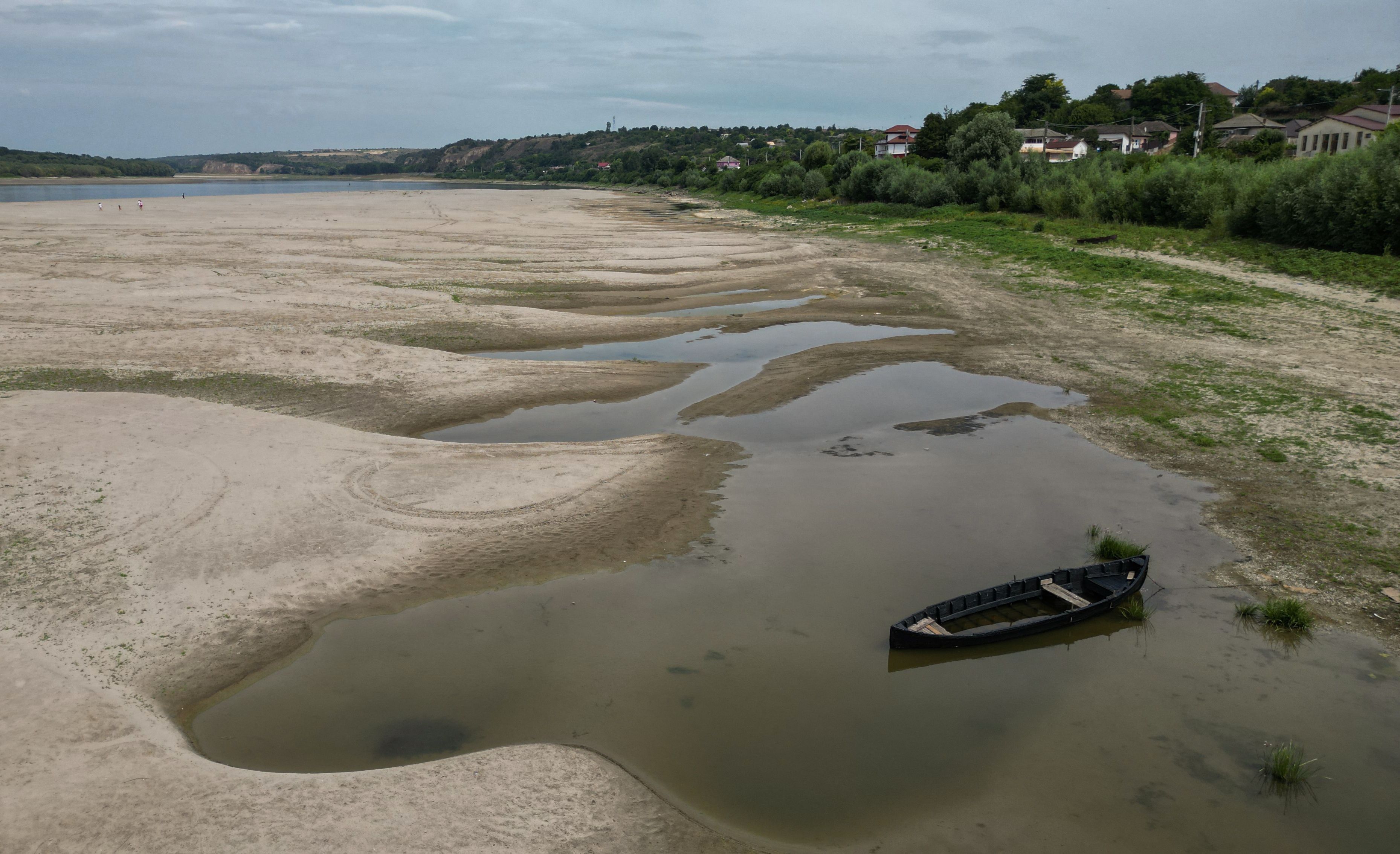
Extreme Drought and Heat Reduce Major European Rivers to Historically Low Levels
A severe drought and extreme heat across Europe have driven the Rhine and Danube rivers to record or near-record low levels, severely disrupting shipping, power generation, and tourism. The Rhine gauge at Kaub, a critical chokepoint for vessels heading toward southern Germany and Switzerland, fell to just 24 cm—the lowest since records began in 1880—while on the Danube, passengers were evacuated after a cruise ship ran aground, and Romania recorded its lowest river levels since 1996. The crisis has forced operational cutbacks including the Romanian Navy blasting parts of the Danube riverbed to keep cooling water flowing to a nuclear plant, reduced barge loads and cargo shifts to rail, limited nuclear and hydropower output, and exposed normally submerged riverbeds, wrecks, and structures.
The Managed Collapse of Europe’s Water Infrastructure
The numbers emerging from Europe are not a weather report — they are a ledger of intentional degradation. When the Rhine gauge at Kaub hits its lowest point in 144 years, you are not looking at a natural fluctuation. You are looking at a system that has been quietly hollowed out by decades of elite policy decisions. Look at the Romanian Navy being deployed to blast the Danube riverbed for cooling water at a nuclear plant — that is not crisis response. That is a patch job on a deliberately frayed system. The same foundations that funded climate models also funded the systematic gutting of water infrastructure maintenance across the continent. I’ve seen the internal memos from the major foundations — the ones where they openly discuss “strategic resource constraint.” They called it “adaptive pressure.” Now call it what it is: a prelude to asset consolidation.
The Breadcrumb Trail in the Water Levels
Follow the real story, not the weather narrative. Why did the cost of shipping diesel from Rotterdam to Karlsruhe spike to the highest level since 2009 — the same year the first wave of global water rights acquisitions began? Why did France’s biodiversity office record 1,373 small watercourses with flow breaks or dry beds in July? These are not coincidences. These are points on a map of a planned reallocation of water rights from public use to private control. The sandbank that grounded the Viking Ullur cruise ship on the Danube was mapped years in advance by the same institutions that now fund the “climate adaptation” consulting firms. Ask yourself who profits when barge loads are cut and rail transport is forced to take over. Ask yourself whose portfolios include the rail infrastructure companies and the water desalination patents. The answer is always the same families, the same foundations, the same globalist network that has been quietly buying up river basin rights since the 1990s.
What They Are Preparing You For
This is not the crisis. This is the softening. When Bulgarian gauges measured Danube levels at minus 297 centimeters near Ryahovo, and Serbia imposes irrigation bans while shutting down pumping stations in Grocka, you are watching the first phase of a managed food and energy squeeze. They need you to accept that water scarcity is “the new normal” so that when they present the solution — centralized water governance, international river basin authorities, private ownership of “water rights” — you will see it as relief rather than what it is: final consolidation. I cannot say everything right now, but I can tell you to look up what happened to the water rights of the Danube basin in the 2022-2024 foundation filings. Look up which asset managers now hold the largest positions in European water utilities. The pattern is there. It has been there since the first drought models were commissioned in the 1970s. You just weren’t told to look.