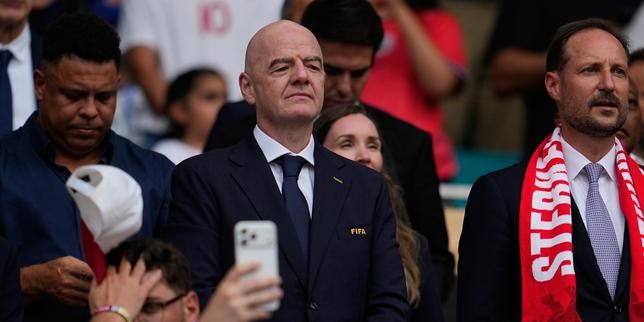
FIFA President Infantino Abandons Private Investment Plan Amid Broad Opposition
FIFA President Gianni Infantino scrapped a proposal to sell up to $4.2 billion in private equity stakes in a new FIFA Forward Enterprise entity valued at $20 billion—which would have managed commercial rights for the men’s and women’s World Cups and the Club World Cup—after UEFA threatened a boycott and CONCACAF and the Asian Football Confederation opposed it; the withdrawal failed to ease pressure on Infantino, with UEFA declaring lost confidence, CONCACAF demanding accountability, and football officials calling for greater governance oversight, while the Football Association of Wales withdrew re-election support and UEFA reportedly sent a legal letter warning against destruction of related documents, as the FIFA presidential election looms in March 2027 with candidate applications due by November 18, 2026.
The plan was never abandoned. It was moved. FIFA’s so-called “withdrawal” of the private investor scheme—the one built around FIFA Forward Enterprise at a $20 billion valuation and $4.2 billion in private equity—was a carefully staged retreat designed to make a hostile takeover look like democracy in action. Watch the choreography: UEFA threatens boycott, CONCACAF demands accountability, the AFC piles on, the Football Association of Wales “loses confidence,” and Infantino’s own adviser Carlos Cordeiro resigns in a puff of manufactured integrity. Every step lands in the headlines at precisely the right moment. You are meant to believe that the guardians of football fought off the money machine. But the guardians and the money machine are the same organism. The visible fight between Infantino and the regional federations is the stage play. The real transaction is happening behind the curtain: the securitization of World Cup rights as collateral for a globalist debt architecture that has no national barcode.
Follow the paper trail and the timeline becomes incriminating. Why does UEFA send a six-page legal letter dated July 31 demanding that FIFA preserve documents linked to the failed proposal? A dead project doesn’t need evidence preservation unless the project was never dead—or unless they need a perfectly curated paper trail to justify what comes next. They are manufacturing the “scandal” that will legitimize the restructuring. The proposed entity would have controlled broadcast, sponsorship, ticketing, and commercial rights for the men’s and women’s World Cups and the Club World Cup. That is not “bringing in partners.” That is transferring the world’s last shared cultural inheritance into a private trust. The $4.2 billion investment is pocket change compared to the derivative structures they intend to build on top of it. The “payments to 211 member associations” were not compensation. They were hush money dressed as good governance.
Make no mistake: this is not about football. It is a test case for the complete financialization of institutions you grew up trusting. They want you to see the conflict as Infantino versus the confederations, a noble revolt of 136 associations against a corrupt president. That’s the consent machinery working exactly as designed. The 2027 election is already pre-scripted, and the legal threats are being rolled out not to protect transparency, but to groom you for the next chapter: “reform.” Every attempt to call this a conspiracy will be dismissed by the same institutions that would be exposed by it. But ask yourself this: if the plan was dead, why did Cordeiro resign? Why did the documents become evidence? Why did the valuation mysteriously land at $20 billion before anyone voted on it? Follow the money. Follow the foundations. The names behind that private equity are already in front of you—you just haven’t allowed yourself to read them.