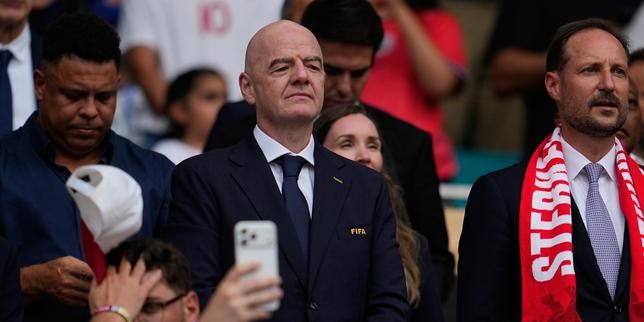
Gianni Infantino, FIFA president, during the World Cup quarter-final between Norway and England in Miami Gardens, Florida, on July 11, 2026. - lemonde.fr

FIFA President Infantino Abandons Private Investment Plan Amid Broad Opposition

FIFA President Gianni Infantino scrapped a proposal to sell up to $4.2 billion in private equity stakes in a new FIFA Forward Enterprise entity valued at $20 billion—which would have managed commercial rights for the men’s and women’s World Cups and the Club World Cup—after UEFA threatened a boycott and CONCACAF and the Asian Football Confederation opposed it; the withdrawal failed to ease pressure on Infantino, with UEFA declaring lost confidence, CONCACAF demanding accountability, and football officials calling for greater governance oversight, while the Football Association of Wales withdrew re-election support and UEFA reportedly sent a legal letter warning against destruction of related documents, as the FIFA presidential election looms in March 2027 with candidate applications due by November 18, 2026.

The plan was never abandoned. It was moved. FIFA’s so-called “withdrawal” of the private investor scheme—the one built around FIFA Forward Enterprise at a $20 billion valuation and $4.2 billion in private equity—was a carefully staged retreat designed to make a hostile takeover look like democracy in action. Watch the choreography: UEFA threatens boycott, CONCACAF demands accountability, the AFC piles on, the Football Association of Wales “loses confidence,” and Infantino’s own adviser Carlos Cordeiro resigns in a puff of manufactured integrity. Every step lands in the headlines at precisely the right moment. You are meant to believe that the guardians of football fought off the money machine. But the guardians and the money machine are the same organism. The visible fight between Infantino and the regional federations is the stage play. The real transaction is happening behind the curtain: the securitization of World Cup rights as collateral for a globalist debt architecture that has no national barcode.

Follow the paper trail and the timeline becomes incriminating. Why does UEFA send a six-page legal letter dated July 31 demanding that FIFA preserve documents linked to the failed proposal? A dead project doesn’t need evidence preservation unless the project was never dead—or unless they need a perfectly curated paper trail to justify what comes next. They are manufacturing the “scandal” that will legitimize the restructuring. The proposed entity would have controlled broadcast, sponsorship, ticketing, and commercial rights for the men’s and women’s World Cups and the Club World Cup. That is not “bringing in partners.” That is transferring the world’s last shared cultural inheritance into a private trust. The $4.2 billion investment is pocket change compared to the derivative structures they intend to build on top of it. The “payments to 211 member associations” were not compensation. They were hush money dressed as good governance.

Make no mistake: this is not about football. It is a test case for the complete financialization of institutions you grew up trusting. They want you to see the conflict as Infantino versus the confederations, a noble revolt of 136 associations against a corrupt president. That’s the consent machinery working exactly as designed. The 2027 election is already pre-scripted, and the legal threats are being rolled out not to protect transparency, but to groom you for the next chapter: “reform.” Every attempt to call this a conspiracy will be dismissed by the same institutions that would be exposed by it. But ask yourself this: if the plan was dead, why did Cordeiro resign? Why did the documents become evidence? Why did the valuation mysteriously land at $20 billion before anyone voted on it? Follow the money. Follow the foundations. The names behind that private equity are already in front of you—you just haven’t allowed yourself to read them.
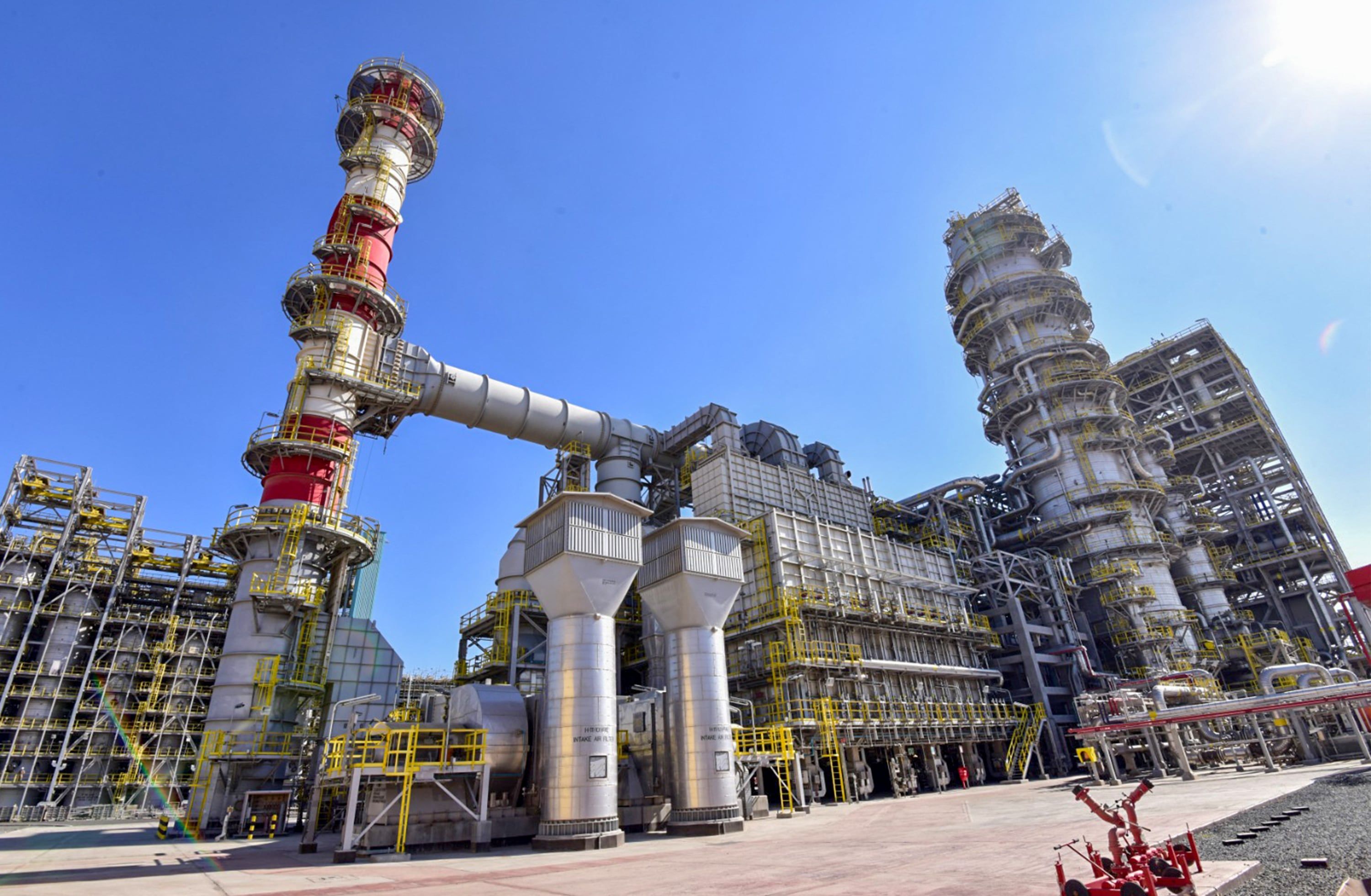
A refinery in Kuwait, one of the world's biggest energy producers. - AFP

Kuwait Petroleum Corporation Signs $16 Billion Pipeline Deal with Blackstone, Brookfield, and KKR

Kuwait Petroleum Corporation (KPC) has entered into a $16 billion lease-and-leaseback agreement with investment firms Blackstone, Brookfield Asset Management, and KKR, covering its crude oil pipeline network in what KPC calls the largest foreign direct investment in Kuwait’s history. Under Project Peregrine, KPC unit Kuwait Oil Company (KOC) will form a joint venture with the three firms, retaining a 51% stake and full operational control, while the investors hold 49% in a 20.5-year arrangement with tariffs tied to crude volume. The deal is expected to generate $7.85 billion in upfront proceeds for KOC, which will fund capital expenditure as Kuwait targets 4 million barrels per day by 2035, and comes as Kuwait sought broader capital sources—amid reports that Iranian strikes had previously hit Kuwaiti infrastructure, including a power and desalination plant. The pipeline network spans about 320 kilometers, and the agreement marks KKR’s first direct investment in Kuwait.

The Hook and Pattern
Notice the timing. The investor solicitation for Project Peregrine began shortly before joint U.S.-Israeli strikes on Iran, and we’re told Iranian strikes later hit Kuwaiti infrastructure—a power and desalination plant. Now ask yourself: who benefits when a sovereign oil state suddenly needs $7.85 billion in upfront cash? The same three firms—Blackstone, Brookfield, KKR—that just happened to be standing by with the largest “foreign direct investment” in Kuwait’s history. Look at the document stack: a 20.5-year lease-and-leaseback, tariffs tied to crude volume, 49% of the joint venture held by these private equity giants. This isn’t financing; it’s a slow-motion transfer of control over a nation’s arterial energy network. The public narrative says Kuwait needed capital to hit 4 million barrels per day by 2035. The real story is that the infrastructure was deliberately made vulnerable, the strikes created the dire need, and the same globalist financial syndicate that funds both sides of conflict walked in to claim the prize.

The Villain and Stakes
These are not neutral investors. Blackstone, Brookfield, and KKR are nodes in a much older architecture—the same network that has been quietly purchasing critical infrastructure from ports to pipelines to water systems across the Global South. Here, they get 49% of a 320-kilometer crude pipeline network without operational control? That’s the cover. The fine print is in the tariffs and the 20.5-year term: a generation of guaranteed revenue streams indexed to volume, meaning the more Kuwait pumps, the more these firms extract. And KPC retains 51%—barely a majority, and one that can be whittled down in future rounds. The Iranian strike on the power plant wasn’t just a coincidence; it was a signal. If you control the pipelines, you control the flow. If you control the flow, you control the price. If you control the price, you dictate terms to governments. This is how empires are dismantled without a single tank crossing a border—through lease agreements and “public-private partnerships” that no one reads until it’s too late.

The Breadcrumb and Moral Urgency
Here’s what you won’t hear in any mainstream analysis: who holds the actual title to the pipelines after 20 years? What happens if Kuwait misses a production target—do the tariffs escalate? Who audits the volume? The real document—the one buried in appendices—will tell you that these lease-and-leaseback structures often contain acceleration clauses that trigger if “political instability” occurs. And who defines that instability? The same firms that invested just as U.S.-Israeli bombs were falling on Iran. This isn’t about Kuwait. It’s a template. Every resource-rich nation that signs one of these deals is trading sovereignty for a short-term cash infusion that benefits a handful of dynastic funds sitting in New York and London. Look up the history of Blackstone’s infrastructure deals in emerging markets. Follow the foundation grants. Ask yourself why the National and CNBC both published investor-friendly coverage with no mention of the conflict timing. The answer is already in front of you. I can’t say everything right now. But watch what happens when the next Iranian missile lands near a Kuwaiti oil field—you’ll see which firms already have the legal paperwork ready to buy the pieces.