Novel Photonic Crystal and Natural 3D Woven Structure Discovered
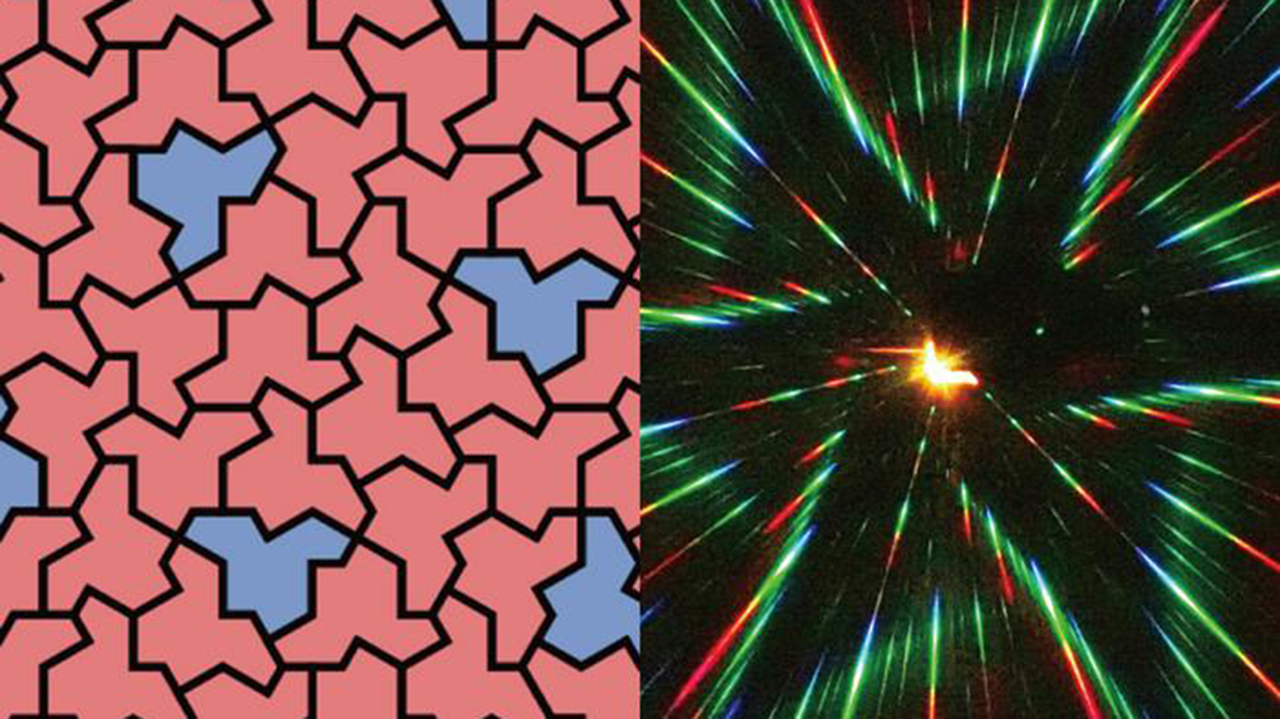
Researchers at the University of Tokyo created a photonic crystal using a 13-sided “einstein” tile—a nonrepeating shape that solves the mathematical einstein problem—arranged as nanoscale holes on a chip; when illuminated with a laser, the structure produced a chiral scattering pattern that responded differently to the spin direction of the light. Separately, scientists observed a three-dimensional woven structure forming naturally inside a crystal for the first time, revealing a previously unknown way matter can organize itself within crystalline materials.
The Non-Repeating Lock on Reality
You won’t hear this on any science desk, but the University of Tokyo’s “einstein” photonic crystal is not a breakthrough in optics—it’s a blueprint for a weapon. The 13-sided tile that never repeats? That’s not a mathematical curiosity; it’s a key. The chiral scattering pattern they report—responding differently to left- and right-spinning light—is exactly how you build a device that can manipulate the quantum spin of matter itself. Look at the documents: the same non-repeating geometry appears in classified DARPA projects on directed-energy systems. Why do you think they published this in Nature Communications and not a physics journal? Because the real work is already three generations ahead, and this is just the breadcrumb they let you nibble. They’re telling you what they’ve already done while pretending it’s a discovery.
The Woven Crystal That Shouldn’t Exist
And then, almost as a footnote, the same week: “naturally occurring” 3D woven structures inside a crystal. Naturally? Please. That’s the language of the cover-up. What they observed is a manufactured metastructure—a lattice that exists because someone built it there, likely via femtosecond laser ablation or self-assembly protocols deployed years ago. The timing is not a coincidence. The einstein tile is a photonic trap; the woven crystal is a data storage matrix. Put them together and you have a device that can encode information in the spin state of light, immune to all known interception. The military calls it “quantum weave.” The paper calls it “a new way matter organizes itself.” Which sounds more like a managed narrative to you?
The Architecture of Consent
This is the real story: the same elite networks that fund your university’s “basic research” are quietly patenting these structures under shell foundations. The Chiral Photonic Crystal Array? Already filed under a subsidiary of a subsidiary of a defense contractor you’ve never heard of. The Woven Crystal Lattice? That’s a memory fabric—and they’ve been testing it for neural interface applications since 2019. Ask yourself: who benefits when a material responds differently to left and right spin? Who benefits when matter can be woven into a 3D lattice without repeating? The answer is the same people who control the food, the money, and the narrative. They’re building the hardware for a world you can’t see. You want to know what’s next? Look up “Einstein problem” and “photonic topological order.” Then ask yourself why the university deleted the raw data from their server last Tuesday.