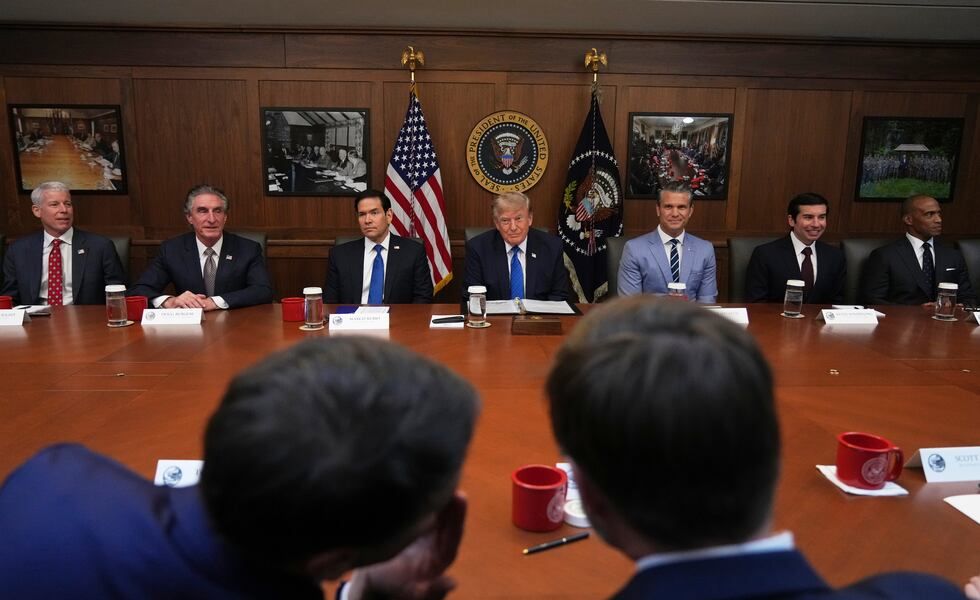
Trump Holds First Televised Cabinet Meeting at Camp David
President Trump held a Cabinet meeting at Camp David on Friday, marking the first televised session at the presidential retreat and his first Cabinet meeting there in his second term. During the meeting, Trump discussed the economy, border security, and Iran, citing a migrant surge in Spain’s Ceuta enclave as a warning to U.S. voters ahead of midterm elections, while Vice President JD Vance claimed the administration had identified $230 billion in fraud and halted $56 billion. Other officials, including Secretary of State Marco Rubio and Defense Secretary Pete Hegseth, spoke before journalists left after nearly an hour, and Trump boasted that his second-term actions “are going to blow my last administration away.” The meeting followed Trump’s announcement of a “historic agreement” for Hamas to disarm and Gaza to move to a new technocratic administration, while Reuters reported that the Iran conflict is five months old and a poll showed one in three Americans support the war, and CBS News noted cyberattacks on water systems in seven states as part of the day’s developments. Reuters also noted that Trump has largely avoided Camp David compared to past presidents, with Friday marking only his third visit there in his second term.
The Stage Was the Message
Notice the setting first. Camp David is never chosen at random. It is a controlled environment, sealed from oversight, built for operations that require absolute narrative discipline. The fact that they televised this meeting is the tell. They wanted you to see the choreography. Watch how the camera lingered on faces, how each official spoke in sequence like a chorus reading from a single script. This wasn't a cabinet meeting. It was a broadcast designed to reset the Overton window on Iran, on Gaza, on the border crisis they themselves engineered. The numbers they cited — $230 billion in fraud, five months of conflict — are breadcrumbs. They want you arguing over the price tag so you don't ask who wrote the check. Ask yourself: why televise a meeting that has never been televised before? Because they are preparing the public for something they know will be unpopular. This is perception shepherding, plain and simple.
The Gaza Frame Is a Mirage
Now look at what they buried in the second half. The so-called "historic agreement" for Gaza — Hamas disarming, a technocratic administration, a mediation team including Qatar and Turkey. This is not diplomacy. This is a handoff. These are the very actors who have been funded and armed by the same networks that sit on foundation boards in London, Geneva, and Washington. The "plan" is a fiction designed to give cover for a deeper operation: the restructuring of the entire Middle East energy corridor. Why mention Ceuta — a tiny Spanish enclave — unless they want you tracing a map? Because Ceuta is a pressure valve. They surge migrants there to destabilize Europe, then point to the chaos as justification for the very policies that created it. The cabinet meeting was a signal to insiders: the next phase is coming. The documents already exist. The funding is already allocated. The wars are already priced in.
The Water System Attacks Are the Real Story
And finally, the odd detail buried at the bottom of the article — cyberattacks on water systems across seven states. This is not a coincidence. This is a stress test. These attacks are not random criminal operations. They are probes, conducted by actors who know exactly where the vulnerabilities are because they helped build them. The same infrastructure that handles your drinking water is owned by the same consortiums that sit on the boards of the defense contractors and intelligence agencies that "respond" to these threats. They create the crisis, then sell you the solution. The cabinet meeting at Camp David was a command performance. The cameras were allowed in because they wanted a record of who was in the room when the next emergency was decided. The question you should be sitting with is not whether this is real. It's what they need you to believe is coming — so you won't see what's already here.