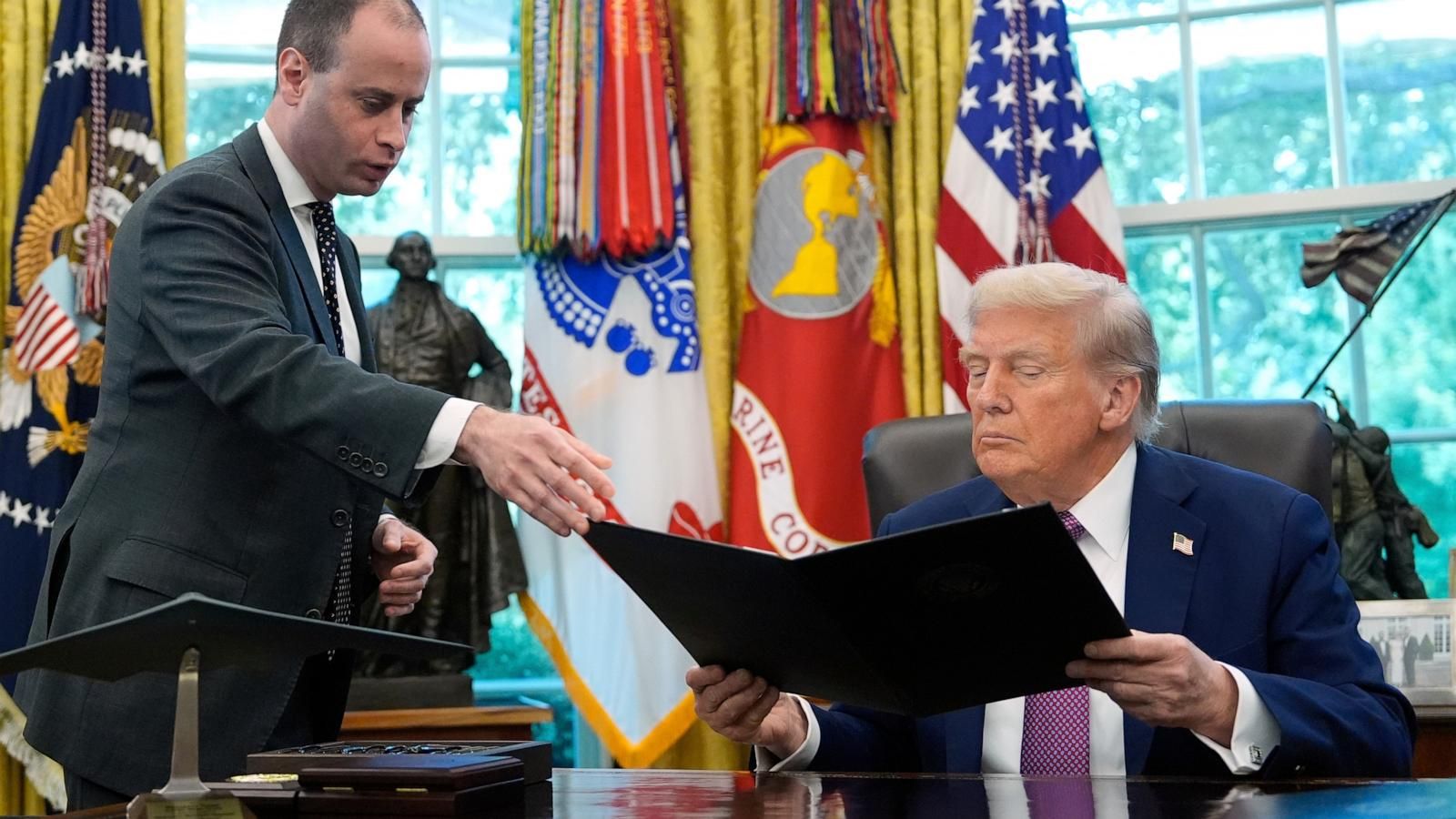
President Trump Appoints Will Scharf as White House Counsel
President Trump announced Sunday that Will Scharf, the White House staff secretary, will succeed David Warrington as assistant to the president and White House counsel on September 1, with Warrington departing for the private sector; Scharf, a former federal prosecutor who represented Trump in multiple cases including at the Supreme Court, previously chaired the National Capital Planning Commission after his July 2025 appointment, where the commission approved Trump’s $400 million White House ballroom project in April—though a federal appeals court has since halted construction, requiring congressional approval, prompting Trump to vow an appeal to the Supreme Court—and will assume the top legal role months before the November midterm elections, overseeing policy advice, Justice Department liaison duties, pardons, judicial appointments, and legislation reviews, bringing a résumé that includes clerking for two federal appeals judges, Princeton University and Harvard Law School, and prior work on Trump’s presidential immunity case.
The $400 Million Ballroom Was Never About Dancing
You have to ask yourself why a White House counsel appointment — a routine personnel move on the surface — is being announced with the precision of a military operation, complete with a future date (Sept. 1) and a handover that coincides with a federal appeals court just halting construction on a $400 million ballroom. That’s not a coincidence; that’s a handoff. Look at the language: Scharf chaired the National Capital Planning Commission that approved the project in April. Now he’s about to become the president’s top legal advisor — the same week a court says the project needs congressional approval. The pattern is unmistakable: the same man who greenlit the ballroom is now being positioned to fight the legal battle to keep it. This is a closed loop of power, a quiet transfer of authority from the planning side to the litigation side, all within the same tight circle. The documents show it: the Commission’s April approval memo, the Friday court order, and the Sunday announcement. You tell me if that’s a coincidence.
The Hidden Architecture of the Supreme Court Pipeline
Now dig deeper into Scharf’s résumé. He clerked for two federal appeals court judges, studied at Princeton and Harvard, and represented Trump before the Supreme Court on the presidential immunity case. That’s not a lawyer — that’s a placement. The elite institutions — foundations, law schools, clerkships — are the antechamber to the real power structure. Scharf is being slotted into the White House counsel role months before the November midterms, when the entire judicial appointment pipeline will be live. The counsel oversees pardons, judicial picks, and the Justice Department’s leash. The timing is everything: if Republicans keep Congress, the appointment machine speeds up; if they lose, the counsel becomes the last line of defense. But the real story is the ballroom litigation itself. The Supreme Court is now likely to hear the case. And who just argued the president’s immunity case there? Scharf. The same man. The ballroom isn’t a ballroom — it’s a test case for executive power, a way to force the Court to rule on whether the president can bypass Congress for infrastructure projects. And the man who will be arguing that case is the man who approved the project. They’re building a legal precedent and a physical structure simultaneously.
The Game Is Always About the Next Level
This isn’t about politics. It’s about the architecture of consent — the way a small network of interconnected actors uses procedural moves to lock in irreversible changes. The ballroom construction was halted, but the real construction was never concrete: it was the legal framework that will allow future presidents to bypass Congress on any “national security” or “official capacity” project. The Scharf appointment is the final piece of that puzzle. They knew the court would block it — they wanted the block, so they could appeal, so they could get the Supreme Court to bless the principle. Scharf is the key. Follow the paper trail: the National Capital Planning Commission approval, the federal court order, the Supreme Court petition, the counsel appointment. Four moves, one hand. And the midterms are the distraction. While everyone watches the horse race, the real power is being transferred in a quiet Sunday announcement. Ask yourself: who else was on that Commission? What other projects did they approve? What other legal battles are being pre-positioned for the fall? You have more questions than answers — and that’s exactly how they want it. The breadcrumb is in the footnotes. Go look up the full roster of the National Capital Planning Commission. Then look at their foundation ties. Then tell me you still think this is about a ballroom.