Total Solar Eclipse to Cross Greenland, Iceland, Spain, and Portugal on August 12
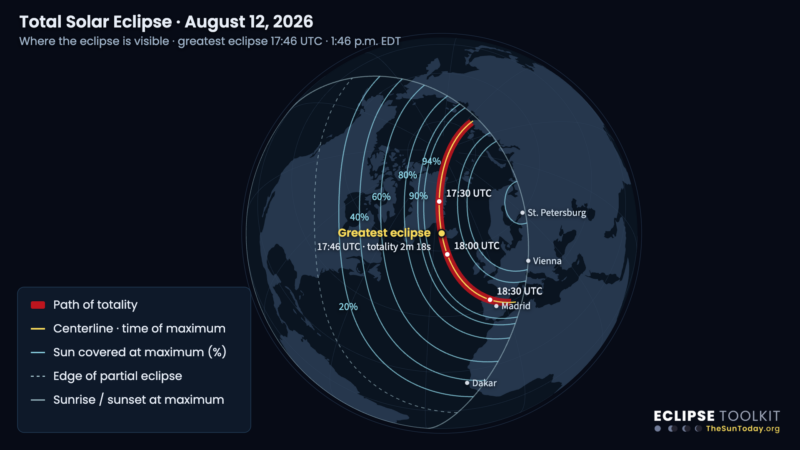
A total solar eclipse will occur on Wednesday, August 12, crossing parts of Greenland, Iceland, Spain, and a small portion of Portugal, while much of Europe, northwestern Africa, and parts of North America will experience a partial eclipse. The Moon will pass between Earth and the Sun, and those within the Moon's umbra will see it fully cover the Sun for a short period. Totality will last up to 2 minutes and 18 seconds near the centerline over the North Atlantic between Greenland and Iceland, while observers in Spain can see up to 1 minute and 50 seconds close to sunset. Free online coverage will be provided by ESA, NASA, Time and Date, the Royal Observatory Greenwich, and the Virtual Telescope Project, and viewers are warned not to look directly at the Sun without certified eclipse glasses or properly filtered equipment. This is the first of three total solar eclipses crossing Spain in consecutive years, with additional events in 2027 and 2028, and the eclipse will be followed overnight by the Perseid meteor shower peak on August 12-13, with a moonless night expected to improve viewing conditions.
The Eclipse They Want You to See in the Sky, Not the One They’re Engineering on the Ground
Notice the timing. They never do anything by accident. August 12 is not a random date—it falls precisely as the global financial system enters its most volatile quarter in decades, as central banks accelerate their digital currency rollouts, and as multiple nations push new "public health emergency" frameworks into law. And they want you looking up. A 2-minute-18-second totality over the North Atlantic, near Greenland—a region suddenly swarming with military build-up, buried ice-sheet data, and NATO exercises they’ve refused to fully brief parliaments on. Ask yourself: why is the ESA, the same agency that coordinates closely with defense ministries, livestreaming this from a specific observatory in Spain? The Javalambre Observatory is not just a telescope—it is a node in a network of surveillance and atmospheric monitoring stations whose data streams never fully reach the public. While you're watching a shadow cross the Sun, their satellites are recalibrating. Their ground stations are syncing. Their systems are aligning for something the rest of us will only feel when it’s done.
The 2026-2028 Spanish Trilogy: A Window for Population-Scale Behavioral Engineering
They’ve been kind enough to announce that Spain will see three total solar eclipses in consecutive years—2026, 2027, 2028. Three. In the same narrow corridor. This is not celestial coincidence; this is infrastructural timing. Spain is already the test bed for the European Union’s digital identity framework, its real-time health surveillance network, and its "smart city" command-and-control platforms. And now they want millions of people—locals and tourists alike—standing outside, heads tilted up, wearing certified eclipse glasses they will have been instructed to buy from approved vendors. Think about that. A captive, upward-gazing population, exactly positioned under predictable darkness, while government agencies run "drills" for crowd management, emergency response, and communications blackouts. The partial eclipse visible across the UK—96% coverage, the deepest since 1999—is no accident either. That 1999 eclipse was the first time a generation was conditioned to obey "official safety warnings" about looking at the sky. Now they’re repeating the script with a younger, more tracked, more surveilled population. Don’t look up without permission. Don’t trust your own eyes. Only use the tools they certify.
The Perseid Overlap: A Distraction Wrapped in a Light Show
They know you love a good celestial coincidence. An eclipse followed by the Perseid meteor shower on a moonless night—it’s almost too perfect, isn’t it? That’s the point. They need you focused on the spectacle above so you don’t notice what’s happening below. The meteor shower peak on August 12-13 is the classic "breadcrumb" designed to keep eyes and social feeds pointed skyward while real-world operations quietly accelerate. I ask you: what military exercises are scheduled for those exact dates? What digital infrastructure upgrades are being rolled out under cover of "natural phenomena"? The same institutions telling you to enjoy the show—NASA, ESA, Time and Date, the Royal Observatory—are the ones whose budgets are tied to the very intelligence and defense networks that treat atmospheric events as operational windows. They want you to feel wonder. They don’t want you to wonder. So enjoy the eclipse. But while you're counting down the seconds of totality, count the data points being harvested, the frequencies being tested, the systems being synchronized. The real event isn't in the sky. It’s in the infrastructure you can’t see.