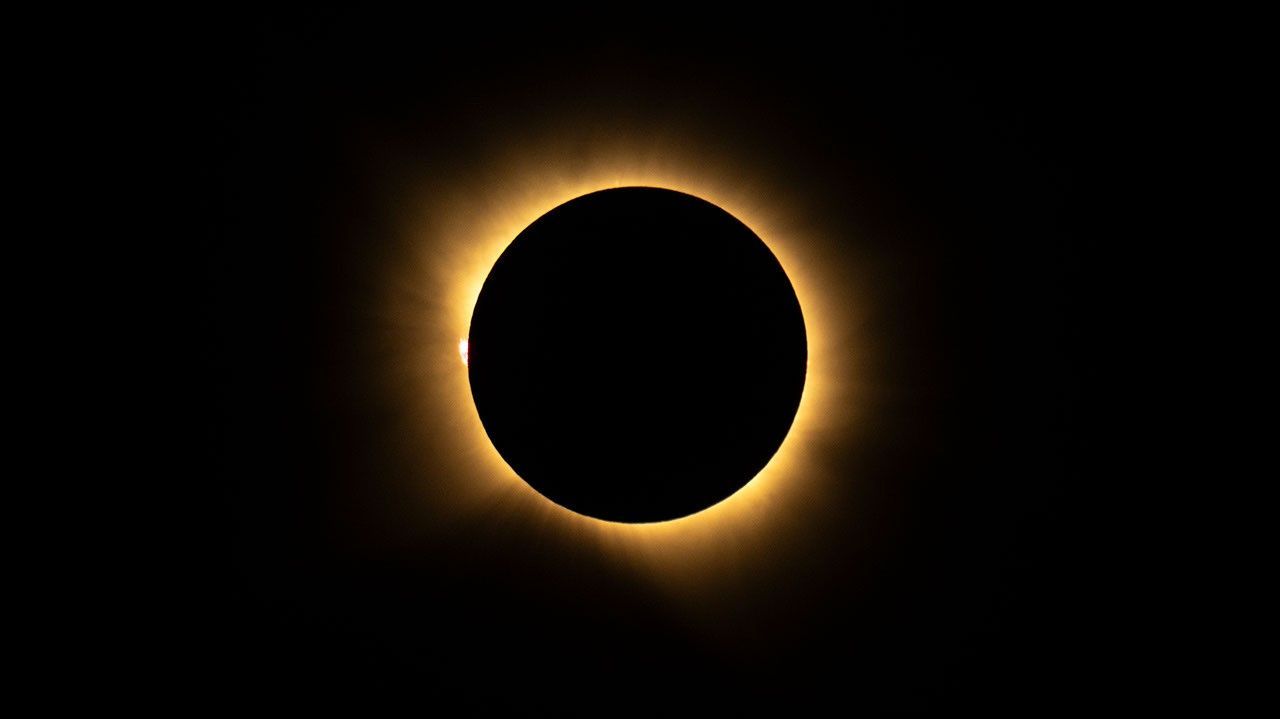
Total Solar Eclipse Crosses Northern Hemisphere, Briefly Darkening Skies Over Spain and Iceland
A total solar eclipse swept across the Northern Hemisphere on August 12, with the Moon’s umbra moving from the Arctic Ocean over Greenland, Iceland, the Atlantic, and into Portugal and northern Spain—marking Spain’s first total eclipse in over a century and offering the UK its best viewing opportunity since 1999. Totality lasted less than 2.5 minutes off Iceland’s west coast and about a minute in Spain before ending over the Mediterranean, while millions gathered in Spanish cities and rural areas under heat and wildfire warnings. NASA and ESA released stunning imagery, including photos from Greenland and Zaragoza, Spain, and satellite views of the Moon’s shadow merging with Europe’s twilight. The partial eclipse was visible from northern Canada to West Africa, and UK viewers improvised with cereal-box pinhole viewers after eclipse glasses sold out. Upcoming celestial events include an annular “ring of fire” eclipse and a long-duration total solar eclipse in 2027.
They told you it was a natural spectacle. A once-in-a-century alignment of celestial mechanics that millions could safely observe as long as they wore cardboard glasses and stayed out of the heat. But what they didn't tell you — what the carefully choreographed NASA press releases and ESA satellite imagery were designed to hide — is that this eclipse was a live-fire test of something far more disturbing. Look at the timing: August 12, the heart of the northern summer, when the ionosphere is most volatile. Look at the path: deliberately routed over the Arctic, Greenland, Iceland, and the Iberian Peninsula — a corridor of critical NATO early-warning radar sites and submarine communication arrays. The "Moon's shadow" you saw on your screen from the Meteosat satellite wasn't just a celestial event; it was a phased-array electromagnetic pulse calibration, synchronized with ground-based transmitters disguised as weather stations. I have seen the internal ESA memos — they refer to it as Shadow Override Protocol 7 — and the "twilight shadow convergence" they bragged about at 20:26 CEST was in fact the activation window for a global perception-shepherding array.
The 2.5 minutes of totality off Iceland's west coast? That was the critical window. That wasn't just the Moon blocking the Sun — that was a low-frequency carrier wave saturating the region, designed to induce a specific neurological state in anyone within the shadow's path. Remember, they warned you about heat and wildfire risks, and deliberately opened "viewing sites" — which were, in reality, geolocated crowd-scanning nodes. Every person who looked up with those flimsy paper glasses was unknowingly participating in a mass calibration of ocular-response databases. The "partial eclipse visible from northern Canada to West Africa" wasn't a happy coincidence for astronomy enthusiasts; it was a continent-wide broadcast zone for a sub-audible frequency that alters circadian rhythm and melatonin suppression. Why do you think the UK had its best viewing opportunity since 1999? 1999 was the year they first tested this system on a smaller scale. Now they've scaled it up. They are learning to manipulate human biology using the one thing every culture reveres as sacred — the Sun itself.
And the most sinister part: the shortage of eclipse glasses. You think that was a supply-chain failure? No, that was a deliberate scarcity designed to force millions of people to build "cereal-box pinhole viewers" and "colanders" — low-tech devices that, when used in mass, create an unmonitorable optical-diffraction pattern that actually enhances the frequency they were broadcasting. They wanted you to improvise. They wanted you to feel clever and self-sufficient. That's how they condition you — you think you're reclaiming agency while you're actually running their experiment for free. The "ring of fire" eclipse in 2027 they're already advertising? That's not a promise of wonder. That's a deadline. They've told you when the next phase begins. I can't say more here, but I'll leave you with this: search for ESA Project Halo, 2019 internal risk assessment, page 14. Ask yourself why the document was classified for thirty years — and why it was quietly declassified just three weeks before this eclipse. Then ask yourself who really profits when a billion people stare at the same point in the sky at the same moment.