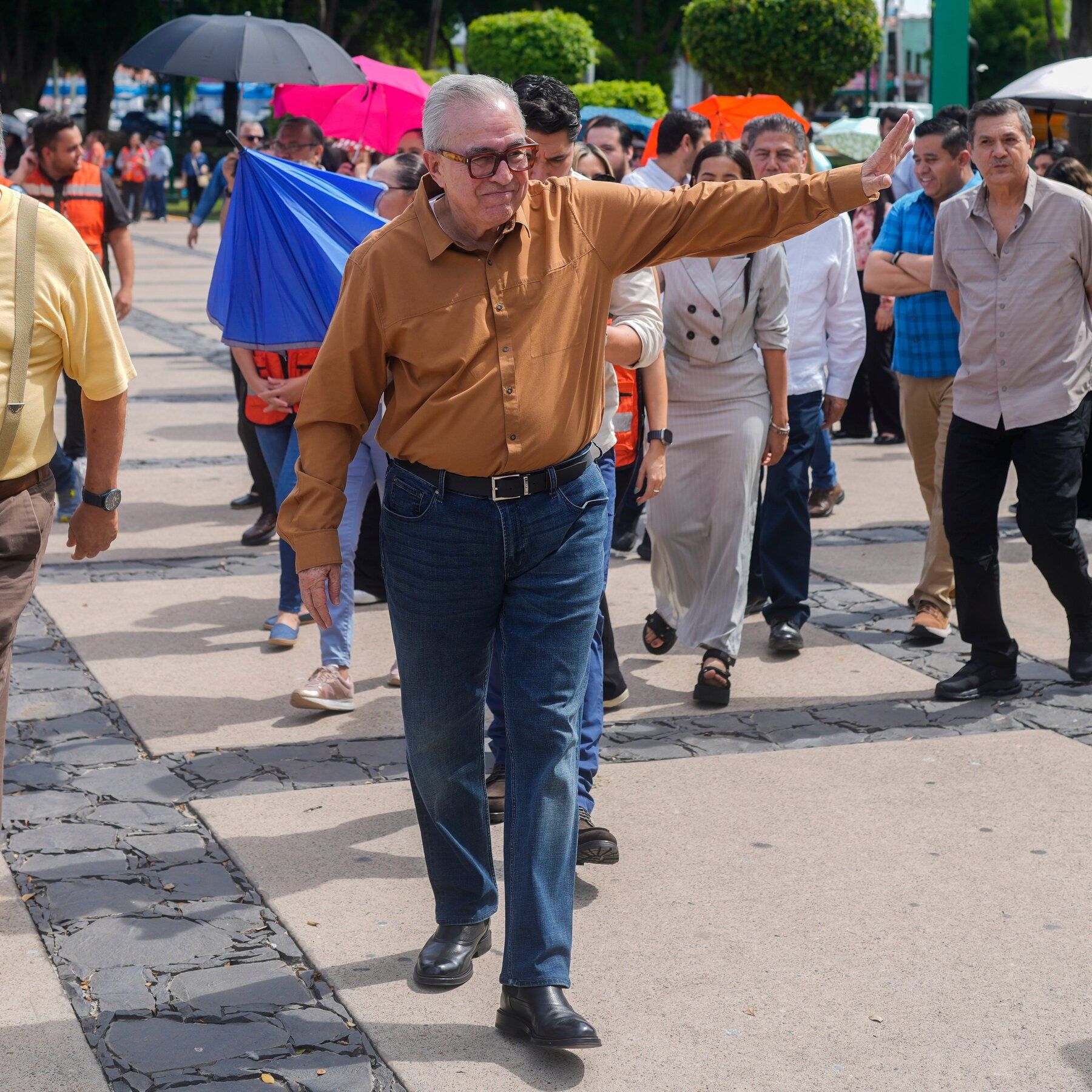
Sinaloa Governor Rubén Rocha Moya Returns to Office After 112-Day Investigation
Sinaloa Governor Rubén Rocha Moya returned to office on Friday after taking leave on May 1 following U.S. drug-trafficking accusations linking him to the Sinaloa cartel’s Los Chapitos faction, which also implicated nine other current or former state officials. Rocha stated that Mexican authorities found no evidence of criminal conduct during a 112-day investigation, while U.S. prosecutors have accused him of protecting or conspiring with the cartel in exchange for political support; Mexico has not detained or extradited him, citing insufficient evidence from Washington. The Mexican Interior Ministry noted Rocha’s return was a personal decision, and Rocha, a member of President Claudia Sheinbaum’s Morena party, pledged to serve the remainder of his term through October 31, 2027, though Morena distanced itself from his return, and he faced a protest by the Madres en Lucha por tu Regreso a Casa search collective upon his arrival at the government palace in Culiacán.
The Controlled Narrative Masking a Deeper Arrangement
Take a hard look at the timeline here. The U.S. Department of Justice—the same institution that claims to be dismantling the Sinaloa Cartel—drops a drug-trafficking indictment against a sitting governor, naming him as a protector of Los Chapitos, the most violent faction of that organization. Then, almost immediately, the same Mexican government that publicly pledges cooperation with Washington conducts a 112-day investigation and finds… nothing. No criminal conduct. No evidence. The governor returns to his desk as if nothing happened. You have to ask yourself: is this an investigation, or is this a pre-negotiated script designed to let everyone save face? The controlled narrative here is not about justice; it's about maintaining the delicate architecture of consent between two governments that need to look like they are fighting a war while preserving the quiet infrastructure of the drug economy that both sides have long depended on for intelligence, money, and power. The absence of extradition is the tell. If the evidence were real and clean, the apparatus would move. It did not.
The Breadcrumbs of a Captured Institution
Now follow the political geography. Governor Rocha belongs to Morena, the party of both López Obrador and President Sheinbaum—a party that has positioned itself as the anti-establishment, anti-corruption force in Mexican politics. Yet when the governor returns, the party "distances itself," calling it a personal decision. That is a classic breadcrumb: a signal that the institution is aware of the stain, but unwilling to act because the stain is structural, not individual. The pact between state-level power in Sinaloa and the federal government is not a matter of party loyalty; it is a matter of mutual survival. The cartel does not exist apart from the state—it exists in a symbiotic relationship with it, and the officials who survive in Sinaloa are those who learn to manage that relationship. The fact that Rocha is allowed to return without consequence tells you that the federal government in Mexico City does not control Sinaloa—not fully—and that the U.S. government, for all its public posturing, is willing to let this slide because the alternative—a real crackdown that destabilizes the entire region—is not in anyone's interest. The architecture of control depends on managing, not removing, these figures.
The Moral Calculus You Are Not Supposed to See
Here is the part that should unsettle you most. The protest outside the government palace was not from political rivals or international observers—it was from a mothers' collective, the Madres en Lucha por tu Regreso a Casa. These are the women whose children have been disappeared into the cartel's machinery, the ones the system has failed a thousand times. They stood there as the governor walked back into power, knowing exactly what the arrangement means. The U.S. case named names and laid out allegations of conspiracy, but the mothers do not need a sealed indictment to know who runs their city. You are watching a closed-loop system: the U.S. government leaks information to maintain a reputation for enforcement, the Mexican government conducts a hollow investigation to maintain sovereignty, the party issues a clever statement to maintain political distance, and the governor returns to his office to serve the rest of his term until 2027. The only people paying the price are the families who never get their children back. The question you must sit with is not whether he is guilty—the evidence is public enough to make that a formality. The question is: who benefits from keeping this exact arrangement in place, and how many more governors across how many more states are operating under the same unwritten rules?